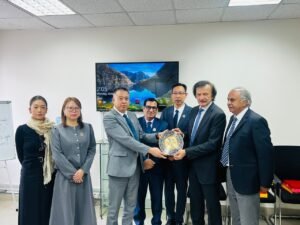
New York, USA (GNP): As part of Pakistan’s high-level global mental health engagement mission to the United States, Honourable Dr Malik Mukhtar Ahmad Bharath, Minister of State for National Health Services, Regulations and Coordination, visited the Stavros Niarchos Foundation (SNF) Global Center for Child and Adolescent Mental Health at the Child Mind Institute (CMI), New York.
The Minister was accompanied by Dr Malik Muhammad Safi, Senior Advisor at the Health Planning, System Strengthening & Information Analysis Unit (HPSIU),at Ministry of National Health Services, Regulation and Coordination, Govt of Pakistan and Dr Syed Usman Hamdani, Founding Director, Global Institute of Human Development (GIHD), Shifa Tameer-e-Millat University and Inaugural SNF Global Center Research Fellow from Pakistan—a recognition that reflects Pakistan’s growing contribution to global child and adolescent mental health leadership and research.
The delegation was hosted by the leadership of the Child Mind Institute and the SNF Global Center, including Dr Harold Koplewicz, President and Medical Director, Child Mind Institute; Dr Giovanni Salum, Senior Vice President, Global Programs; Mr Peter Raucci, Director, Global Fellowship Strategy; and colleagues from the Global Center’s science and research teams. The meeting also included a strategic tele-discussion with Dr Ayesha Mian, Executive Committee Member and Councillor, International Association for Child and Adolescent Psychiatry and Allied Professions (IACAPAP), to explore future collaboration opportunities.
As part of the engagement, Dr Harold Koplewicz and Dr Giovanni Salum personally led the Pakistani delegation through a detailed institutional visit of the Child Mind Institute and showcased the SNF Global Center as an emerging global model of excellence for child and adolescent mental health. The visit highlighted how research, implementation science, digital innovation, youth engagement, workforce development, and partnerships can be integrated into a sustainable system of care and translated into measurable population impact. The delegation explored how key elements of this model could inform Pakistan’s efforts to strengthen child and adolescent mental health services nationally.
The visit focused on understanding the *SNF Global Center model—an internationally emerging systems-strengthening approach established under the *Stavros Niarchos Foundation Global Health Initiative to improve child and adolescent mental health through locally led, evidence-driven and scalable action across low- and middle-income countries.
The delegation explored the relevance of the Center’s six strategic pillars for Pakistan’s national agenda:
- Global Child and Adolescent Landscape Mapping — generating data and evidence to guide national policy and investment decisions;
- Scalable Psychosocial Support and Treatment — adapting interventions for schools, communities and primary care;
- Technology and Digital Innovation — expanding access through digital tools and data systems;
- Public Awareness and Youth Engagement — reducing stigma and strengthening mental health literacy;
- Global Fellowships — developing national leadership and workforce capacity;
- Convening Experts and Building Networks — accelerating translation of evidence into policy and practice.
Pakistan highlighted how this model aligns strongly with national priorities, including the development of the National Mental Health Policy, the establishment of the National Hub of Excellence for Mental Health, the integration of mental health into schools and primary healthcare, digital mental health innovation, and strengthening child and adolescent mental health systems.
Also Read: 8.6 million Children remain in Child Labour in Pakistan, ILO
The delegation also discussed opportunities for collaboration through:
- Technical collaboration with the Child Mind Institute and its SNF Global Center to strengthen child and adolescent mental health systems in Pakistan;
- Joint research and implementation partnerships;
- Engagement in the Global Landscape Mapping initiative to support national data systems;
- Opportunities for Pakistani institutions and emerging leaders to participate in the Research Fellowship and Communicator Fellowship programmes;
- Exploration of collaboration with IACAPAP on workforce development, specialist training, mentorship, and strengthening child and adolescent mental health capacity in Pakistan.
During the visit, Dr Malik, Dr Hamdani and the Honourable Minister presented Pakistan’s journey from evidence generation to implementation, showcasing examples of locally developed and globally recognized mental health interventions and highlighting the importance of government–academic–global partnerships in creating measurable population impact.
Importantly, both parties agreed to pursue a formal institutional agreement to translate this strategic engagement into real-world impact through collaborative research, capacity strengthening, innovation, policy engagement, and implementation partnerships in Pakistan, with an emphasis on sustainable systems strengthening and locally led solutions.
The Minister thanked the Child Mind Institute and SNF Global Center leadership for hosting the delegation and acknowledged the importance of sustained global collaboration to accelerate progress in child and adolescent mental health.
The Honourable Minister extended a formal invitation to the leadership of the Child Mind Institute, SNF Global Center, IACAPAP colleagues, and global partners to participate in World Mental Health Day 2026 in Islamabad (1–2 October 2026), where Pakistan intends to launch key national mental health initiatives and strengthen international collaboration for implementation and scale.
This engagement reflects Pakistan’s commitment to building long-term partnerships that convert science into policy, policy into services, and services into better outcomes for children, adolescents, and families.