
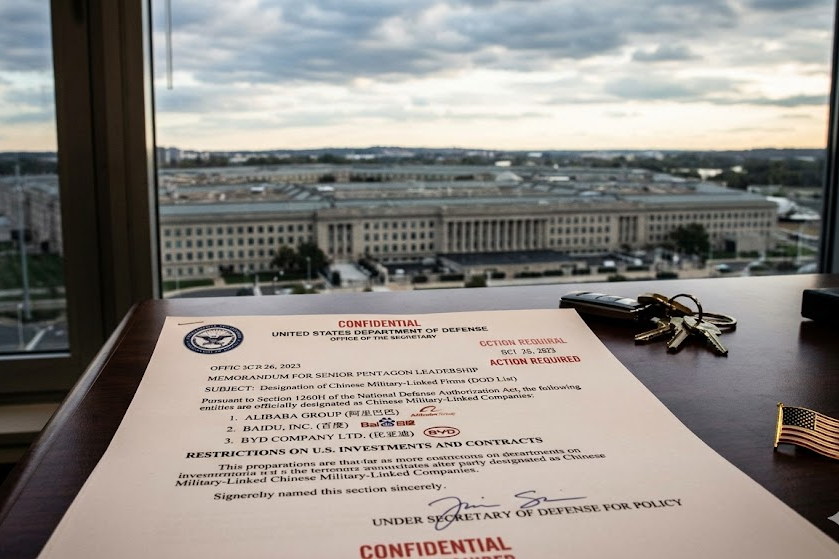
WASHINGTON (GNP): The United States Department of Defense has formally named several of China’s biggest technology corporations on a revised military-linked companies roster, a move that threatens to unsettle a fragile diplomatic rapport between Washington and Beijing. Among those designated are e-commerce powerhouse Alibaba, search engine provider Baidu, electric vehicle manufacturer BYD, and automaker Nio.
The list, made public on Monday, covers a broad cross-section of China’s technology landscape, spanning artificial intelligence, semiconductor production, robotics, biotechnology and telecommunications. Memory chipmakers ChangXin Memory Technologies and Yangtze Memory Technologies were reinstated after having been stripped from a short-lived February version of the roster that the Pentagon released and then quietly withdrew without explanation.
Other newly added entities include pharmaceutical firm WuXi AppTec, humanoid robotics developer Unitree, AI-driven sensor company RoboSense Technology, and telecoms equipment maker Baicells. Messaging and gaming giant Tencent, designated in a previous round, remains on the list.
The timing is notable. President Donald Trump visited Beijing just weeks ago, where he and Chinese President Xi Jinping projected a measured willingness to stabilise the bilateral relationship. Trump has since extended a reciprocal invitation for Xi to visit Washington in September. Against that backdrop, the Pentagon’s move introduces fresh complications into what analysts had cautiously described as a period of de-escalation.
John Moolenaar, Republican chairman of the House Select Committee on China, framed the update as a direct alert to American businesses and government bodies at every level, urging US companies to cease dealings with the designated firms and warning that continued engagement risked accelerating China’s military advancement.
The affected companies were swift to respond. Alibaba called its inclusion an outright mistake, denied any connection to military programmes or civil-military integration strategies, and threatened legal action. Baidu categorically rejected the characterisation, describing the allegation as entirely without foundation and pledging to pursue all available channels to secure its removal. WuXi AppTec similarly contested its designation, calling it incorrect and announcing immediate steps to challenge it formally.
China’s embassy in Washington condemned the measure as discriminatory targeting of Chinese enterprises and called on the United States to provide a fair and non-discriminatory commercial environment for foreign companies operating on its soil.
Also Read: Ukraine War Deadliest Point 2026 UN Council Warns
While the designations carry limited immediate legal weight for many listed firms, they are broadly interpreted as a signal of the Pentagon’s view to federal agencies and private-sector partners and are seen as a potential precursor to more punitive restrictions.
Under recently enacted legislation, the Defense Department will be prohibited from direct procurement dealings with designated companies later this month, with third-party purchase restrictions scheduled to take effect in 2027. Listed firms retain the right to petition for removal.