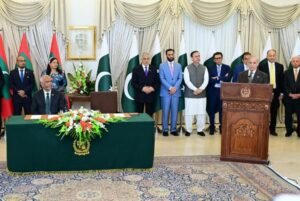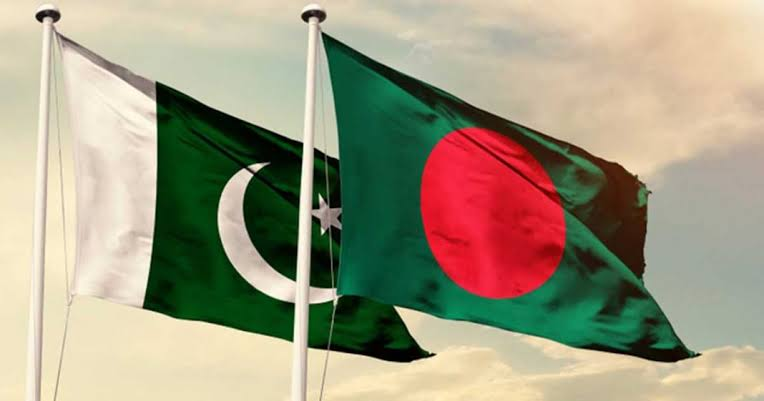
Bangladesh and Pakistan have ended a long freeze in their relations. The recent meeting between Prime Minister Tarique Rahman and his Pakistani counterpart on the sidelines of the UN General Assembly clearly signaled this thaw. It was not an isolated handshake. It followed months of growing contact on trade, memoranda of understanding, defense engagement and diplomatic exchanges.
This is a welcome development. Two large Muslim-majority nations should not remain strangers for half a century. But the renewed warmth raises a harder question: is this a genuine step toward regional healing, or the start of a new alignment aimed at India? Bangladesh must answer honestly, before others answer for it.
A Thaw That Was Overdue
The relationship between Dhaka and Islamabad has been weighed down by history since 1971. Unresolved questions of memory and recognition kept it cold for decades. Official contact stayed thin, and trade remained far below its potential.
The thaw, however, does not mean that old wounds have healed. It means that, for the first time in years, they can heal them. Trade and MoUs can build goodwill, but they cannot replace honest engagement on the unresolved questions from 1971. Pakistan has long held a rigid position on these matters. That rigidity must now give way. A warmer climate is the right moment to resolve these issues, not to set them aside.
Recent years have also brought real movement. Direct trade links have widened, delegations have traveled in both directions, defense and training talks have resumed, and several MoUs have been signed or negotiated. The UNGA meeting gave all of this a visible political seal.
There is a sound case for this opening. Both countries are large, young economies that need markets, investment and stable partners. A normal relationship between sovereign states needs no special justification.
The Perception Problem
Yet perception matters in diplomacy as much as intent. Many regional observers believe this rapprochement serves a second purpose: to counter India.
That view is not baseless. Pakistan has long defined much of its foreign policy in relation to India, so Islamabad welcomes any new friend. In Bangladesh, the relationship with New Delhi became a heated domestic issue after the August 2024 political change. For some, warming up to Pakistan became a way to signal independence. Whatever the motive, the signal was heard in New Delhi, and it was not read as neutral.
This is the elephant in the room. It cannot be wished away by calling the ties purely bilateral. India is Bangladesh’s largest neighbor and surrounds it on three sides. It is a major trading partner and a key source of electricity, transit, and essential goods. Bangladesh cannot afford a cold relationship with India, just as it should not accept a frozen one with Pakistan.
Bangladesh’s Real Strategic Strength
Bangladesh has one major strategic asset that few countries in the region share. It can maintain balanced, equitable relations with everyone without alarming anyone. It has no territorial dispute with a major power and no history of using proxies. It has deep economic links with China, close ties with India, a growing relationship with the Gulf, and working partnerships with the United States, Japan, and Europe.
In a region divided by suspicion, a country that talks to all sides is valuable. It can host dialogue and carry messages.
This strength depends on one condition. Bangladesh must be seen as nobody’s instrument. The moment it appears to lean on one neighbor over another, it loses the trust that makes it useful.
How the Advantage Was Weakened
This strength has been eroded. The interim government’s foreign policy choices were often driven by domestic politics. Its tone toward India was at times sharp, and its outreach to Pakistan was public and symbolic. Bangladesh began to look like a party to the regional rivalry rather than a bridge across it.
The elected BNP government has inherited this position. Domestic political pressure makes a quick correction difficult. Any visible softening toward India can be attacked at home as weakness. Any warmth toward Pakistan can be attacked abroad as a tilt. That is understandable, but foreign policy shaped mainly by internal compulsions trades long-term interest for short-term comfort.
South Asia’s Wasted Decades
The wider region has paid a heavy price for the India-Pakistan rivalry. SAARC, once a promising forum, has been effectively dormant for years. South Asia remains one of the world’s least integrated regions, with intra-regional trade far below that of Southeast Asia or Europe. Shared problems such as climate change, river management and disaster response are handled separately, if at all.
The cost is real for ordinary people. Goods take longer routes, investment goes elsewhere, and young people look abroad for opportunity.
Bangladesh has suffered from this more than most. Its geography makes it a natural link between South and Southeast Asia, but this potential stays unused while its neighbors remain at odds.
A More Strategic Role
Bangladesh should therefore resist the pull of a counterbalancing strategy. A bloc against India would further divide the region, expose Bangladesh, and give India a reason to view Dhaka with suspicion.
A better course is to use the renewed ties with Pakistan to broaden dialogue, not narrow it. Bangladesh can say openly that these ties are not directed at any third country, and say the same of its relations with Beijing or Washington. Then it must act consistently with those words.
It should also engage India with equal seriousness. Pending issues such as water sharing, border management, trade barriers and visa access need steady, quiet work. They are shared interests that serve both peoples.
If trust grows on all sides, Bangladesh could go further and facilitate regional dialogue, even as a modest mediator. It can create spaces where officials, businesses, and civil society from all countries meet without pressure.
Compartmentalized Cooperation – For beginners!
Skeptics will say this is idealistic. Perhaps it is, if one expects a sudden breakthrough. But cooperation can start in compartments.
Climate adaptation is one such area. Disaster management, public health, energy trade, digital connectivity and academic exchange are others. These areas carry low political risk and high shared benefit. Success in one builds confidence for the next.
Also Read: A Chorus, Not a Solo: Bangladesh, Palestine and the Global South
The Way Ahead
Many of Bangladesh’s foreign policy thinkers believe the current approach will not last. They argue that the political pressures behind it will fade as the internal situation settles. Then policymakers will see what the economic data already show: growth, investment, jobs, and security all depend on a stable, cooperative neighborhood. No national aspiration of Bangladesh can be met through confrontation or a sharp tilt.
Prime Minister Tarique Rahman has himself spoken of the need for cooperation. As domestic politics becomes more manageable, there is good reason to hope he will guide foreign policy toward a more inclusive framework, one that treats Delhi, Islamabad, Beijing and others as partners rather than as sides.
The renewed relationship with Pakistan can be a real gain for Bangladesh and for the region. But it will only be a lifeline if it is not used as a weapon. Its durability will depend on whether Islamabad is willing to meet Dhaka halfway on past issues. The elephant in the room will not leave on its own. It must be addressed directly, with candor and respect, and brought into the conversation as a friend.
Bangladesh is well placed to do this. It has the credibility, the location, and the interest. Now it needs the confidence to be a bridge, not a bargaining chip. South Asia has waited long enough for someone to play that role.

Political and International Affairs Analyst; Research Fellow, Bangladesh Neeti Gobeshona Kendra (Policy Research Center, NGK)