United Nations, GNP: Pakistan has called for the responsible and orderly conclusion of the International Residual Mechanism for Criminal Tribunals (IRMCT), stressing that the legacy of international war crimes tribunals must continue to strengthen future accountability efforts.
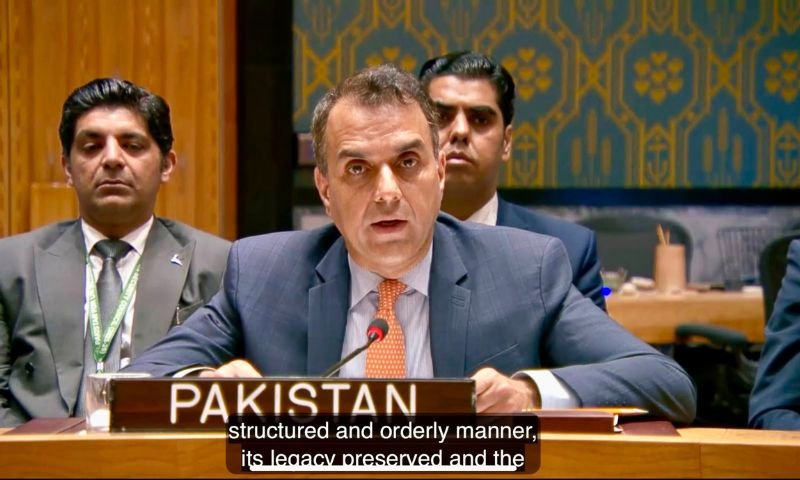
Speaking during a United Nations Security Council debate on the IRMCT, Pakistan’s Ambassador Usman Jadoon said that while the Mechanism has completed much of its mandate, its work cannot erase the painful memories of grave crimes committed against humanity.
Ambassador Jadoon emphasized that the greatest value of the Mechanism’s legacy lies in applying its lessons to future accountability efforts, particularly in situations where fundamental rights, freedom, and human dignity continue to be violated.
He recalled that Security Council Resolution 1966 (2010) established the Mechanism as a “small, temporary and efficient structure” whose functions and size would gradually reduce over time. He noted that Resolution 2740 (2024) further highlighted the need for the Mechanism to complete its remaining responsibilities without unnecessary delay.
The Ambassador said that since the IRMCT concluded its core judicial and prosecutorial work in 2023, appropriate steps should now be taken toward transferring its remaining functions and bringing its mandate to a responsible conclusion.
“This is an onerous task which ought to be discharged with great care and a sense of historic responsibility,” Ambassador Jadoon said.
He stressed that the ongoing review process should protect the important legacy of the International Criminal Tribunal for the former Yugoslavia (ICTY), the International Criminal Tribunal for Rwanda (ICTR), and the IRMCT, while ensuring fair and equal treatment of convicted persons.
Ambassador Jadoon expressed confidence that Security Council members would explore practical solutions for transferring the Mechanism’s remaining functions, while considering proposals presented in the UN Secretary-General’s reports and the Mechanism’s Strategic Plan.
Highlighting the importance of historical preservation, he said that the archives of the Mechanism currently located in The Hague and Arusha hold significant educational and historical value for future generations.
Pakistan supported the proposal that these archives should be preserved under United Nations supervision and suggested that, while selecting a future location, preference may be given to Member States capable of providing suitable infrastructure without creating additional financial burdens for the UN.
Concluding his remarks, Ambassador Usman Jadoon reaffirmed Pakistan’s commitment to constructive engagement with Security Council members to ensure that the Mechanism’s work is completed in a structured and orderly manner, its legacy is protected, and the victims of international crimes are remembered.