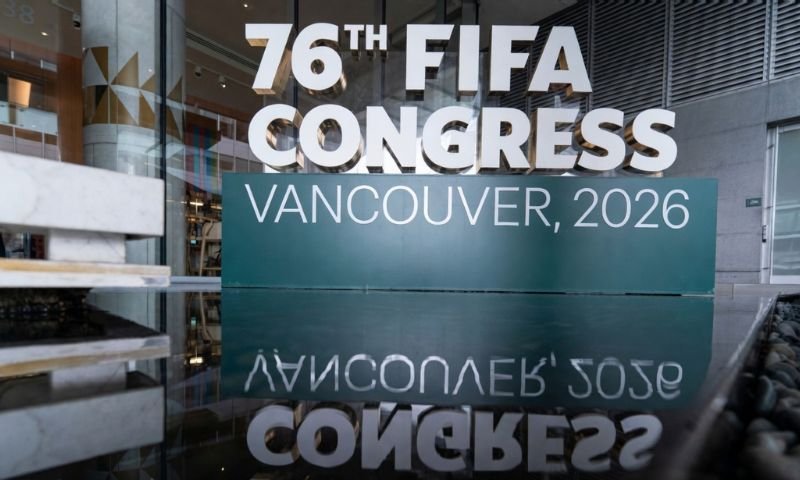
VANCOUVER (GNP): Football’s annual gathering of power rarely arrives without baggage, but the 76th FIFA Congress in Vancouver on Thursday is carrying more than most. With the expanded 2026 World Cup less than two months away, the biggest edition of the tournament in history, delegates from over 200 member associations arrived to find the agenda already hijacked by a diplomatic incident, unresolved geopolitical disputes, and a growing chorus of complaints about money.
Around 1,600 delegates are attending. The administrative business is routine. Almost nothing else about this Congress is.
Iran: The Crisis Before the FIFA Tournament Even Starts
The most immediate flashpoint arrived before the Congress even opened. Officials from the Iranian Football Federation (FFIRI) landed in Toronto earlier this week, then abruptly turned around and flew home, abandoning their trip to Vancouver entirely. Iranian media reported that FFIRI president Mehdi Taj a former member of Tehran’s Islamic Revolutionary Guard Corps (IRGC) and two colleagues left after being treated disrespectfully by Canadian immigration officers.
Canada’s position is unambiguous. The immigration agency confirmed that IRGC-linked individuals are barred from entering the country, citing national security grounds, and said the government had been “clear and consistent” on the matter.
The incident is not just a diplomatic embarrassment. Iran has qualified for the World Cup, but deep uncertainty remains about how the team’s matches in the United States including two in Los Angeles and a group-stage fixture against Egypt in Seattle will be handled given the ongoing diplomatic tensions between Tehran and Washington. FIFA has so far refused to alter the schedule, with president Gianni Infantino insisting Iran will compete as planned, according to the draw.
Also Read: Babar’s 4th Century Seals Epic 70-Run Win over Islamabad United
But that position is easier to hold in a press statement than in practice. Visa access, travel restrictions, and the security arrangements for Iranian players and staff in American cities are questions that do not have clean answers yet.
It was not only Iran facing border difficulties. Officials from the Palestinian Football Association were also denied entry to Canada for a pre-congress meeting, though Palestinian association president Jibril Rajoub and vice president Susan Shalabi were subsequently granted visas and are expected to attend. The episode underlines how quickly sport and immigration politics collide when a tournament spans three countries with different border regimes.
The Hidden Cost Problem No One Wants to Address
Beneath the geopolitical noise, a more prosaic set of concerns has been building among participating nations. UEFA has passed on complaints from several European associations that teams could struggle to break even financially unless they advance deep into the competition. The distances involved in a 48-team tournament spread across the United States, Canada and Mexico multiple time zones, long-haul internal flights, separate tax regimes add up fast.
FIFA moved to address some of those concerns, confirming that prize and participation funding for 2026 will rise by 15 per cent, bringing total distributions to $871 million USD. Whether that is enough to satisfy smaller federations with thin operating budgets remains to be seen.
Ticket pricing has also become a contested issue. For 2026, FIFA has moved to dynamic pricing costs fluctuating with demand, similar to major sports leagues and concert promoters rather than the fixed pricing tiers used at previous tournaments in Qatar and Russia. Concacaf president Victor Montagliani defended the approach as a reflection of North American commercial realities. Fans and several local governments have been less receptive.
Infantino himself drew unwanted attention this week after reports that he had requested a police motorcade in Vancouver comparable to security arrangements typically reserved for heads of state. Local authorities reportedly declined.
Russia: The Ban That Will Not Stay Quiet
Russia’s suspension from international football in place since the 2022 invasion of Ukraine is also expected to come up at the Congress. Infantino has been openly pushing for the ban to be reconsidered, telling Sky News earlier this year that it has “not achieved anything” and has “just created more frustration and hatred.” The position puts him at odds with UEFA and a number of European member associations who have been firm that readmission while the war continues is unacceptable. No vote on Russia’s status is scheduled, but the conversation is not going away.
The Bigger Picture
FIFA projects revenues of around $13 billion for the current four-year cycle, with the 2026 tournament expected to be the largest and most commercially lucrative in the organisation’s history. The scale is genuinely unprecedented. So are the complications.
A 48-team World Cup across three countries is a logistical challenge that no governing body has attempted before. The Vancouver Congress was meant to be a confidence-building exercise six weeks out from kickoff. Instead it has surfaced in one sitting the Iran question, the Russia question, the cost question, and a row about police escorts.
The football starts June 11. There is still a great deal to sort out before then.