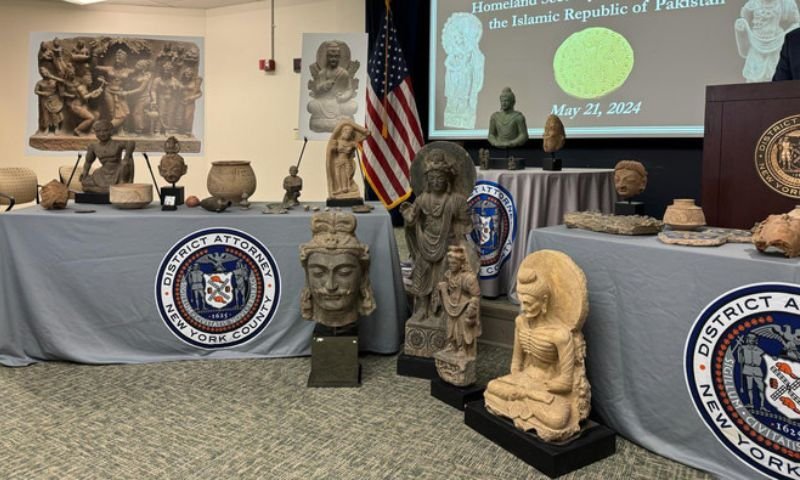
ISLAMABAD GNP: The United States formally returned more than 450 stolen cultural artifacts to Pakistan during a ceremony at the Islamabad Museum on Wednesday, marking one of the largest repatriations of Pakistani antiquities in recent years.
The recovered artifacts, many of which were illegally smuggled out of Pakistan decades ago, were identified and seized through joint efforts between U.S. law enforcement agencies and Pakistani authorities. Officials said the collection includes priceless archaeological objects tied to Pakistan’s ancient civilizations and Buddhist heritage.
Speaking at the ceremony, S. Paul Kapur emphasized the cultural and historical importance of the returned items.
“These artifacts represent chapters of Pakistan’s history, connecting generations to their heritage,” Kapur said. “Among these artifacts are terracotta figurines that are more than four thousand years old. Each of these objects tells a story. Each belongs to the people of Pakistan. And each now is home.”
The artifacts were recovered by the Antiquities Trafficking Unit of the Manhattan District Attorney’s Office following investigations into international smuggling operations involving foreign criminal networks. Alvin Bragg announced the return after years of investigations conducted with support from the U.S. Department of Homeland Security.
Authorities said the unit has recovered and repatriated 514 Pakistani antiquities worth nearly $23 million over the past decade.
Among the most valuable recovered objects is a rare 2nd-century C.E. Buddhapada sculpture valued at approximately $1.1 million. The sculpture was reportedly looted from Pakistan during the 1980s before being trafficked into New York’s illicit antiquities market.
Other notable artifacts returned include a Gandharan frieze depicting Buddhist figures, ancient terracotta figurines from Mehrgarh dating from 3500–2600 B.C.E., a statue of the Bodhisattva Maitreya, and a rare Gold Strato I coin from 105–85 B.C.E. recovered in 2023.
Officials said the investigations have resulted in multiple convictions and exposed major trafficking networks involved in the illegal trade of cultural property.
Pakistani officials welcomed the repatriation, describing it as a significant step toward preserving the country’s rich archaeological and cultural heritage. They also praised continued cooperation with the United States in combating the illicit trafficking of antiquities.
The repatriation highlights growing collaboration between Pakistan and the United States in cultural preservation, law enforcement, and heritage protection efforts.