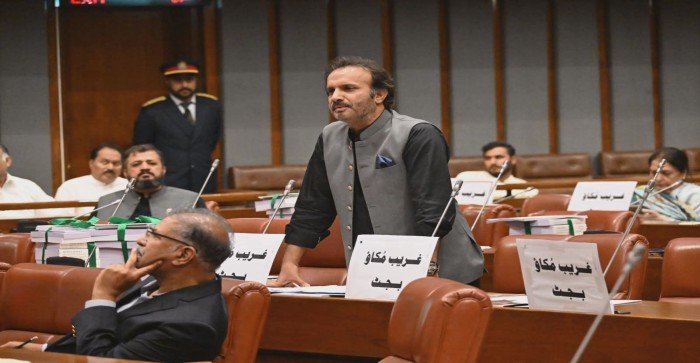
Islamabad (GNP): Senator Aon Abbas Buppi, while speaking on the federal budget in the Senate, said that the current “experienced government” has made life extremely difficult for ordinary people.
He highlighted the devastating impact of inflation and shared the story of Muhammad Sajid from Chistian, Bahawalnagar, South Punjab. Sajid earned a living by selling vegetables from a handcart. One day, he received an unusually high electricity bill. He approached the electricity department and requested a correction, but officials refused. When he could not pay the bill, his electricity meter was disconnected. Unable to get financial help from his family and overwhelmed by his situation, he reportedly took his own life by consuming poisonous pills.
Senator Buppi said that during the last year, 116 people in Pakistan had reportedly died by suicide due to financial hardship and inflation. He stated that while these may seem like mere numbers for the powerful elite and government, but each case represents a destroyed family and shattered lives.
He said that South Punjab’s economy depends heavily on agriculture. According to him, because South Punjab supported former Prime Minister Imran Khan during 2024 General elections, the current government has neglected and damaged the farming sector in the region.
He claimed that during the Pakistan Tehreek-e-Insaf (PTI) government in 2021, Pakistan produced 31 million metric tons of wheat, and the government set the wheat price at Rs. 4,000 per maund. At that time, diesel cost Rs. 160 per liter, urea fertilizer Rs. 1,600 per bag, and DAP fertilizer Rs. 4,400 per bag, while international oil prices had reached $120 per barrel.
Senator Buppi said that government representatives often blame current inflation, rising fuel prices, and poverty on the Iran–United States conflict. He argued that during PTI’s tenure, Pakistan faced the global COVID-19 pandemic, when businesses worldwide were shut down, yet the economy still achieved a GDP growth rate of 6 percent before the government left office. He added that agriculture, which contributes around 24 percent of Pakistan’s economy, was growing at 4.4 percent at that time.
Referring to the government’s own Economic Survey figures, he said agricultural growth is now below 3 percent, while overall GDP growth is reported at 3.6 percent. He further stated that diesel now costs around Rs. 380 per liter despite international oil prices being around $80 per barrel. Urea fertilizer is selling for about Rs. 6,000 per bag and DAP fertilizer for about Rs. 19,000 per bag.
He claimed that agricultural land which could previously be rented for Rs. 75,000 per acre now costs around Rs. 150,000 per acre. Rice that once sold for Rs. 5,000 per maund is now difficult to sell even at Rs. 4,500. Similarly, maize prices have fallen from Rs. 2,500 per maund to around Rs. 2,200, while production has also declined.
The senator said cotton production has fallen from 8.3 million bales during PTI’s tenure to 7.02 million bales today. Wheat production, which was 31 million metric tons during PTI’s final year, has reportedly declined to 27 million metric tons. He added that farmers are struggling to sell wheat even at Rs. 3,000 per maund despite production costs having tripled.
He predicted that Pakistan may have to import another 4 million metric tons of wheat in October due to what he described as anti-farmer policies and the absence of a support price, which has discouraged farmers from cultivating crops.
He also cited the example of potato farmers in Okara, claiming that some farmers ploughed their crops back into the ground because harvesting and transporting them to market cost more than the expected revenue. He said farmers were suffering losses exceeding 50 percent of their production costs. He further claimed that while tomatoes sold for Rs. 1,200 per maund during PTI’s government, farmers today struggle to find buyers even at Rs. 200 per maund and are forced to discard their produce.
Discussing taxation, Senator Aon Abbas Buppi, said the government plans to collect Rs. 7.6 trillion in direct taxes and Rs. 7.7 trillion in indirect taxes. He argued that citizens will pay taxes on their income and then again on everyday necessities such as rice, lentils, cooking oil, flour, and matches.
He criticized the government’s target of collecting Rs. 1.7 trillion through the petroleum levy, saying that even if global oil prices decline, fuel prices in Pakistan are likely to remain high, which would further increase inflation.
He stated that poverty in Pakistan has reached 29 percent and claimed that around 25 million additional people have fallen below the poverty line in just two years. According to him, government figures indicate that 75 million people are living below the poverty line, while United Nations estimates suggest the figure could be as high as 115 million people, or approximately 45 percent of the population.
Senator Aon Abbas Buppi also criticized the official poverty threshold, noting that a person earning less than Rs. 8,448 per month is considered poor, while anyone earning even one rupee more is officially counted as being above the poverty line.
He accused the government of favouring wealthy individuals by abolishing Federal Excise Duty on business-class air travel and offering concessions on overseas credit card spending. Meanwhile, he said, ordinary people travelling abroad for Umrah, religious visits, or employment still have to pay Rs. 20,000 in Federal Excise Duty on economy-class tickets.
Also Read: NTC & PSW Ink Digitalization Agreement to Boost Trade
He questioned how policymakers could remain unaware of public suffering, saying many mothers go to bed hungry so their children can eat.
Regarding education, he said the government allocated only Rs. 46 billion for higher education compared to Rs. 76 billion in 2021 under PTI. He argued that this represents a reduction of nearly 35 percent and is insufficient for the country’s 275 universities. According to him, spending on education remains below 0.8 percent of GDP, while international standards suggest at least 4 percent should be allocated to education and research.
He further stated that only Rs. 16 billion has been allocated for health. He contrasted this with the PTI government’s Sehat Card program, which provided free treatment for major illnesses, including cancer, heart disease, kidney disease, and maternal healthcare across Pakistan.
Senator Aon Abbas Buppi, further said that shelters and free meal programs for the poor had been shut down by the current government. He also noted that approximately 26 million children remain out of school, while, according to him, the government priorities are to spent Rs. 11 billion on purchasing an aircraft.
He described the budget as “a Ransom receipt for collecting money from the public,” arguing that citizens are taxed on their income and then taxed again on basic necessities such as tea, rice, gas, and water.
Quoting Imran Khan, he said: “My leader was right when he said that I may endure these hardships, but the people will not.”
He further questioned why the current leadership was brought into power if, in his view, PTI had performed better in every sector.
Expressing hope for the future, Senator Aon Abbas Buppi said he believes a time will come when Imran Khan will once again become Prime Minister of Pakistan, PTI members will hold key positions in parliament, and the party will return to government.
He reaffirmed his commitment to supporting Imran Khan’s vision of transforming Pakistan into a true welfare state inspired by the concept of a “Riyaasat -e- Madinah,”.