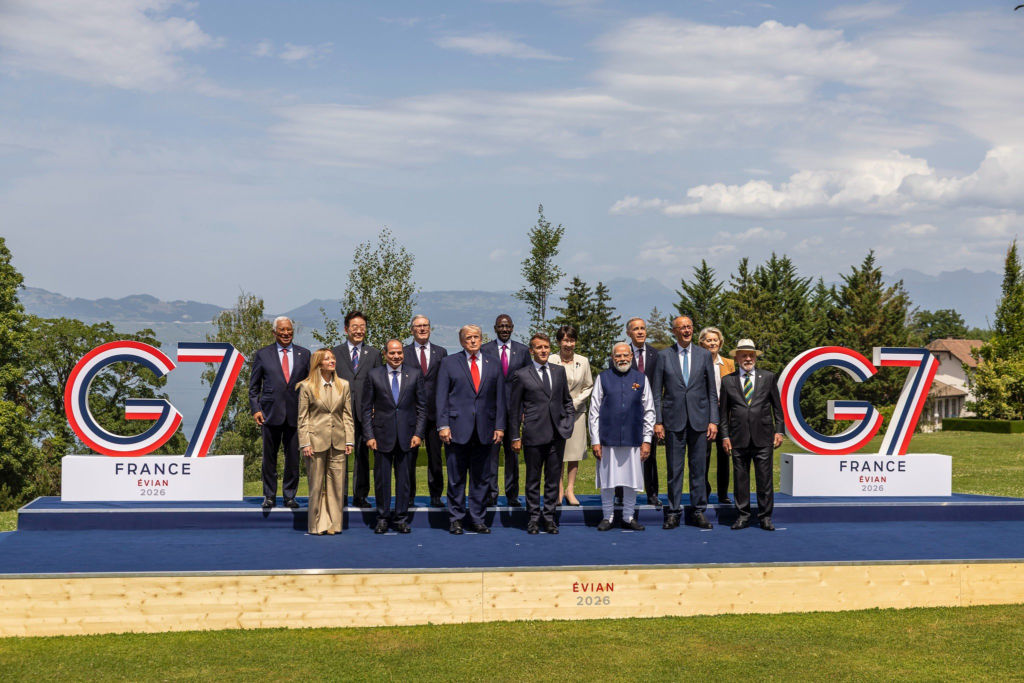
EVIAN, France (GNP): The 52nd summit of the Group of Seven wrapped up Tuesday in the French lakeside town of Evian-les-Bains, with world leaders reaching consensus on a wide spectrum of pressing international issues ranging from the Iran nuclear framework and the Russia-Ukraine conflict to global trade imbalances and development finance reform.
Twenty-three years after the 2003 Evian G8 Summit and seven years after the 2019 G7 Summit in Biarritz presided over by the Head of State, Evian once again became the centre of global diplomacy from June 15 to 17, 2026, as France exercised its rotating presidency of the bloc.
The summit brought together leaders from Canada, France, Germany, Italy, Japan, the United Kingdom and the United States, alongside European Union representatives.F
rench President Emmanuel Macron also extended invitations to several non-member heads of state, including Indian Prime Minister Narendra Modi, Ukrainian President Volodymyr Zelenskyy, Egyptian President Abdel Fattah el-Sisi and Qatari Emir Sheikh Tamim bin Hamad Al Thani. Leaders from Australia, Brazil, Kenya and South Korea also participated in select working sessions.
Iran and the Strait of Hormuz
A landmark development heading into the summit was a preliminary agreement between Washington and Tehran, which the G7 formally welcomed in its closing leaders’ statement.
The bloc endorsed the framework deal as a historic opportunity to prevent Iran from acquiring nuclear weapons and to address its regional and ballistic activities. Leaders also pledged support for a France and United Kingdom-led multinational maritime initiative aimed at facilitating the safe reopening of the Strait of Hormuz, a critical artery for global energy trade.
United States President Donald Trump said he expected the formal agreement to be signed in Geneva on Friday, with the strait to be fully opened thereafter. A 60-day window for complex follow-on negotiations, including on highly enriched uranium and sanctions relief, was built into the framework.
Ukraine
Ukraine dominated much of the agenda, with President Zelenskyy participating directly in G7 sessions and holding separate talks with Trump and United States Secretary of State Marco Rubio.
In its joint statement, the G7 reaffirmed unwavering support for Ukraine’s sovereignty and territorial integrity, committing to accelerated delivery of air defence systems, interceptors and long-range capabilities. Leaders also agreed to provide a winter support package and pledged to deepen sanctions on the Russian oil and gas sectors.
Trump, who described his meeting with Zelenskyy as very productive, said Moscow should pursue a negotiated settlement. European Council President Ursula von der Leyen noted that battlefield momentum had shifted in Ukraine’s favour compared to the previous year.
Trade and the Global Economy
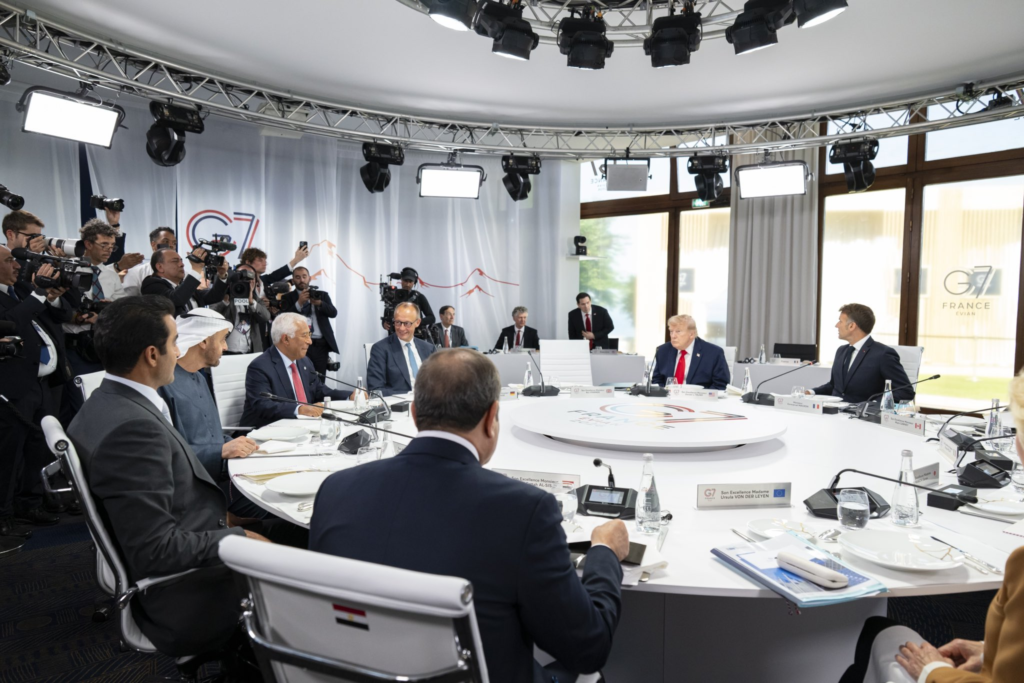
Trade featured prominently throughout the two-day discussions. The Trump administration’s threat of tariffs ranging between 10 and 12.5 per cent on some 60 trading partners over alleged forced labour violations added urgency to economic talks.
Leaders also took up the challenge of macro-economic imbalances, framed by France as a tripartite problem of Chinese overproduction, American overconsumption and European underinvestment. Brazil, India, Kenya and South Korea joined discussions on rebalancing global growth.
Also Read: Portugal Pledges to Strengthen Relations with Pakistan, Amb Paulo
Development Finance
In a separate declaration on international partnerships, G7 leaders committed to reforming the global development finance architecture, stressing the need to mobilise private capital, reduce dependency on external assistance and strengthen debt restructuring mechanisms for vulnerable economies.
Kenya and South Korea co-endorsed the declaration. Leaders also pledged to reinforce supply chain resilience, critical minerals cooperation and digital infrastructure investment across partner nations.
Artificial intelligence executives from several leading technology firms attended the summit as part of France’s effort to anchor the agenda around both immediate crises and longer-term economic challenges facing the international community.

Managing Editor at Global News Pakistan (GNP), with a Bachelor's degree in International Relations from Riphah International University, graduated with a Gold Medal. Reach out at sabahtareengnp@gmail.com