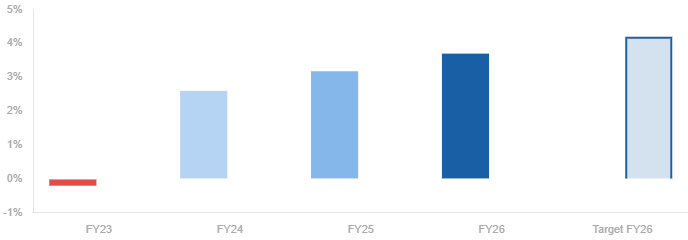
Islamabad (GNP): Pakistan’s gross domestic product expanded by 3.7 per cent in the fiscal year 2025-26, marking the strongest growth rate recorded over the past four years, according to the Pakistan Economic Survey (PES) for FY2025-26 released on Thursday.
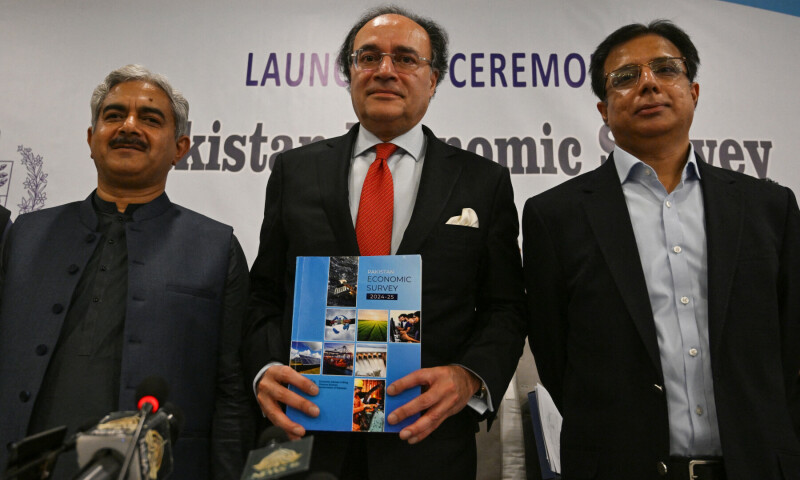
The figure surpasses last year’s growth of 3.18 per cent but falls short of the government’s target of 4.2 per cent. Finance Minister Muhammad Aurangzeb, flanked by Finance Secretary Imdadullah Bosal and Chief Economist Imtiaz Ahmed, unveiled the survey at a press conference in Islamabad, describing the year as one defined by resilience in the face of multiple economic and geopolitical pressures.
Aurangzeb attributed the shortfall partly to the ongoing Middle East conflict, which disrupted global oil markets and supply chains. He noted that global GDP growth itself slipped to 3.1 per cent from 3.7 per cent during the same period. Domestically, the country also contended with severe floods in August and September 2025 and a regional conflict in March 2026. Despite these headwinds, the minister said Pakistan remained on a trajectory from stabilisation toward sustained growth. The overall size of the economy reached a historic Rs126.9 trillion in nominal terms.
Per capita income rose to $1,901 from $1,751 recorded in FY2025.
Sectoral Performance
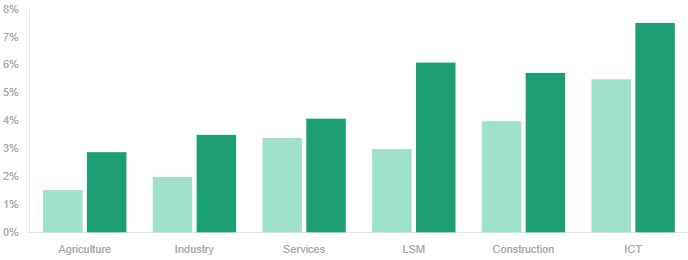
Agriculture grew at 2.89 per cent in FY26, nearly doubling the previous year’s rate of 1.53 per cent, even as floods posed a significant threat to the crop sub-sector, which posted growth of 1.44 per cent. The livestock sector continued its upward trend.
The industrial sector expanded by 3.51 per cent overall. Large-scale manufacturing (LSM) posted growth of 6.1 per cent, also the highest in four years, with 16 of its 22 sub-sectors recording positive output. Year-on-year demand surges were recorded across key industries: cement consumption rose 10 per cent, fertiliser 17 per cent, petroleum products 5 per cent, automobiles 31 per cent, and mobile phones 9 per cent. The broader manufacturing sector, including small and medium-scale units, expanded by 6.6 per cent. Construction activity grew by 5.73 per cent. Mining and quarrying returned to positive territory after contracting in the prior year. The electricity, gas, and water supply segment contracted due to reduced subsidies and a higher deflator.
The services sector, which accounts for close to 58 per cent of national GDP, grew by 4.09 per cent, again the highest in four years. Communication and information services led within the sector, registering growth of 7.52 per cent, underpinned by the expanding digital economy.
Pink: FY26 Yellow: FY25
Fiscal Consolidation
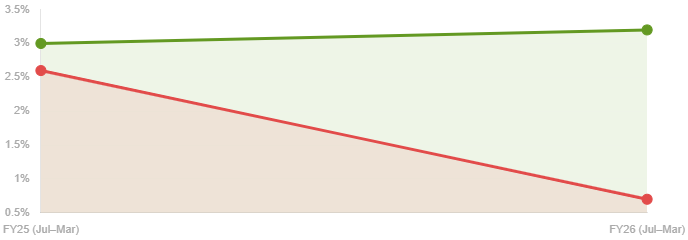
The fiscal deficit narrowed sharply to 0.7 per cent of GDP, equivalent to Rs856.4 billion, during July–March FY26, compared to 2.6 per cent of GDP, or Rs2,970 billion, in the same period a year earlier. The primary surplus strengthened to 3.2 per cent of GDP from 3 per cent, a level the survey described as historic. Federal Board of Revenue (FBR) tax collection grew by 10.1 per cent to Rs9,305.9 billion, while provincial tax revenues climbed 25.8 per cent to Rs860.7 billion, lifting total tax revenue by 11.3 per cent to Rs10,166.6 billion. Markup payments declined by 23 per cent, freeing up additional fiscal space.
Digital production monitoring introduced in the cement and sugar sectors yielded Rs60 billion in additional revenue. Artificial intelligence-based audit selection generated a further Rs34 billion. The number of digital banking users reached 133 million, surpassing the government’s target of 120 million. The number of merchants using digital payments stood at approximately 1.7 million against a target of two million by June 2026.
Inflation and Poverty
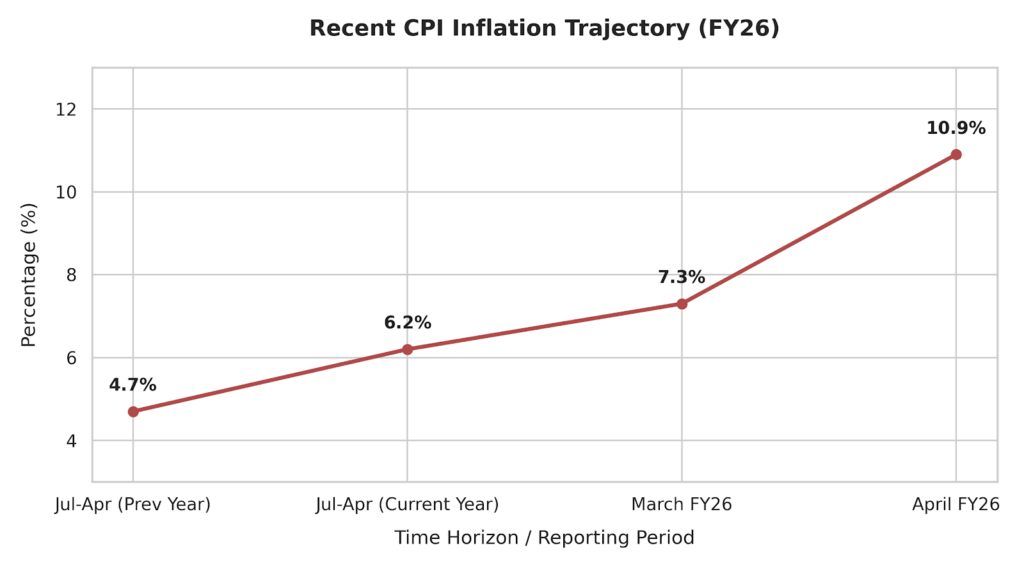
Average consumer price inflation for July–April FY26 was recorded at 6.2 per cent, compared to 4.7 per cent in the corresponding period of the previous year. Inflation measured by the sensitive price indicator (SPI) eased to 4.1 per cent from 4.8 per cent. The policy rate currently stands at 11.5 per cent, down from a peak of 28 per cent. However, inflation climbed from 7.3 per cent in March to 10.9 per cent in April following a spike in global oil prices and supply disruptions linked to the Middle East crisis, posing risks to near-term price stability.
The national poverty headcount rose to 28.9 per cent in 2024-25, with inequality also widening, reflecting the cumulative impact of the COVID-19 pandemic, inflationary shocks, climate-related disasters, and economic adjustment policies.
External Accounts
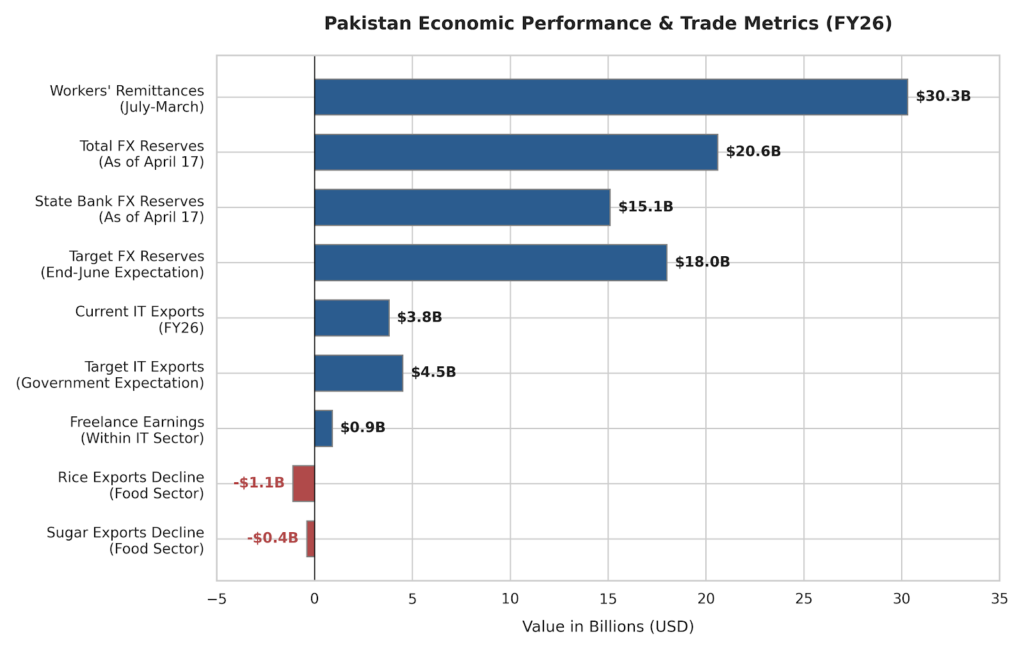
The current account posted a marginal surplus of $72 million during July–March FY26, compared to $1.7 billion in the same period last year. Workers’ remittances rose 8.2 per cent to $30.3 billion, remaining a critical pillar of external balance. Foreign exchange reserves stood at $20.6 billion as of April 17, including $15.1 billion held by the State Bank of Pakistan, with the minister expecting total reserves to reach $18 billion by end-June, equivalent to three months of import cover.
Also Read: 8.6 million Children remain in Child Labour in Pakistan, ILO
The trade deficit for FY26 was recorded at 8.5 per cent. Merchandise exports were weighed down by a $1.1 billion drop in rice exports and a $403 million decline in sugar exports, resulting in an overall fall of approximately $1.5 billion in food-sector exports. Textile exports, however, recorded growth. Sports goods exports rose 18 per cent during July–May FY26, with Pakistan-manufactured footballs selected for use at the upcoming FIFA World Cup. Information technology exports crossed $3.8 billion, with freelance export earnings approaching $900 million; the government expects IT exports to reach $4.5 billion.
Capital Markets and Investment
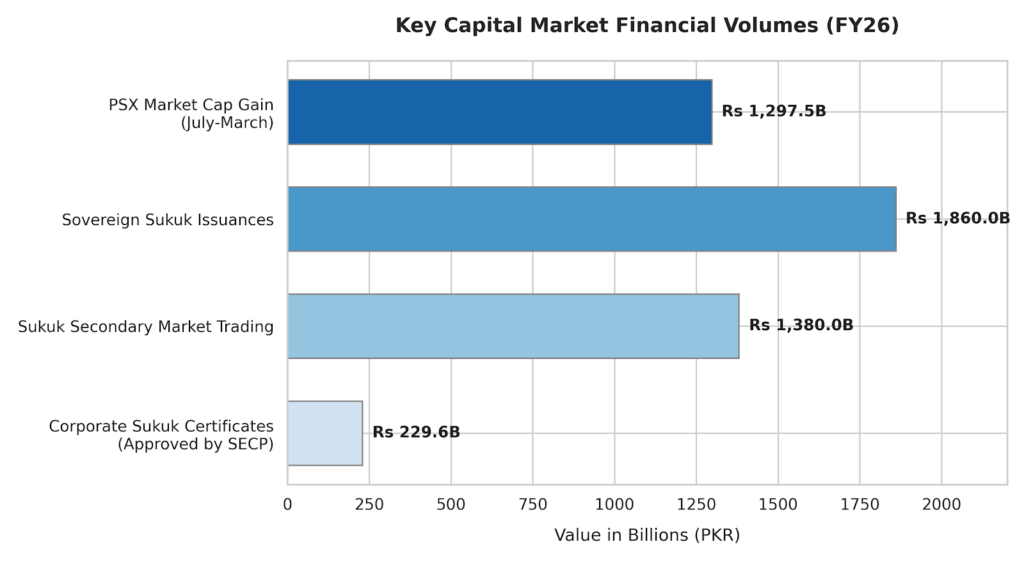
The KSE-100 index gained 18.4 per cent during July–March FY26, outperforming several major global equity benchmarks. Pakistan Stock Exchange (PSX) market capitalisation rose from Rs15,237 billion at end-June 2025 to Rs16,534 billion by end-March 2026, a gain of Rs1,297.5 billion. The Securities and Exchange Commission of Pakistan (SECP) issued 53 Shariah-compliance certificates to corporate Sukuk issuers under the Shariah Governance Regulations, 2023, amounting to Rs229.6 billion. Sovereign Sukuk issuances totalled Rs1.86 trillion, with secondary market trading exceeding Rs1.38 trillion. A total of 39,000 new companies were registered during FY26, bringing the total number of registered companies to 300,000.
Public Debt
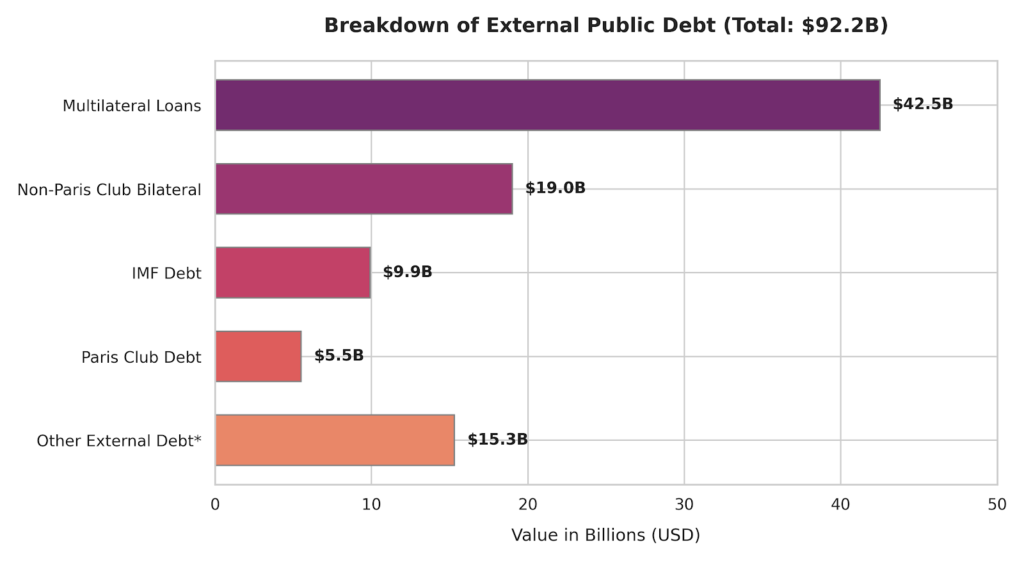
Total public debt stood at Rs83,285 billion at end-March 2026, comprising Rs57,566 billion in domestic debt and Rs25,720 billion in external debt. Public debt growth was contained at 3.4 per cent during the first nine months of FY26, against 6.7 per cent in the same period last year. The public debt-to-GDP ratio declined to 68.5 per cent from 70.7 per cent in FY25 and 75 per cent in FY23. Of total external public debt of $92.2 billion, multilateral loans accounted for $42.5 billion, International Monetary Fund (IMF) debt stood at $9.9 billion, Paris Club debt at $5.5 billion, and non-Paris Club bilateral loans at $19 billion. External budgetary disbursements reached $6.1 billion, including $1.2 billion received under the IMF Extended Fund Facility (EFF) during July–March FY26.

Managing Editor at Global News Pakistan (GNP), with a Bachelor's degree in International Relations from Riphah International University, graduated with a Gold Medal. Reach out at sabahtareengnp@gmail.com