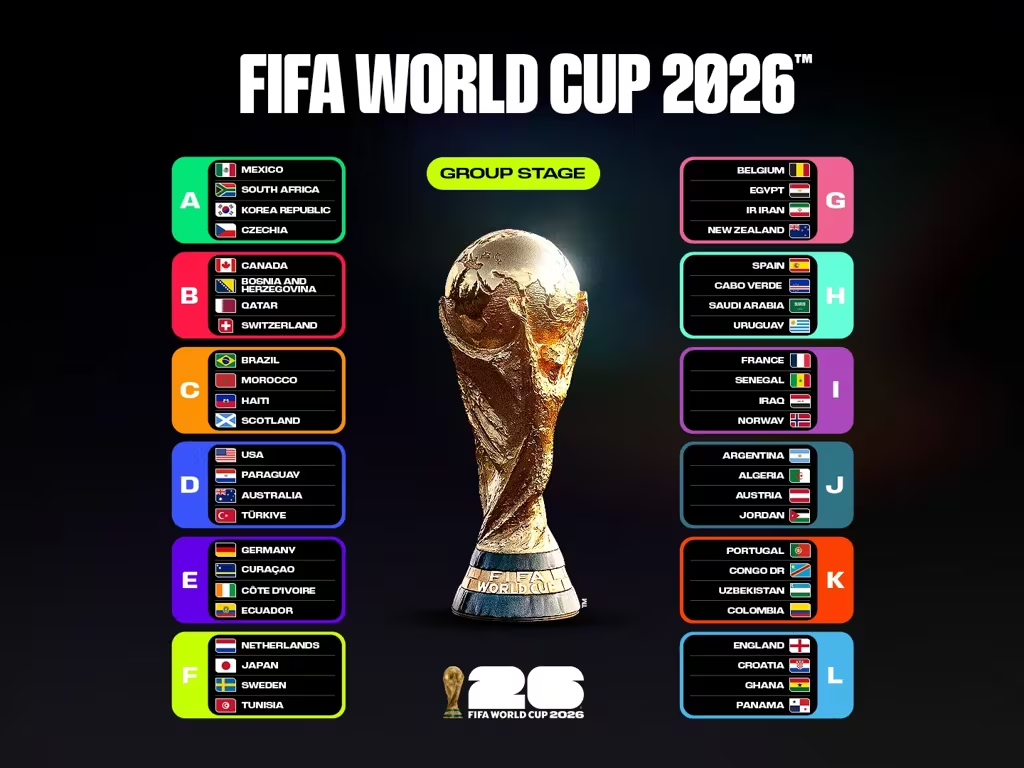
North America (GNP): The most expansive edition of the FIFA World Cup in the tournament’s near-century-long history is set to get underway on June 11, as North America prepares to stage international football’s most coveted prize across three host nations simultaneously for the very first time.
The United States, Mexico, and Canada will collectively welcome 48 competing nations, a significant expansion from the 32-team format that defined previous editions, signalling a new chapter in the evolution of the world’s most-watched sporting competition.
The tournament will span 16 host cities across the three countries, with a total of 104 matches scheduled between the opening fixture on June 11 and the grand final on July 19 in the New York and New Jersey metropolitan area. Mexico will host matches in Guadalajara, Monterrey, and Mexico City.
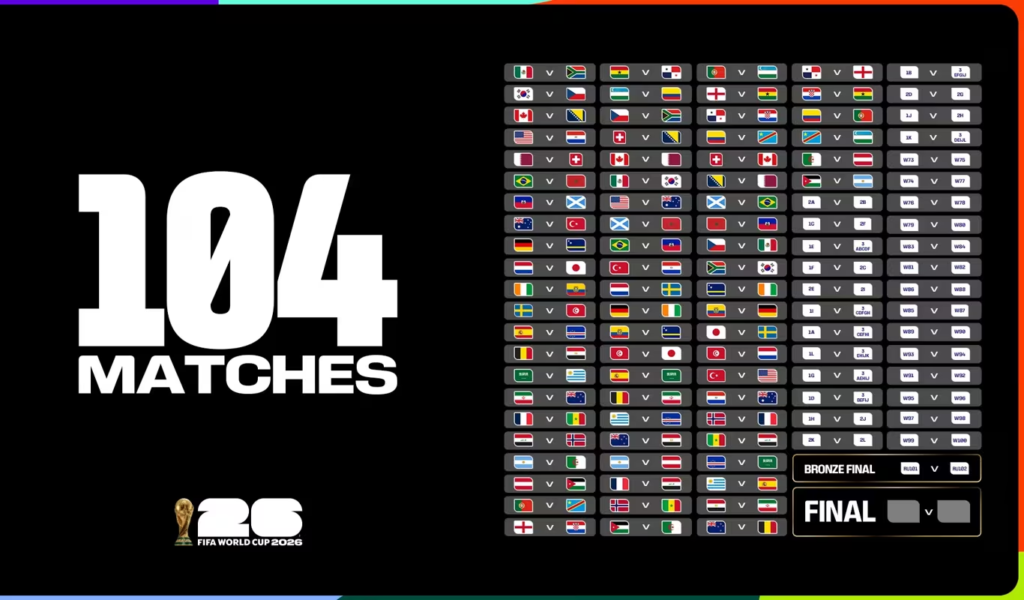
Canada’s fixtures will be split between Toronto and Vancouver, while the United States carries the largest share with venues in Atlanta, Boston, Dallas, Houston, Kansas City, Los Angeles, Miami, Philadelphia, San Francisco Bay Area, and Seattle.
Mexico opens the tournament on June 11 at Mexico City Stadium against South Africa, with the Mexican government having declared a national public holiday in the capital to mark the occasion. Canada enters competition on June 12, hosting Bosnia and Herzegovina in Toronto in what will be a watershed moment for Canadian football, the country’s men’s national team playing a World Cup match on home soil for the very first time. The United States faces Paraguay in Los Angeles the same day in their opening group-stage encounter.
The 48 participating nations have been distributed across 12 groups of four teams each. The top two sides from every group advance automatically to the round of 32, while the best third-placed finishers across the groups also progress to fill out the knockout bracket. From the round of 32 onward, the competition follows a straight single-elimination format through to the final.
Also Read: FIFA World Cup 2026 Fan Festival Biggest in History
On the pitch, the tournament carries an exceptionally high concentration of elite talent. France enter as one of the strongest favourites, led by Kylian Mbappé, who is appearing at his third World Cup and has already guided his country to two successive finals.
Spain arrive with momentum and youth, anchored by 18-year-old Lamine Yamal, whose performances at club level have established him as one of the game’s most exciting emerging talents. Brazil, the tournament’s most decorated nation with five titles, are chasing a sixth crown and their first since 2002.
England carry the weight of consecutive European Championship final defeats into the competition, with a squad widely regarded as capable of ending the nation’s long wait for major international silverware. Argentina, the reigning world champions, will lean heavily on Lionel Messi, who turns 39 during the tournament and is widely expected to be competing at his final World Cup. Portugal’s Cristiano Ronaldo, at 41, faces a similar farewell narrative as one of the sport’s all-time greats.
Other players commanding attention include Brazil’s Vinícius Júnior, England’s Jude Bellingham, the United States’ Christian Pulisic, Canada’s Alphonso Davies, South Korea’s Son Heung-min, and Norway’s Erling Haaland, whose prolific scoring record in club football makes him one of the most dangerous forwards in the competition.
Several fixtures carry geopolitical and historical significance beyond the sport itself. France and Senegal meet on June 16 against a backdrop of colonial history, with Senegal having famously defeated the then-reigning French champions at the 2002 tournament. Ghana and England, also linked by colonial ties, face off in Philadelphia on June 23. Haiti make their return to the World Cup for the first time since 1974, taking on Scotland, who are themselves ending a 28-year absence from the tournament.
With the final whistle scheduled to blow in New Jersey on July 19, the 2026 FIFA World Cup represents the boldest and most geographically ambitious tournament ever staged.

Managing Editor at Global News Pakistan (GNP), with a Bachelor's degree in International Relations from Riphah International University, graduated with a Gold Medal. Reach out at sabahtareengnp@gmail.com