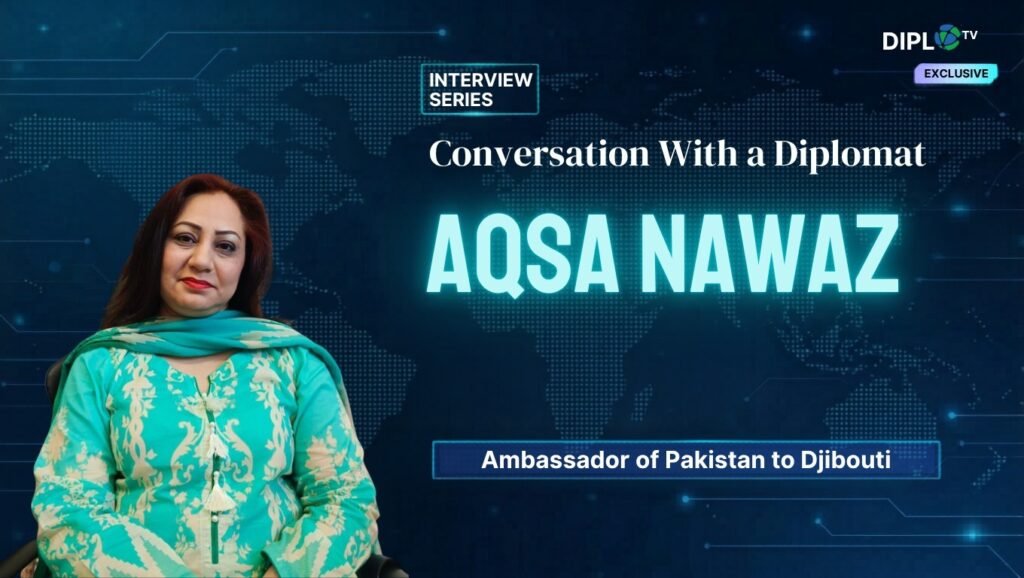
In this episode of Conversation with a Diplomat, DiploTV sits down with H.E. Aqsa Nawaz, Ambassador of Pakistan to Djibouti, for an insightful discussion that moves beyond policy frameworks and into the personal journey behind diplomacy.
With over two decades of experience in Pakistan’s Ministry of Foreign Affairs, Ambassador Nawaz has served in key roles including Consul General in Milan, Director General for Central Asian Republics and West Asia, and diplomatic postings in Bangkok, New York, and France. Her career reflects a diverse and dynamic engagement with global diplomacy.
In this conversation, she reflects on her early aspirations, career transitions, the mindset required for diplomacy, and the deeper human connections that define international relations.
TDI: There is a significant difference between botany and foreign service. What led to this transition in your career?
Aqsa Nawaz: I would not describe it as a complete shift, but rather a matter of circumstances and timing. Both academia and public service were always in my mind. When I was unable to secure a lectureship, I realized that time was passing and I needed to pursue other opportunities. That is when I decided to prepare for the CSS examination. Fortunately, I succeeded and joined the Foreign Service of Pakistan. Even today, I sometimes miss scientific research, but I have developed a strong interest in diplomacy as well. It is important in life to remain open to different possibilities and to have alternative plans because not everything unfolds exactly as one initially envisions.
TDI: When you look back at your younger self entering the foreign service, what mindset helped you grow and succeed?
Aqsa Nawaz: The most important factor was the spirit of serving the nation. Even though foreign service operates indirectly, it contributes significantly to shaping policies that impact people’s lives. This sense of purpose has always guided me. Additionally, I have always been interested in interacting with people and learning about different cultures. Over time, I have come to appreciate diversity more deeply. Initially, it was just an interest, but through experience, I learned how important it is to accept and respect different cultures. This openness and willingness to learn have been essential in my professional growth.
TDI: You have spoken about diversity. What is your perspective on this concept based on your experience?
Aqsa Nawaz: I believe that diversity is a fundamental aspect of our world. Every nation, culture, and individual is different, and that difference is what creates beauty. If uniformity were ideal, the world would have been created that way. Instead, we see variations in cultures, values, climates, and lifestyles. These differences are not barriers; they are opportunities to learn and grow. My experience in different parts of the world has taught me flexibility, acceptance, and respect for others. When you begin to appreciate diversity, it enhances both your personal and professional outlook.
TDI: Having served in various regions, how would you describe the core nature of human beings across the world?
Aqsa Nawaz: Despite cultural and geographical differences, human beings are fundamentally similar. Everyone seeks respect, understanding, and a sense of belonging. In diplomacy, one of the most important skills is listening. When you listen to people, you build trust and confidence. While cultures may differ in their expressions, the basic needs of individuals—such as food, shelter, health, and security—remain the same. When we focus on these commonalities, it becomes easier to build relationships and cooperation between nations.
TDI: Could you share your experience of serving in Djibouti and your perspective on Africa?
Aqsa Nawaz: My experience in Djibouti has been extremely enriching. Before coming to Africa, I had limited exposure to the continent, and like many others, I was influenced by certain perceptions. However, living here has completely changed my understanding. The people are warm, welcoming, and no different from people elsewhere in the world. They have their own cultures, traditions, and celebrations, and they engage with others in a very genuine manner. This experience has broadened my perspective and highlighted the importance of direct engagement in overcoming misconceptions.
TDI: Why do you think there are certain narratives or misconceptions about African countries?
Aqsa Nawaz: These perceptions are largely rooted in historical and structural factors. Africa has experienced a long history of discrimination and inequality, which contributed to its marginalization in global narratives. Additionally, lack of awareness and limited interaction have reinforced these misconceptions. However, this is gradually changing due to increased global connectivity, media exposure, and the growing presence of African nations in international forums. Today, there is greater recognition that talent and capability are not defined by race or geography.
TDI: In your opinion, what defines a true diplomat?
Aqsa Nawaz: Diplomacy is a complex and dynamic process. A true diplomat must be able to manage multiple responsibilities simultaneously. It is not only about engaging with other countries but also about representing and projecting one’s own nation effectively. A diplomat must communicate carefully, understand different perspectives, and work creatively to achieve objectives. It is equally important to build connections, foster understanding, and create opportunities for cooperation. In essence, diplomacy is about linking people and building bridges.
TDI: What are some of the lesser-known realities of a diplomat’s life?
Aqsa Nawaz: There is a common perception that diplomacy is a comfortable or glamorous profession, but in reality, it involves significant challenges. It is a highly demanding role that requires working under pressure, adapting to different environments, and making personal sacrifices. Diplomats must be extremely careful in their communication, as even a small misstep can have serious consequences. The job requires discipline, awareness, and a constant commitment to representing one’s country responsibly.
TDI: What advice would you give to young individuals aspiring to join the foreign service?
Aqsa Nawaz: I would advise them to remain open-minded and prepared for challenges. This profession requires adaptability, patience, and a willingness to step out of one’s comfort zone. It is important to understand that diplomacy is not just about travel or exposure; it is about responsibility and service. One must be ready to embrace different cultures, learn continuously, and make sacrifices when necessary. With the right mindset and dedication, it can be a very rewarding career.
Also Read: IFWA Hosts Taste the World Event in Islamabad
Courtesy: The Diplomatic Insight & Global News Pakistan

Managing Editor at Global News Pakistan (GNP), with a Bachelor's degree in International Relations from Riphah International University, graduated with a Gold Medal. Reach out at sabahtareengnp@gmail.com