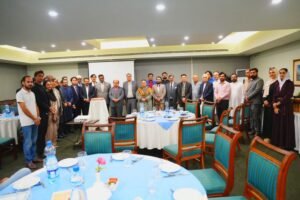
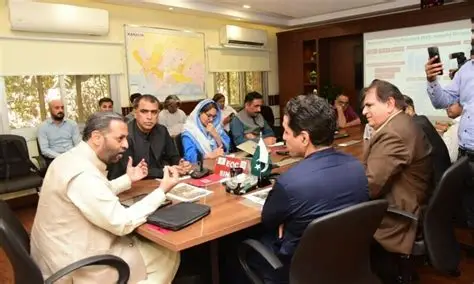
Islamabad (GNP): Pakistan Vaccine Manufacturing 2026 took center stage at a high-level meeting chaired by Federal Minister for Health, Syed Mustafa Kamal, at the Ministry of National Health Services, Regulations and Coordination in Islamabad. The meeting brought together senior health officials to review progress on key decisions taken in the context of recent engagements at the World Health Assembly in Geneva, with a strong focus on achieving self-reliance in Pakistan’s health sector.
Pakistan Vaccine Manufacturing 2026 progress was the central agenda item of the meeting, which was attended by the Federal Secretary for Health, Additional Secretary, Chief Executive Officer of the Drug Regulatory Authority of Pakistan, Chief Executive Officer of the National Institute of Health, and senior officials of the Ministry.
The Federal Minister emphasized the critical importance of timely and effective implementation of global commitments and partnerships made at the international level, particularly those agreed upon during Pakistan’s participation at the World Health Assembly in Geneva. He directed all concerned departments to ensure that no time is wasted in translating international agreements into concrete action on the ground.
Indonesia Partnership Key to Pakistan Vaccine Manufacturing 2026
A significant highlight of the meeting was the discussion around Pakistan’s partnership with Indonesia in the field of vaccine production. Federal Minister Syed Mustafa Kamal described Indonesia as Pakistan’s leading partner in vaccine manufacturing cooperation and stressed the urgent need to further strengthen this critically important bilateral relationship.
The Minister directed that all necessary steps be taken immediately to finalize the agreement with Indonesia in the field of vaccine production, signalling that Pakistan’s leadership is determined to move quickly on securing the partnerships needed to build a robust domestic vaccine manufacturing capability.
Also Read: Dr.Tedros Calls for Community Action to End Ebola Outbreak in DRC
DRAP and NIH Directed to Accelerate Regulatory Processes
As part of Pakistan Vaccine Manufacturing 2026 efforts, Federal Minister Mustafa Kamal issued clear and direct instructions to both the Drug Regulatory Authority of Pakistan and the National Institute of Health to accelerate all regulatory and technical processes required for local vaccine production. The Minister’s directive underscores the government’s recognition that bureaucratic delays in regulatory approvals cannot be allowed to hold back Pakistan’s push for health sector self-reliance.
The meeting highlighted that local production of vaccines for thirteen major diseases has now become an unavoidable necessity for Pakistan, given the country’s vulnerability to supply disruptions and the high cost of importing vaccines from abroad. Developing domestic manufacturing capacity for these thirteen vaccines is now a national priority for the health sector.
The meeting also addressed the future of vaccine programme funding under the Gavi framework, with officials reviewing ongoing discussions and commitments related to Gavi support for Pakistan’s immunization programmes.
The Gavi framework has historically been a critical source of financing for Pakistan’s vaccine procurement, and ensuring continued access to this funding remains an important priority for the Ministry of National Health Services.
Progress on the National Health Support Programme was also reviewed during the meeting. Federal Minister Mustafa Kamal described the programme as the flagship initiative of the government, designed to ensure improved and quality healthcare services for the public across every region of the country.
The Minister expressed satisfaction with the progress made to date while directing officials to maintain momentum and ensure that the programme delivers tangible benefits for ordinary Pakistani citizens.
Pakistan’s health sector has long faced significant challenges related to vaccine supply security and dependence on imported pharmaceutical products. The government’s push toward local vaccine manufacturing represents a strategic shift aimed at reducing vulnerability to global supply chain disruptions and ensuring that Pakistan has reliable access to life-saving vaccines for its population of over 230 million people.
The Federal Ministry of National Health Services has been at the forefront of efforts to build domestic health sector capacity, in alignment with global health commitments made through platforms such as the World Health Assembly.