
New York (GNP): A senior United Nations envoy has warned the Security Council that Gaza faces the risk of becoming permanently trapped in a state of devastation and despair if the international community fails to urgently implement the Council-backed transition plan for the enclave. The warning came as humanitarian conditions in Gaza continued to deteriorate and the fragile ceasefire showed signs of fraying.
UN Envoy Warns of Deteriorating Situation
Ramiz Alakbarov, UN Deputy Special Coordinator for the Middle East Peace Process, briefed the Security Council on Thursday, describing the situation across the Occupied Palestinian Territory as increasingly precarious, with mounting violence in both Gaza and the West Bank.
He said that delays in the implementation of Security Council Resolution 2803, alongside daily violence and a continuing humanitarian crisis, had replaced the early momentum that followed the ceasefire agreement. He warned in the strongest possible terms against any return to full-scale fighting.
“The people of Gaza cannot take more war,” he told the Security Council. “This scenario must be avoided at all costs.”
Resolution 2803, adopted last November, endorsed the United States peace plan to end the conflict, authorising the Board of Peace transitional authority and backing an International Stabilization Force, paving the way for an Israeli withdrawal from the territory.
Humanitarian Crisis Reaches Breaking Point
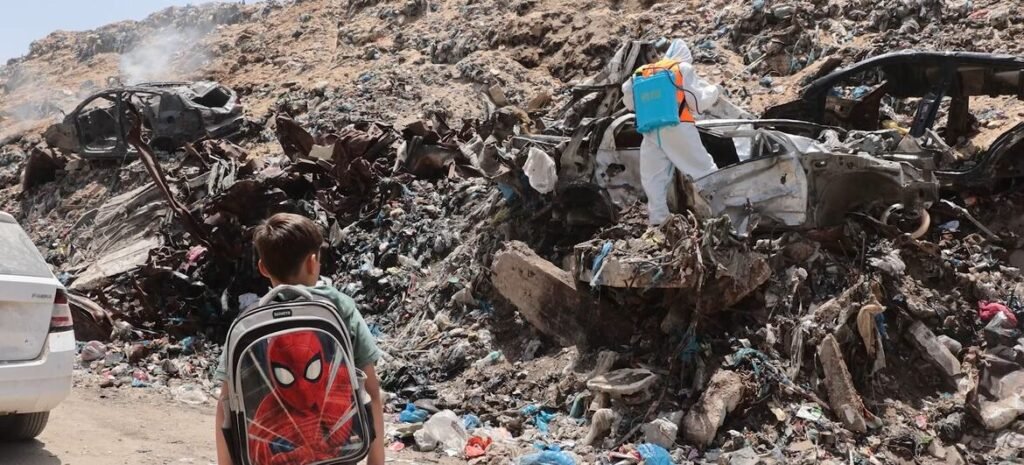
The humanitarian situation inside Gaza remains severe and shows little sign of improvement. Nearly one million people across the enclave still require urgent shelter assistance, while the overwhelming majority of the population remains displaced from their homes.
Major funding and operational constraints continue to frustrate the aid effort on the ground. Delays at checkpoints, damaged roads, and restrictions on critical supplies entering the territory have severely hampered the ability of humanitarian organizations to reach those most in need.
The United Nations-coordinated 2026 Flash Appeal, which seeks more than four billion dollars to support nearly three million people across Gaza and the West Bank, remains only around 13 percent funded, a figure that humanitarian workers have described as woefully inadequate given the scale of the crisis.
Also Read: WHO Regards Global Public Health Champions
No Recovery in Sight
Nickolay Mladenov, the Board’s High Representative for Gaza, told Security Council ambassadors that while the ceasefire had significantly reduced violence and improved humanitarian access, there was still no recovery to speak of in Gaza. The scale of destruction across the territory remains staggering.
Around 80 percent of the buildings in Gaza have been damaged or destroyed. More than one million people have no permanent shelter and are living in tents or in the broken shells of damaged buildings, with no clear timeline for reconstruction or return to normal life.
Mladenov described the proposed roadmap for implementing the transition plan as being based on a principle of reciprocity, with each step by one side triggering obligations by the other. He stressed that Hamas and all armed groups must eventually be disarmed under Palestinian authority, though he was clear that no Palestinian armed group would be required to transfer weapons to Israel directly. The roadmap also envisions a phased Israeli withdrawal tied to verified progress on the decommissioning of weapons and the deployment of a stabilization force.
He warned that failure to move forward with the plan risked entrenching a divided and devastated Gaza for years to come.
“The risk is that the deteriorating status quo becomes permanent,” he said. “Another generation of children growing up in tents, in fear, with despair as the most rational thing for them to feel.”
West Bank Violence and Settlement Expansion
Alongside the crisis in Gaza, Alakbarov also warned the Security Council of worsening violence and accelerating settlement expansion in the occupied West Bank, including East Jerusalem. He said Israeli planning authorities had recently advanced plans for more than 2,200 new settlement housing units, while attacks by settlers against Palestinian communities had intensified sharply this year.
Some 220 Palestinian communities have faced attacks, he said, adding that the violence was increasingly displacing entire communities from their land. The envoy also noted recent Israeli government plans concerning the UNRWA compound in Sheikh Jarrah in East Jerusalem, following an earlier seizure of the site, which the UN Secretary-General strongly condemned.
Voice from Inside Gaza
The Security Council also heard a deeply personal account from Rami Hijjo of the Palestine Red Crescent Society, who described the daily struggle for survival inside Gaza amid continued bombardment, displacement, and severe shortages of essential supplies.
Hijjo, who described himself as both a civilian and a humanitarian worker living in Gaza, told ambassadors that the ceasefire had yet to bring genuine safety to the people of the territory. He described repeated displacement, collapsing health services, and mounting dangers faced by humanitarian workers, including the killing of Palestinian Red Crescent medics earlier this year.
“No amount of creativity can fully overcome the occupational, systematic and deliberate restrictions designed to make life unbearable for all civilians and all those trying to help them,” he told the Council.
A Crucial Window of Opportunity
Despite the deeply troubling assessments presented to the Security Council, Alakbarov insisted that the current ceasefire framework still represented the best available opportunity to prevent a return to large-scale war and to begin the long process of rebuilding Gaza. He called for collective responsibility from all parties and urged Israeli and Palestinian leaders to return to the path of a two-state solution.
He warned that without urgent and concrete progress on implementing Resolution 2803, the situation on the ground would only continue to grow more dire, with the human cost falling most heavily on Gaza’s civilian population.