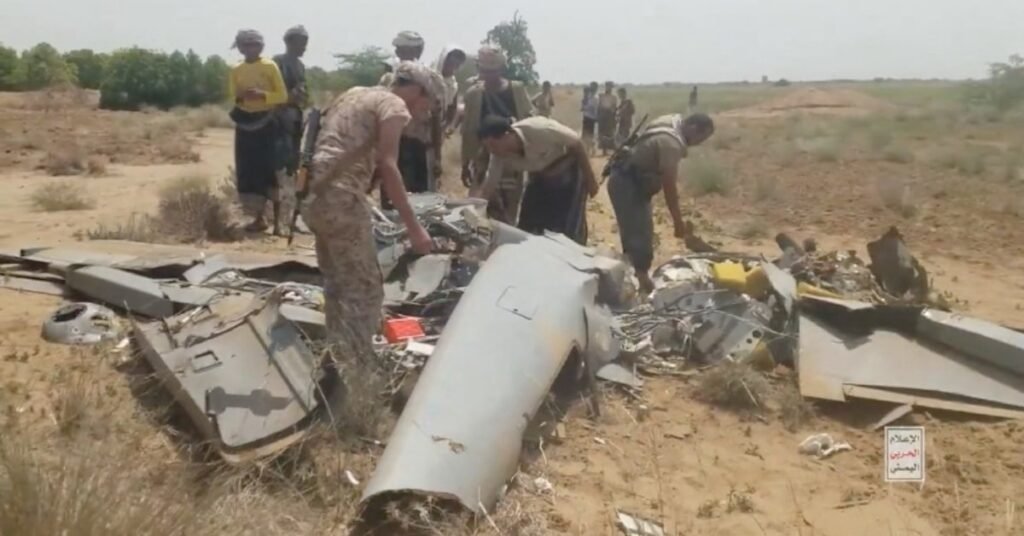
Washington (GNP): Developments surrounding renewed Yemen conflict are drawing increased attention to Houthi territorial expansion, reported Iranian support and the potential implications for shipping routes around the Bab al-Mandeb, after reports that U.S.
President Donald Trump decided not to strike Houthi targets “for the time being.”
The reported decision, dated September 20, came as the Houthis continued efforts to consolidate recently captured territory in southwestern Yemen.
Reuters reported that the group was pushing to control strategic highlands in Taiz and Lahij provinces, with the fighting adding another layer to the wider regional conflict.
The reported U.S. decision was also highlighted by the Institute for the Study of War and Critical Threats Project in its September 21 Iran update.
The assessment said Trump had reportedly decided to refrain from planned strikes against Houthi targets at that time.
At the same time, the Institute for the Study of War reported that Iran’s Islamic Revolutionary Guards Corps (IRGC) was allegedly supporting Houthi efforts to develop infrastructure in newly captured areas along Yemen’s southwestern coast.
According to the assessment, two Houthi military sources told AFP on September 19 that IRGC personnel had visited recently captured territory along the Red Sea coastline and supervised efforts to construct tunnels in mountainous terrain around the port city of Mokha in Taiz Governorate.
ISW described the reported infrastructure as potentially useful for consolidating Houthi positions and defending against possible counteroffensives.
The developments have renewed attention on Mokha and the Bab al-Mandeb, a strategically important maritime passage connecting the Red Sea with the Gulf of Aden.
Also Read: PM Arrives in New York for 81st UNGA Session
Control and security around the waterway have wider implications for international shipping and regional energy flows.
Reuters reported that the Houthi advance was threatening access between Saudi-backed Yemeni forces and parts of the Red Sea coast, while the renewed fighting had also created significant humanitarian consequences.
The Houthis have also publicly indicated that their current military campaign does not necessarily extend to U.S. vessels.
The Associated Press reported that a senior Houthi official said the group did not intend to target American ships, while maintaining that Saudi-linked targets remained part of its confrontation.
The report also said U.S.-Houthi contacts had reaffirmed a 2025 ceasefire arrangement involving U.S. vessels and American airstrikes.
Meanwhile, Iranian officials have continued making statements about the wider regional conflict. ISW reported that Iran’s Supreme National Security Council Secretary, Major General Mohsen Rezaei, spoke to Al Jazeera on September 20, presenting Iran as a potential regional security partner while making claims concerning Iranian military operations and a missile test.
Those claims were statements by the Iranian official and were not independently established by the assessment. The regional dimension has also expanded beyond Yemen.
Saudi Arabia has faced Houthi missile and drone attacks, while other governments have considered measures to support Saudi defensive capabilities. AP reported that the United Kingdom was providing limited aerial-refueling support to Saudi Arabia amid the renewed fighting.
The conflict has therefore developed into a combination of territorial competition inside Yemen, cross-border attacks, maritime-security concerns and wider regional military calculations.
For international shipping, developments around the Bab al-Mandeb remain particularly significant. Any sustained disruption or increased military activity around the route could affect commercial shipping and energy movements between the Red Sea and the Indian Ocean.
The reported U.S. decision to hold off on strikes, alongside continued Houthi territorial advances and allegations of Iranian assistance, leaves the situation subject to further developments on the ground and through regional diplomacy.