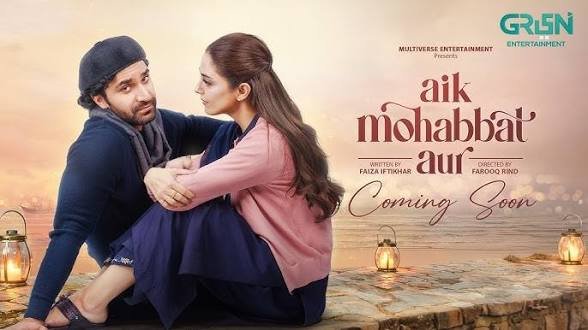
Karachi (GNP): Aik Mohabbat Aur has emerged as one of Pakistan’s most talked about television dramas, not merely because of the on-screen pairing of Maya Ali and Ahad Raza Mir, but because it addresses complex social realities through characters that challenge conventional storytelling.
Written by Faiza Iftikhar and directed by Farooq Rind, the drama follows Assistant Commissioner Khushbakht Naz, portrayed by Maya Ali, and journalist Haroon Malik, played by Ahad Raza Mir.
Rather than presenting a conventional romance, the series explores emotional healing, second chances, and the societal challenges faced by divorced women and single mothers.
Khushbakht Naz stands out as a refreshing female lead in Pakistani television. She is a successful law enforcement officer whose professional achievements contrast sharply with the emotional scars left by an abusive marriage.
Her journey reflects the insecurity many women experience after divorce, not because they lack capability, but because society often questions their worth, decisions, and ability to rebuild their lives.
The drama portrays these insecurities realistically, showing that emotional vulnerability can coexist with professional strength.
Instead of depicting women solely as victims, Aik Mohabbat Aur presents resilience as an ongoing process.
Khushbakht’s hesitation to trust again is rooted in trauma rather than weakness. By portraying her as a capable officer, devoted mother, and emotionally guarded individual, the series offers a nuanced representation of women navigating life after domestic abuse.
Critics have praised the drama for centering a single mother in a high ranking public office, a role that remains relatively uncommon in mainstream Pakistani television.
Another important aspect of the drama is its exploration of journalism through Haroon Malik.
As an ambitious journalist, Haroon is portrayed as someone driven by the pursuit of impactful stories. His profession highlights the influence of media in shaping public opinion, holding powerful individuals accountable, and bringing hidden issues into public debate.
At the same time, the series also raises questions about journalistic ethics, illustrating how the pursuit of exclusive stories can sometimes blur the line between responsible reporting and sensationalism.
This complexity adds depth to the narrative and encourages audiences to think critically about the role of the media in society.
The evolving relationship between Khushbakht and Haroon also challenges traditional gender roles.
Rather than portraying a male character who “rescues” the female lead, the story focuses on mutual respect, emotional understanding, and personal growth.
Khushbakht’s independence remains central to her identity, while Haroon gradually learns to appreciate her resilience beyond societal labels attached to divorce and single motherhood.
This dynamic reflects broader conversations about equality, empathy, and second chances in modern relationships.
Beyond romance, Aik Mohabbat Aur highlights social issues that resonate with many viewers, including the stigma surrounding divorce, emotional trauma, family expectations, and the challenges faced by working women balancing professional and personal responsibilities.
The narrative demonstrates that healing from abuse is not immediate but requires patience, understanding, and supportive relationships. It also encourages audiences to reconsider long held stereotypes about divorced women and single parents.
Also Read: China Guizhou Music Festival Highlights Cultural Tourism Innovation
Audience reactions have largely praised the drama for its mature storytelling, realistic characters, and willingness to address sensitive topics without relying solely on melodrama.
Many viewers have welcomed the portrayal of a career-oriented female protagonist whose identity extends far beyond her relationships, while also appreciating the chemistry between the lead actors and the thoughtful exploration of emotional recovery.
As Aik Mohabbat Aur continues to unfold, it serves as more than a romantic drama. It becomes a reflection of changing social attitudes toward women, the importance of ethical journalism, and the power of resilience in overcoming trauma.
Through its layered characters and socially relevant themes, the series contributes to broader conversations about gender equality, personal dignity, and the possibility of rebuilding one’s life after adversity.