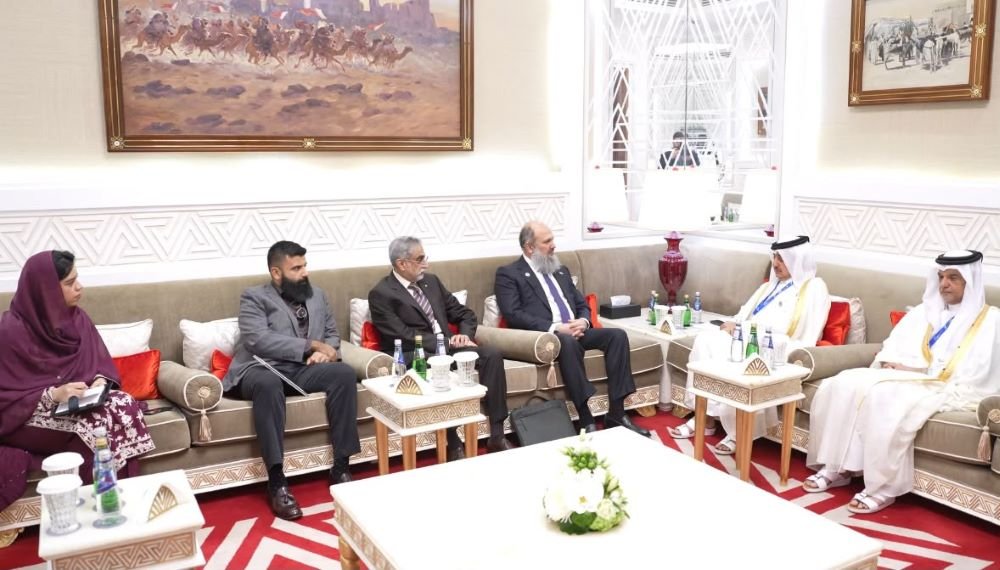
DOHA (GNP): Commerce Minister Jam Kamal Khan held a series of meetings in Doha, Qatar, on the margins of the World Investment Forum 2026, with senior officials, international economic leaders and business representatives. His aim was to strengthen Pakistan’s trade ties, attract foreign investment, improve regional connectivity and widen economic cooperation.
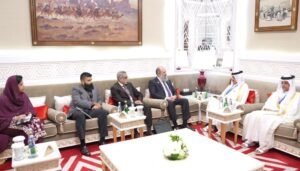
He met the Secretary-General of the D-8 Organization for Economic Cooperation, Qatar’s Minister of Municipality, the Chairman of the Qatar Chamber of Commerce & Industries and representatives of Retaj Group. The talks covered trade, private-sector links and investment in agriculture, food security, industrial development, hospitality and tourism.
Meeting the D-8 Secretary-General, Khan discussed ways to deepen economic integration and speed up trade among member countries. The Secretary-General thanked Pakistan for its continued support and stressed the importance of implementing the D-8 Preferential Trade Agreement now that Egypt has ratified it.
Both sides agreed that existing cooperation frameworks need to become practical commercial opportunities through greater private-sector involvement, better market access and stronger trade links. They also discussed the organisation’s target of US$500 billion in intra-member trade by 2030. Khan reaffirmed Pakistan’s commitment to the D-8 framework and to initiatives that ease trade, encourage investment and support sustainable growth.
In a bilateral meeting, Khan and the Qatari minister discussed cooperation in agriculture, food security and trade. They exchanged views on strengthening commercial relations and on closer engagement between institutions and businesses in agricultural development and food supply chains. They saw scope for government bodies and the private sector to identify practical areas of cooperation, and both reaffirmed their commitment to the long-standing bilateral relationship.
Khan urged the Qatari business community to increase business-to-business contact with Pakistani counterparts and build stronger people-to-people ties, so that the friendship between the two countries produces concrete commercial results.
He invited Qatari investors to look at Pakistan’s Special Economic Zones, particularly the Karachi industrial area, where export-oriented manufacturing and industrial partnerships could reach both domestic and international markets. He also pointed to Pakistan’s strategic location and the chance for investors to reach wider regional markets, including Africa, through better trade connectivity and supply-chain networks.
The Chamber’s Chairman spoke about changing global supply-chain dynamics and expressed interest in proposed regional transit routes and connectivity initiatives. Both sides agreed that better logistics infrastructure, diversified supply chains and stronger regional transport links could ease trade, reduce commercial barriers and open new markets. They stressed the value of continued engagement among chambers, investors and business communities to find viable projects, and reaffirmed their commitment to expanding private-sector partnerships.
Khan also met Retaj Group representatives to discuss hospitality and tourism. The group said it is interested in joint ventures with Pakistani partners and in expanding its hospitality brands into Pakistan and other Islamic countries. The talks focused on investment partnerships and hospitality-sector development, and both sides saw hospitality and tourism cooperation as a way to encourage private investment and strengthen economic ties.
Also read: Dr. Malik Calls for Greater Climate Cooperation Ahead of COP31
The meetings reflect Pakistan’s efforts to diversify its international economic partnerships, attract foreign investment and strengthen its place in regional and global trade networks. They also underline the growing importance of private-sector cooperation, connectivity, agriculture, food security, industrial investment and hospitality.

Sohail Majeed is a Special Correspondent at The Diplomatic Insight. He has twelve plus years of experience in journalism & reporting. He covers International Affairs, Diplomacy, UN, Sports, Climate Change, Economy, Technology, and Health.