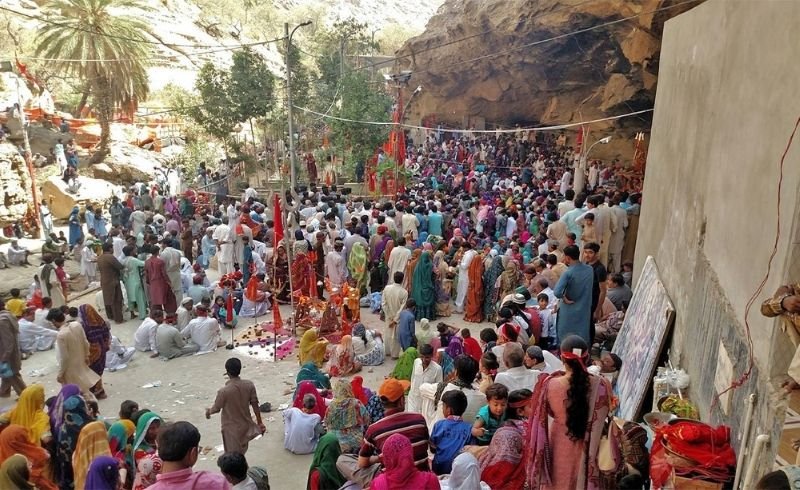
QUETTA, Pakistan: The annual three-day festival at the revered Hinglaj Mata Temple concluded on Sunday, drawing an estimated 300,000 Hindu pilgrims and reaffirming its importance as a symbol of religious harmony and coexistence in Pakistan.
Held in the rugged mountainous landscape of Balochistan, the festival began on April 17 and once again underscored the deep spiritual significance of the shrine, widely regarded as one of the holiest sites in Hinduism. Officials highlighted that this year’s turnout, significantly higher than previous years, reflects a growing message of unity and tolerance.
The gathering is considered the third-largest Hindu religious congregation after major festivals in India and Nepal. Authorities estimate that close to one million devotees visit the shrine annually, demonstrating its enduring religious and cultural importance.
Thousands of pilgrims traveled long distances on foot from various districts of Sindh, including Tharparkar, Umerkot, and Sanghar. For many, the journey lasted up to 20 days, reflecting deep devotion and commitment. Participants described the pilgrimage as not only a spiritual duty but also a celebration of peaceful coexistence among communities.
Extensive arrangements were made by the provincial government, the Provincial Disaster Management Authority, and local administration to ensure smooth proceedings. Relief efforts included the distribution of ration bags and essential supplies to pilgrims, while senior officials closely monitored logistics and security on-site.
A comprehensive security plan was implemented, with personnel from the Pakistan Army, Frontier Corps, police, and Levies deployed throughout the area. Officials described the arrangements as highly effective, allowing devotees to perform their rituals without disruption.
In addition to security, several humanitarian initiatives were introduced. The Pakistan Coast Guards, the People’s Primary Healthcare Initiative, and the Lasbela Health Department established free medical camps, where teams of specialists and female doctors provided treatment and medicines to hundreds of pilgrims.
The Shri Hinglaj Mata Welfare Mandli played a key role in organizing the festival, managing a continuous bhandara (community kitchen) that provided food, water, and refreshments around the clock. Volunteers worked alongside Mandli officials to ensure that the needs of attendees were met efficiently.
The event also saw participation from various political and social figures, who joined the celebrations and expressed support for interfaith harmony. Speaking on the occasion, Daanesh Kumar described the shrine as one of the most sacred sites in Hinduism and noted that the increased number of pilgrims compared to last year reflects growing confidence among minority communities.
He stated that the large turnout demonstrates Pakistan’s commitment to protecting minority rights and fostering religious harmony, adding that devotees were able to perform their rituals peacefully despite the challenging terrain.
He further emphasized that the successful organization of the festival helps counter negative perceptions about minority rights in Pakistan, sending a strong message globally about the country’s inclusive environment.
As the festival came to a close, both participants and organizers expressed hope that the spirit of unity and coexistence witnessed during the gathering would continue to strengthen social cohesion and contribute to Pakistan’s progress and prosperity.