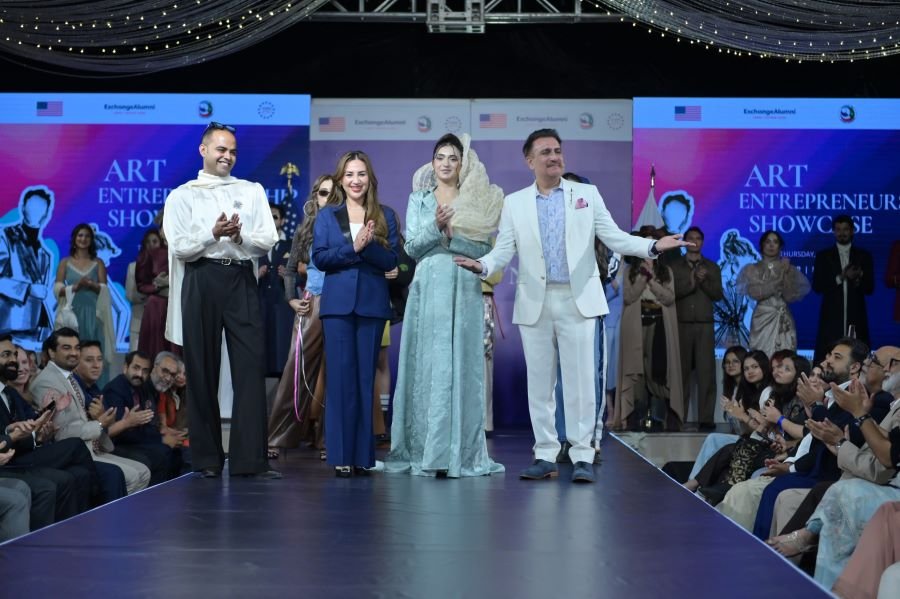
Islamabad (GNP): The U.S. Embassy in Islamabad held an Arts Entrepreneurship Showcase at the United States Educational Foundation in Pakistan (USEFP), bringing together artists, designers, entrepreneurs, and cultural figures to highlight how creative industries can drive economic growth, deepen ties between the two countries, and link people across cultures.
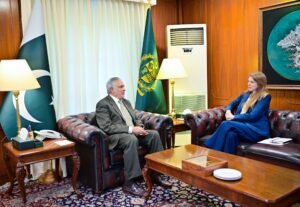
U.S. Chargé d’Affaires Natalie Baker and well-known Pakistani fashion designer HSY led the event, which was moderated by broadcaster and filmmaker Tauseeq Haider.
The event was organized under the Freedom 250 initiative, which marks 250 years of American independence, and was built around three main components: an entrepreneurship lecture sharing American business expertise and practices, a marketplace featuring the work of 20 alumni of the Pakistan-U.S. Alumni Network (PUAN) working in Pakistan’s creative sector, and a fashion show tracing 250 years of American design, culture, and textile innovation.
Together, the three segments were meant to showcase the breadth of the U.S.-Pakistan relationship across business, culture, and the arts. In her remarks, CDA Baker pointed to the arts as a uniquely effective way to build lasting connections between countries and their people.
She highlighted textiles in particular, noting that Pakistani exports of finished apparel and clothing to the United States have averaged more than $4 billion annually over the past five years.
Much of that production, she said, relies on American cotton, with Pakistan importing close to $800 million worth of U.S. cotton and related raw materials each year — making the United States the country’s second-largest cotton supplier and illustrating how closely the two nations’ textile supply chains are linked, from American farms to Pakistani factories to markets worldwide.
She also noted that Pakistan is among the world’s top producers of denim, suggesting that a pair of jeans on an American store shelf may well have started out in a Pakistani factory — pointing to brands like Levi’s as everyday evidence of how intertwined the U.S.-Pakistan relationship really is.
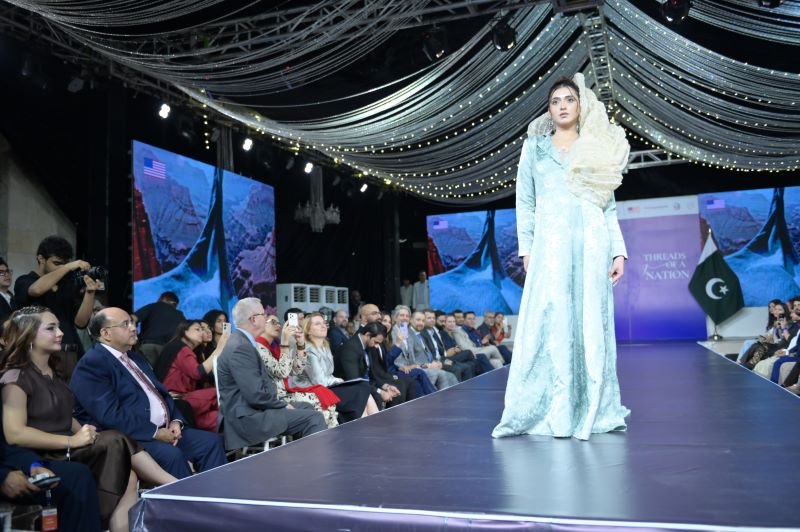
Baker also spoke to Washington’s broader commitment to creative entrepreneurship as an engine of economic opportunity and bilateral cooperation, describing the value placed on creative industries as part of America’s national identity going back to 1776. She framed American achievement in art and design as rooted not just in talent but in a culture that rewards experimentation and risk-taking, and said American creative industries continue to influence global trends and audiences.
The evening’s centerpiece was the runway presentation, which traced 250 years of American fashion through textiles and design as a visual narrative of the country’s creative history and its continual reinvention.
Also Read: Pak-UK Reaffirm Ties in Counterterrorism & Immigration
The Freedom 250 initiative marks the 250th anniversary of U.S. independence through a year of events and partnerships intended to highlight American achievement, promote U.S. values, and strengthen relationships with partner countries.

Sohail Majeed is a Special Correspondent at The Diplomatic Insight. He has twelve plus years of experience in journalism & reporting. He covers International Affairs, Diplomacy, UN, Sports, Climate Change, Economy, Technology, and Health.