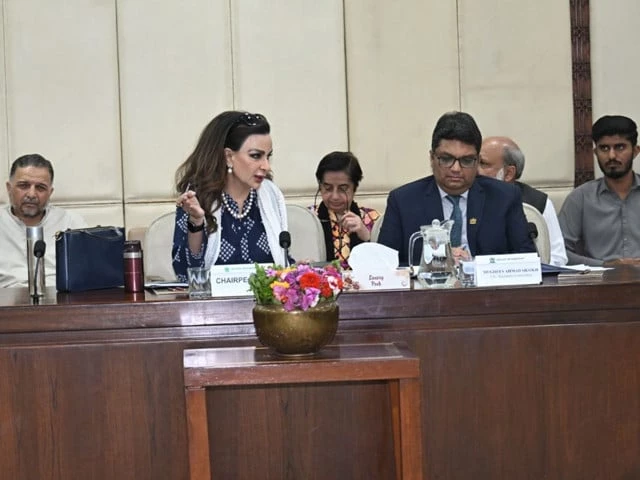
Islamabad (GNP): Presiding over a session of the Senate Standing Committee on Climate Change and Environmental Coordination, Chairperson Senator Sherry Rehman cautioned that Pakistan is heading into a period of sharply increased climate vulnerability, citing worsening heatwaves, faster glacier melt, unpredictable rainfall, mounting water insecurity, and declining environmental conditions in cities.
Given the severity of the situation, she instructed the Committee to keep monsoon readiness at the top of its agenda and pushed for tighter coordination across institutions to address what she termed a deepening climate polycrisis.
Senator Rehman flagged her unease over the numbers: the Climate Ministry’s overall PSDP allocation has dropped to Rs 2.478 billion, following an earlier cut from Rs 3.5 billion to Rs 2.7 billion the previous fiscal year. She argued that climate risk is rising even as funding shrinks and implementation problems persist, calling it a serious issue — while also noting that the Ministry has struggled to spend even the money it was already given.
She also pressed officials on the rationale behind the newly proposed Climate Authority, asking what purpose it would serve that the Climate Ministry doesn’t already fulfill, and describing it as another state-owned enterprise without a clear mandate that would add to an already heavy fiscal burden. She pointed out that state-owned enterprises collectively lost Rs 832.848 billion in FY2025, pushing cumulative losses to Rs 6.563 trillion, with a further Rs 451 billion earmarked for SOEs in the current budget. Her position was that climate governance needs better coordination among existing bodies, not another bureaucratic layer like the proposed Authority.
Shifting to monsoon planning, Senator Rehman insisted there was no room to delay preparedness and directed the Committee to turn its attention immediately to the risks Pakistan is likely to face in the coming months.
The Committee then heard detailed briefings — one from the National Disaster Management Authority (NDMA) on monsoon forecasts and readiness, and another from the Capital Development Authority (CDA) on the status of sewage treatment infrastructure.
NDMA Chairman Inam Haider Malik told the Committee that El Niño conditions are expected to shape the 2026–27 period, intensifying both extreme weather events and broader climate variability in the region. He added that global temperatures in June 2026 were running roughly 1.47°C above historical norms, with Pakistan’s temperatures already about 1.56°C above baseline — and warned that climate milestones once projected for the end of the decade are now arriving years early.
Asked by Senator Rehman whether Pakistan should brace for less rainfall overall, the NDMA chairman confirmed that precipitation patterns are growing more erratic: many regions are seeing reduced total rainfall, others are experiencing more concentrated and intense downpours, and large swaths of the country are facing extended dry spells that are straining both water supplies and agriculture. Senator Rehman remarked that rainfall in Pakistan itself seems to be becoming a moving target.
NDMA also reported that glacier melt has accelerated by roughly 3.5 percent and evaporation rates by close to 3 percent, warning that faster glacier loss, flash floods, and Glacial Lake Outburst Floods (GLOFs) are expected to worsen in the north — with GLOF events projected to climb from about 33 to nearly 50.
Pressing on the longer-term consequences of glacier retreat, Senator Rehman asked where water for the country’s dams and reservoirs would come from if the glaciers kept disappearing at this rate. In response, NDMA stressed the need to scale up rainwater harvesting, groundwater recharge, and the construction of monsoon basins nationwide.
When Senator Rehman asked whether these adaptation measures had been costed and what planning had actually been done, the Ministry said consultations were complete and a national drought action plan had been drafted. She instructed the Ministry to share the plan with the Committee without delay.
She also raised alarm over regional water security, pointing to reports that India is building new infrastructure capable of diverting substantial water flows, and stressed the growing need for better water governance, transparency on cross-border flows, and reliable data-sharing — calling the current lack of shared data on water flows a serious and rising concern. Given how high the stakes are, she directed that a dedicated briefing on water resources, river flows, storage capacity, and regional developments be scheduled for July.
The Committee was also told that erratic weather, drought, and extreme heat could cut agricultural output by 11 to 12 percent in affected areas, while also raising the risk of public health emergencies.
On urban environmental issues, Senator Rehman noted that Pakistan’s climate challenges are compounded by failing waste management and worsening water pollution. A presentation from the CDA chairman revealed that Islamabad’s sewage treatment projects have been stuck since 2023, prompting Senator Rehman to question why such urgent infrastructure work remains stalled.
Officials told the Committee that bidding for three sewage treatment plants should wrap up by June 30, with four joint ventures currently in technical evaluation, while acknowledging that funding for the projects remains inadequate and that cost estimates will need to be revised upward.
Also Read: Pakistan Facilitates Islamabad MoU Between United States and Iran
Senator Rehman warned that continued delays in sewage treatment carry direct consequences for both public health and the environment, saying that untreated sewage and toxins are effectively being allowed to flow into the country’s rivers, lakes, dams, and water systems, and that the situation cannot be allowed to continue.
The Committee also learned that Islamabad produces around 990 tonnes of solid waste a day, of which only about 500 tonnes are reliably collected — leaving major gaps, especially in rural parts of the capital.
Finally, Senator Rehman called for a separate briefing on Islamabad’s green cover and urban ecological planning, arguing that Pakistan’s cities need far greater investment in environmental restoration. She noted that the country loses roughly 11,000 hectares of forest every year.

Sohail Majeed is a Special Correspondent at The Diplomatic Insight. He has twelve plus years of experience in journalism & reporting. He covers International Affairs, Diplomacy, UN, Sports, Climate Change, Economy, Technology, and Health.