
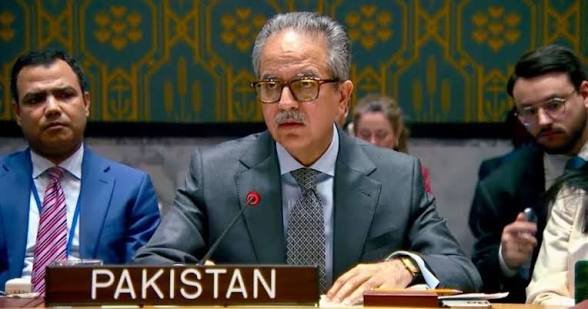
New York (GNP): Pakistan’s Permanent Representative to the United Nations, Ambassador Asim Iftikhar Ahmad, has raised serious concerns over the security situation in the region, arguing that the Taliban regime has itself become a proxy contributing to regional destabilization.
The remarks were made during an interview with Arab News in which Ambassador Asim Iftikhar Ahmad discussed Afghanistan, cross-border terrorism and Pakistan’s broader regional security concerns.
The ambassador maintained that developments in Afghanistan have direct implications for Pakistan’s national security.
Islamabad has repeatedly expressed concern over militant groups operating from Afghan territory and has called for stronger measures to prevent Afghan soil from being used for attacks against neighbouring states.
Pakistan has particularly raised concerns regarding the Tehreek-e-Taliban Pakistan (TTP), which Islamabad accuses of conducting attacks inside Pakistan from bases and safe havens in Afghanistan.
Pakistan’s UN envoy has previously told the Security Council that militant groups received what he described as a “new lease of life” following the Taliban takeover of Afghanistan in 2021.
Ambassador Ahmad’s latest comments reflect Islamabad’s continuing position that instability in Afghanistan cannot be separated from the wider security environment of South and Central Asia.
Pakistan has also called for greater international attention to the availability of sophisticated weapons left in Afghanistan following the withdrawal of foreign forces.
The Pakistani government has argued that such weapons could increase the capabilities of militant organizations operating in the region.
The ambassador’s remarks come amid continuing tensions between Pakistan and Afghanistan over terrorism, border security and the activities of militant groups.
For Pakistan, the issue is not limited to bilateral relations with Kabul.
Islamabad views Afghanistan-related militancy as part of a wider regional security challenge that can affect economic connectivity, trade, border communities and regional stability.
Also Read: Gilani Expresses Grief Over Indonesia Earthquake
Pakistan has consistently urged the international community to address what it considers the underlying sources of terrorism and to ensure that Afghan territory is not used against neighbouring countries.
At the same time, Islamabad has emphasized the importance of regional stability and diplomatic engagement.
Pakistan’s foreign policy approach toward Afghanistan therefore combines security concerns with calls for dialogue and international cooperation.
Ambassador Ahmad’s comments also underline Pakistan’s effort to raise Afghanistan-related security concerns at international forums, particularly the United Nations.
Pakistan has previously urged the UN Security Council to take action against militant organizations that Islamabad says are responsible for attacks inside the country.
In February 2026, Ahmad called on the Security Council to consider sanctions against the Balochistan Liberation Army following attacks in Balochistan.
The ambassador’s latest interview demonstrates that Afghanistan remains a central issue in Pakistan’s diplomatic and security agenda.
As regional security dynamics continue to evolve, Islamabad is expected to maintain pressure for stronger international action against militant networks while seeking diplomatic mechanisms capable of preventing further escalation.
Pakistan maintains that lasting regional stability requires responsible state behaviour, effective action against terrorism and cooperation among neighbouring countries.
The remarks by Ambassador Asim Iftikhar Ahmad therefore highlight Islamabad’s continuing message to the international community: developments in Afghanistan have consequences beyond its borders, and addressing regional insecurity requires sustained international attention and cooperation.