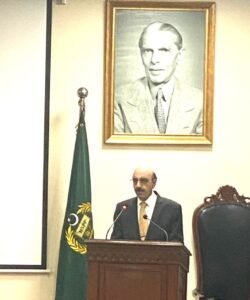
Islamabad (GNP): Pakistan has consistently played a constructive role in international diplomacy and can continue contributing to efforts for a more representative, transparent and effective United Nations, said Sardar Masood Khan, Former Ambassador of Pakistan to the United States, China and the United Nations, and former President of Azad Jammu and Kashmir.
Speaking in an interview with Diplo TV of Diplomatic Insight Group, Ambassador Khan reflected on his four-decade diplomatic career, his early life in Rawalakot, his formative experiences in journalism and broadcasting, and his diplomatic assignments in China, Geneva and New York.
Recalling his early years, Ambassador Khan said growing up in Rawalakot and witnessing the natural beauty of Kashmir had profoundly shaped his outlook. He said his student years at Hussain Shaheed College and Gordon College, followed by his studies in English literature at Punjab University, were an important period of his life. His early involvement in student politics, journalism, Radio Pakistan and Pakistan Television also developed his interest in international affairs.
He said his decision to join the Foreign Service was influenced by his exposure to international politics through broadcasting. Although he had the option of joining the administrative service after securing a strong position in the CSS examination, he deliberately chose the Foreign Service.
Ambassador Khan recalled beginning his diplomatic career in China after opting to study Chinese. He spent two years at the Beijing Language Institute, obtained a diploma in Chinese-language interpretation and subsequently served as a third secretary at the Pakistan Embassy in Beijing. Decades later, he returned to China as Pakistan’s ambassador.
Describing his second tenure in Beijing, he said Pakistan reoriented its diplomacy beyond traditional state-to-state engagement by promoting health, education, people-to-people and business-to-business relations. He also highlighted efforts that laid groundwork for what later developed into the China-Pakistan Economic Corridor (CPEC), including work on energy, communication and other connectivity corridors.
Reflecting on his multilateral career, Ambassador Khan said his assignments in Geneva and New York provided opportunities to lead difficult international negotiations. He recalled presiding over negotiations on internet governance and the Biological Weapons Convention, where deeply divided parties were brought towards consensus.
He said Pakistan also played an active role in the UN Human Rights Council, particularly on issues concerning Kashmir, Palestine and Islamophobia, while representing the OIC group.
Recalling his tenure at the UN Security Council in 2012–13, including his presidency of the Council in January 2013, Ambassador Khan described the body as divided among the permanent members and said Pakistan sought greater transparency and inclusiveness. He highlighted Pakistan’s efforts to promote open sessions of the Council and greater accountability in the use of the veto.
On UN reform, he said Pakistan had consistently advocated a more representative Security Council and supported the United for Consensus approach, opposing the creation of additional permanent seats.
Also read: Judge Who Defended Mandela Wins Nobel Peace Prize, Not Trump
Ambassador Khan said his transition from diplomacy to public leadership was also connected to his longstanding engagement with politics, describing multilateral diplomacy itself as an arena requiring coalition-building, negotiation and consensus-building.

Sohail Majeed is a Special Correspondent at The Diplomatic Insight. He has twelve plus years of experience in journalism & reporting. He covers International Affairs, Diplomacy, UN, Sports, Climate Change, Economy, Technology, and Health.