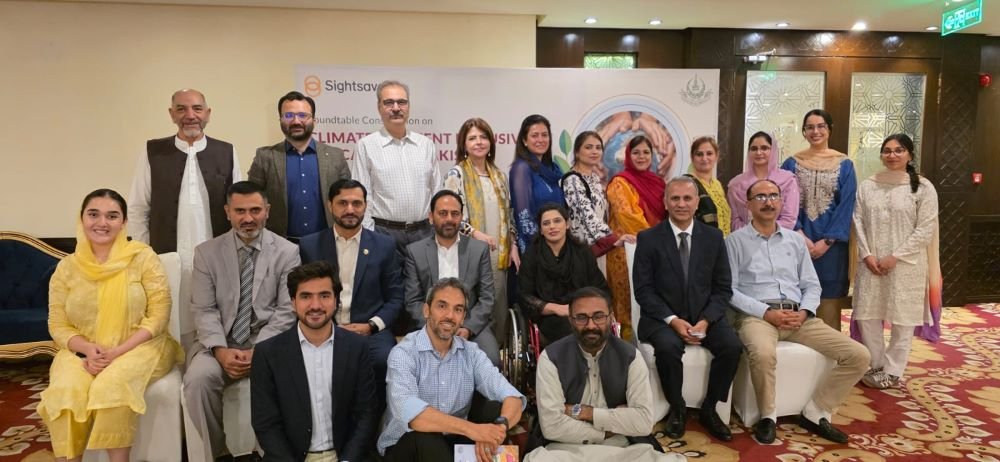
Islamabad (GNP): Sightsavers Pakistan teamed up with Allama Iqbal Open University (AIOU) to host a major roundtable on building climate resilience into the country’s education system. The gathering brought together federal and provincial officials, academics, development organizations, civil society groups, and education specialists to map out how schools across Pakistan can withstand mounting climate pressures without leaving any group of learners behind.
The discussion was grounded in two studies carried out under the Data and Research in Education – Research Consortium (DARE-RC), which looked at how climate hazards are affecting schools, students, teachers, and the communities around them. Both studies pointed to the same pattern: floods, extreme heat, smog, and water shortages are steadily eroding school attendance and learning outcomes, with girls, children with disabilities, and students from marginalized backgrounds bearing the heaviest burden.
Dr. Zaigham Qadeer, who heads the Pakistan Institute of Education, opened the session by underlining how urgently the education system needs to adapt to worsening climate shocks. He pushed for the event to produce concrete recommendations that federal and provincial policymakers could actually put into practice.
Munazza Gillani, Sightsavers’ Director for Pakistan and the Middle East, used her remarks to call out a recurring problem: work on climate, education, disability inclusion, and disaster risk reduction tends to happen in silos rather than in coordination. Her proposed fix was a shared, multi-sectoral platform where stakeholders could pool knowledge and act collectively instead of duplicating effort.
Sightsavers researchers Dr. Sapana Basnet, Itfaq Khaliq Khan, and Dr. Sulaman Ijaz walked participants through the findings, describing how schools nationwide are facing several climate and environmental risks at once, with effects that compound one another. Rather than isolated incidents, these disruptions are recurring problems that chip away at attendance, continuity of learning, health, household livelihoods, and social inclusion. The team argued that any adaptation strategy needs to be shaped by local conditions and built around both disability inclusion and gender equity.
From the Sindh government, Dr. Fouzia Khan, Chief Executive Advisor for the School Education and Literacy Department, made the case that real climate resilience can’t happen without coordinated, institutionalized action across different sectors. She pointed to Sindh’s Disaster Risk Reduction Working Group as an example already in motion, and stressed that resilience needs to be built directly into sector planning, teacher training, and school-level emergency preparedness.
Salman Ali, Deputy Secretary for Academics in Punjab’s School Education Department, spoke for the provincial government and reaffirmed its commitment to inclusive, climate-resilient schooling. He argued that closer ties between education authorities, disaster management bodies, and development partners are what will actually turn policy promises into protections for learning when climate emergencies hit.
Throughout the roundtable, participants from government, academia, development agencies, and civil society traded experiences and practical approaches around school safety, disaster readiness, climate adaptation, and community-level resilience. Recurring themes included the need for better school-level preparedness, stronger data systems that account for both climate risk and disability, more capacity-building for teachers, and tighter integration of climate resilience into how education is planned and delivered.
Also Read: Green Skills Program Strengthening Environmental Journalism, Amb Maja
By the end of the session, there was broad agreement to form a multi-sectoral working group dedicated to climate-resilient, inclusive education — a body meant to keep stakeholders coordinated and push collective action forward. Participants also flagged several priorities going forward: building the evidence base for policy, aligning advocacy efforts, strengthening data systems, and developing practical ways to carry policy commitments through to schools and communities on the ground.
Dr. Zahid Majeed, AIOU’s Director of Academics, moderated the full consultation. Closing the event with a vote of thanks, Hafiz Inamullah, DARE-RC’s Policy Engagement Specialist, framed the roundtable as part of a broader program effort and a sign of shared resolve to build an education system that can absorb climate shocks while still reaching every learner.

Sohail Majeed is a Special Correspondent at The Diplomatic Insight. He has twelve plus years of experience in journalism & reporting. He covers International Affairs, Diplomacy, UN, Sports, Climate Change, Economy, Technology, and Health.