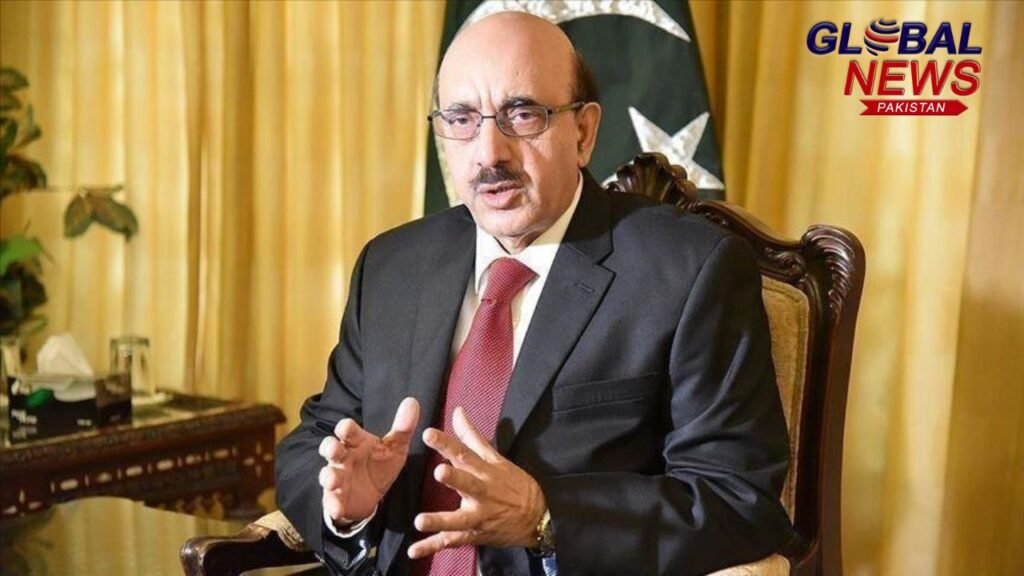
Islamabad (GNP) :- Ambassador Masood Khan, former President of Azad Jammu and Kashmir and former Ambassador of Pakistan to the United States, China and Permanent Representative to the United Nations, has emphasized that despite ongoing military escalation in the Gulf, all parties involved increasingly recognize the urgent need for a diplomatic pathway to avert wider strategic and economic devastation.
Responding to questions in TV interview on the credibility of emerging dialogue efforts, Ambassador Khan noted that while public posturing and denial of negotiations persist, there is substantial evidence of behind-the-scenes diplomatic engagement. He observed that military deployments, including the movement of United States Marine Expeditionary Units to the region, are part of a broader strategy of deterrence and coercive signalling rather than a contradiction of diplomacy. “Escalation and diplomacy are proceeding simultaneously,” he stated, adding that such parallel tracks are often designed to strengthen negotiating positions, though they inevitably narrow the political space for compromise.
He cautioned, however, that the prevailing trust deficit—particularly from Iran’s perspective—remains a major obstacle. He pointed out that previous disruptions to nuclear negotiations, including military actions during ongoing talks, have eroded confidence, making any future dialogue fragile and complex.
Highlighting Pakistan’s evolving role, Ambassador Khan stated that Islamabad has moved beyond a traditional back-channel facilitator to emerge as a credible lead mediator. He noted that Pakistan’s balanced and equidistant posture, coupled with its strong relations with the United States, Iran, and Gulf countries, has positioned it uniquely in the current crisis. He recalled that Pakistan had previously facilitated sensitive diplomatic exchanges between Washington and Tehran, a role that was publicly acknowledged by senior US leadership.
He further explained that Pakistan is working in close coordination with regional actors including Egypt, Turkey, and Oman, all of whom have a direct stake in restoring stability. “This will be a collective diplomatic effort, not a solo initiative,” he remarked, underscoring the importance of multilateral engagement in addressing a conflict of such scale and complexity.
Ambassador Khan noted that key stakeholders, including Gulf states, view Pakistan as a reliable intermediary that can pursue de-escalation without tilting the regional balance. He added that while Israel would monitor Pakistan’s involvement cautiously, Islamabad’s non-partisan status enhances its credibility as an honest broker.
Addressing the broader scope of negotiations, he stressed that reopening critical maritime routes such as the Strait of Hormuz would require more than a ceasefire. He outlined a wide range of contentious issues, including Iran’s nuclear programme, regional security concerns, and demands for guarantees against future attacks.
He concluded that the path to peace would be long and challenging. “The immediate priority is to secure a ceasefire and transition towards structured diplomacy,” he stated, emphasizing that durable peace would depend on credible security guarantees for all parties involved.

Sohail Majeed is a Special Correspondent at The Diplomatic Insight. He has twelve plus years of experience in journalism & reporting. He covers International Affairs, Diplomacy, UN, Sports, Climate Change, Economy, Technology, and Health.