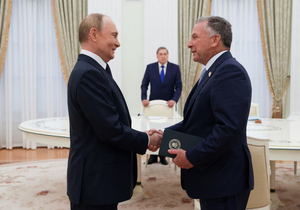
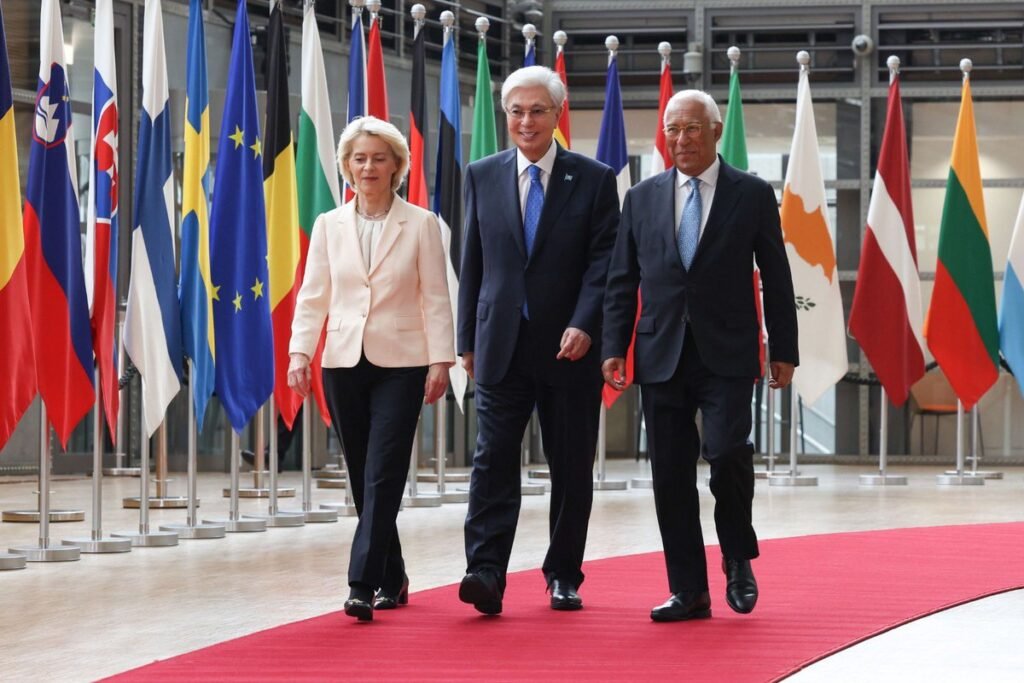
Brussels (GNP): EU Kazakhstan Partnership 2026 took a significant step forward as European Council President António Costa welcomed Kazakhstan President Kassym Jomart Tokayev to Brussels for high level talks, describing the visit as a testament to the growing engagement between the European Union and Kazakhstan across many areas of mutual interest. The meeting came just six months after President Costa’s own visit to Kazakhstan, demonstrating the remarkable pace at which the relationship between the two sides has been developing.
President Costa expressed genuine pleasure at welcoming President Tokayev to Brussels, noting that the Enhanced Partnership and Cooperation Agreement between the EU and Kazakhstan is delivering real and tangible benefits for both Kazakhstan and for Europe.
He described the two sides as strategic partners who are continuing to strengthen their cooperation across a wide and growing range of sectors, from trade and investment to energy, connectivity, and people to people exchanges.
The EU Kazakhstan Partnership 2026 visit reflects the broader strategic importance that the European Union has been placing on its relationships with Central Asian countries in recent years. As the geopolitical landscape of Eurasia has shifted significantly, particularly following Russia’s war in Ukraine and the resulting disruption to traditional trade and energy routes, Kazakhstan has emerged as an increasingly important partner for the European Union in a variety of strategic areas.
Kazakhstan is Central Asia’s largest economy and one of the world’s most significant producers of oil, gas, uranium, and critical minerals. Its geographic position makes it a crucial transit country for trade routes connecting Europe with China and the wider Asia Pacific region, and its stable political environment and reformist economic policies have made it an attractive destination for European investment. The EU Kazakhstan Partnership 2026 high level engagement in Brussels reflects a clear recognition on both sides that their relationship has strategic depth and long term value.
The Enhanced Partnership and Cooperation Agreement, which was signed in 2015 and entered into force in 2020, provides the legal and institutional framework for the EU Kazakhstan Partnership 2026 and covers an extensive range of areas including trade and investment, energy cooperation, environmental protection, education and research, human rights, and good governance. Both sides have been working steadily to implement the commitments made under the agreement, and the results are being felt in growing trade volumes, increased investment flows, and deeper people to people contacts between the European Union and Kazakhstan.
Energy cooperation has been one of the most dynamic areas of the EU Kazakhstan relationship in recent years. As Europe has worked to diversify its energy supplies away from Russian sources, Kazakhstan has become an increasingly important supplier of oil and gas, with the Trans Caspian route providing an alternative pathway for Kazakh energy resources to reach European markets without passing through Russian territory. The EU Kazakhstan Partnership 2026 talks are expected to further deepen this energy cooperation, with discussions around critical minerals also featuring prominently given Europe’s urgent need to secure reliable supplies of the materials needed for its green transition.
Also read: Pak-Denmark focused on strengthening ties for shared sustainable progress
Beyond energy, the EU and Kazakhstan have been strengthening cooperation in areas such as digital connectivity, sustainable development, education, and civil society engagement. The European Union has been a major provider of development assistance and technical expertise to Kazakhstan over the years, supporting the country’s modernisation agenda and its efforts to build stronger, more transparent, and more accountable institutions.
President Tokayev’s visit to Brussels and his meetings with European Council President Costa and other EU leaders send a strong signal that Kazakhstan values its partnership with Europe and sees it as a central pillar of its foreign policy and economic development strategy for the years ahead. The EU Kazakhstan Partnership 2026 engagement in Brussels is therefore not just a diplomatic courtesy but a genuine and substantive moment in a relationship that continues to grow in depth, breadth, and strategic importance.