
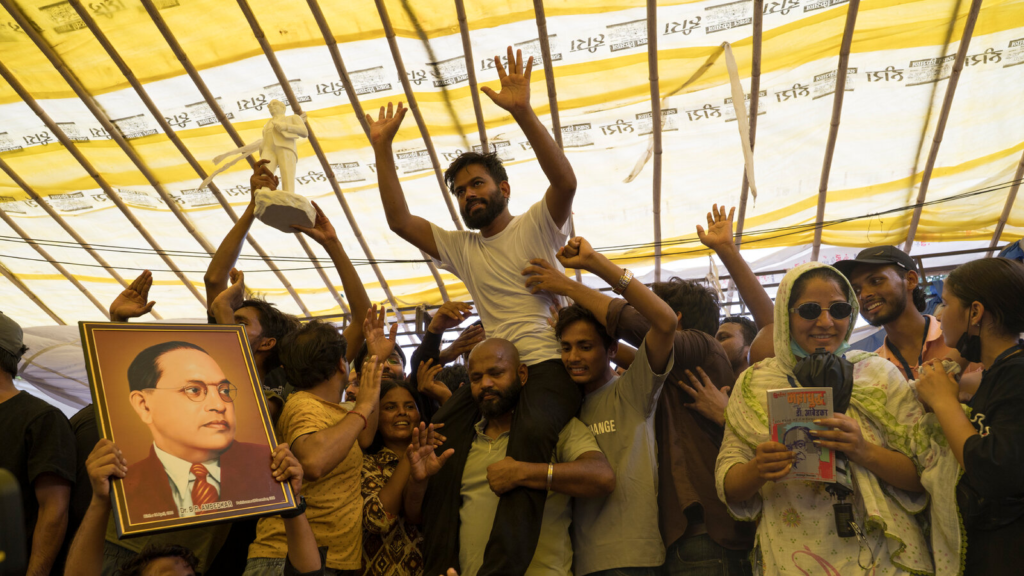
Islamabad (GNP): For twelve years, there was one rule for how Narendra Modi’s government dealt with ministers under fire, and the rule was simple: nobody resigns. Not after lynchings. Not after a Dalit scholar took his own life and left a note naming names. Not even when a minister’s own son stood accused in the deaths of protesting farmers.
Through all of it, the line from the BJP stayed the same: resignation was surrender, a habit from “the politics of scapegoats” that this government supposedly did not believe in. On Saturday that line broke. Dharmendra Pradhan quit as education minister, and in doing so became the first Cabinet-rank figure in twelve years of Modi’s rule to step down while openly taking the blame. Whether this counts as a win for the Cockroach Janta Party is not really in question; it obviously is one. What’s worth asking is why this case, out of all the others, was the one where the government finally blinked.
A government that doesn’t resign, until it does
Go back and look at what didn’t work before this. Mahesh Sharma called a lynching “an accident” and stayed in his job for years afterward. Smriti Irani and Bandaru Dattatreya kept their portfolios even after a student’s suicide note pointed straight at their ministry. Ajay Mishra Teni held onto his post for three years while his son faced charges connected to farmers being run over by a convoy of jeeps.
In each case, the calculation from the top was the same: wait it out, let the news cycle move on, don’t give the opposition a scalp. So if that model survived cases where people actually died, what changed with a student protest movement that started, of all things, as a joke about cockroaches? Was it simply the numbers, tens of thousands camped out at Jantar Mantar for over a month? Or was it something the government understood better than it let on: that this particular scandal wasn’t really about one exam; it was about whether anyone could still trust the system that hands out degrees to a fifth of the country’s youth.
What this does to “Study in India”
For years now, Modi’s government has been pushing the “Study in India” pitch, promoting Indian universities and testing bodies as credible alternatives to Canada, the UK, and Australia, keeping both students and tuition money at home. The whole pitch rests on one thing: that an Indian exam actually measures merit and isn’t just a matter of who got the leaked paper first. Pradhan’s own resignation letter more or less admits the wound is real, blaming an “examination mafia” for what happened.
But a mafia embedded deep enough in the country’s biggest medical entrance exam to force a nationwide retake and a CBI probe isn’t a footnote. It’s the kind of thing that makes a foreign student, or a foreign university weighing a partnership, ask exactly how much an Indian degree can be trusted to mean what it says. Students at home had to occupy a public square for over a month to get one minister removed. What is a family abroad supposed to conclude from that?
Who actually failed here, and who’s paying for it
Here’s the part that gets glossed over once a minister resigns: Pradhan never ran the exam. The National Testing Agency did. The vendors did. Whoever handled the paper between the printing press and the exam hall did. That’s a layer of bureaucracy that sits well beneath any minister’s desk, and none of it disappears just because Pradhan wrote a letter.
A resignation gives the public a name and a face to be angry at, which is politically useful. Still, it doesn’t touch the actual machinery that let a leak happen in the first place: the protocols, the custody chain, the digital systems now being rushed toward a computer-based rollout.
Civil servants in India rarely face anything like the reckoning a minister just did, partly because their failures get spread across committees and vendors instead of sitting on one desk. So here’s a fair question as the exam moves online: is the system that tests millions of Indian students every year itself being tested for fairness the same way it demands fairness of them? A minister is gone. The apparatus that let this happen is still standing, mostly on a promise.
A bureaucrat went first, and it wasn’t enough
There’s a detail that’s easy to miss in all this, and it matters. Before Pradhan resigned, the government had already tried something cheaper. Late on a Thursday night, days ahead of the minister’s own exit, the Centre quietly removed Vineet Joshi as Secretary of the Department of Higher Education and shifted him to the Ministry of Panchayati Raj, putting Naresh Pal Gangwar in his place. This wasn’t some routine transfer buried in a gazette notification.
Joshi had been the NTA’s first director-general, chaired the CBSE twice, and was holding acting charge of the UGC, arguably the one bureaucrat with his fingerprints on more of the exam machinery than anyone else in Delhi. Moving him out let the government look like it was acting without touching a single elected official, and it’s a move India has run before: an NTA chief was pushed out the same way back in 2024, during an earlier leak scandal, with no minister so much as saying sorry.
Also Read: Pradhan Out! India’s Youth Movement Claims Historic Victory
It didn’t work, and it didn’t take long to fail either. The camps at Jantar Mantar didn’t pack up. The CJP kept saying Pradhan’s resignation was non-negotiable, and within days, he was gone too. Read that sequence honestly, and it says more about the government than about the protesters. The first move wasn’t to fix anything; it was to hand over the least politically expensive name available and hope that was the end of it. That’s not accountability; that’s a deflection wearing accountability’s clothes, and this time people simply weren’t buying what was being sold. Only once that didn’t work did Delhi reach for the one name it had been protecting from the start.
Precedent, or just an exception
None of this takes away from what the Cockroach Janta Party pulled off. Breaking a twelve-year habit of political self-preservation is not a small thing, and it says something real about a generation of students no longer willing to sit quietly through “this is not the politics of scapegoats.”
But one resignation doesn’t make a pattern. Whether this becomes the moment India’s accountability model actually shifts, or just an exception carved out under unusual pressure, depends entirely on what happens the next time a ministry is caught out and there isn’t a crowd of thirty thousand students camped outside its gates to make it happen again.

Managing Editor at Global News Pakistan (GNP), with a Bachelor's degree in International Relations from Riphah International University, graduated with a Gold Medal. Reach out at sabahtareengnp@gmail.com