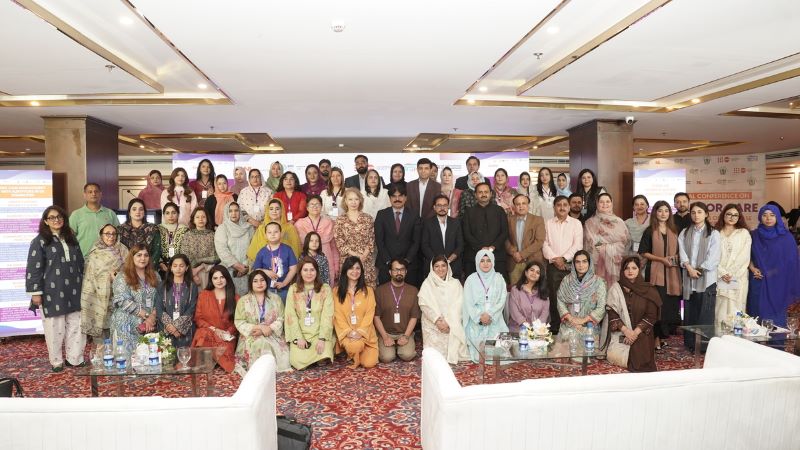
Islamabad (GNP): The two-day national conference “Connected for Care” concluded on 23 June 2026 at a local hotel. Organized by the Ministry of Human Rights with technical support from Strengthening Participatory Organization (SPO) and UNFPA Pakistan, and funded by the Foreign, Commonwealth and Development Office (FCDO) and the Embassy of the Netherlands, the conference brought together stakeholders from across Pakistan to strengthen the country’s response to gender-based violence (GBV).
The first day established the stakes. Senior voices from the Ministry of Human Rights, UNFPA Pakistan, and SPO presented a sobering baseline: close to one in three ever-married women in Pakistan has experienced violence, and persistent gaps in investigation and case processing continue to deny survivors the justice they are entitled to. The message was clear, coordinated, survivor-centred GBV case management is no longer optional but a national necessity. Provincial presentations by certified trainers from all five regions reinforced this, surfacing common obstacles including poor referral coordination, social stigma, and inadequate supervision, alongside examples of promising grassroots practice.
The second day shifted the focus from problem diagnosis to institutional action.
UNFPA Pakistan Consultant Mehreen Jaswal facilitated a session on GBV case management for married women and adolescent girls, drawing on regional data that revealed a critical service gap. Married girls, she explained, are routinely excluded from both GBV services and child protection systems, leaving them stranded in an uncoordinated gap where they rarely seek help until they have endured years of abuse or reached a point of acute crisis. She called for a more proactive bridging approach — one that reaches out to married girls and informs them of the services available to them, while keeping survivor-centred principles at the core. She also cautioned that GBV case management alone, however well delivered, cannot provide lasting protection without also addressing economic dependency, legal contradictions, and deeply normalized patterns of child marriage.
A panel discussion followed, moderated by Mahjabeen Qazi, Head of UNFPA Pakistan’s Khyber Pakhtunkhwa office, examining how GBV case management skills can be embedded in universities and professional training programmes so that graduates are genuinely practice-ready when they enter the workforce. Punjab and Khyber Pakhtunkhwa were highlighted as provincial frontrunners in curriculum integration. The KP Social Welfare Department shared that revising its Standard Operating Procedures to incorporate GBV case management had produced a measurable shift in frontline practice, with staff now approaching cases with greater ethical awareness and genuine focus on survivor needs rather than procedural box-ticking. The panel also identified persistent gaps that still need dedicated attention: ongoing mentoring support, disability inclusion in crisis facilities, and formal interpretation services for GBV survivors who do not speak Urdu.
Clinical Psychologist and Mental Health Specialist Zehra Kamal led a session on mentorship and supervision as structural tools in GBV case management, drawing an important line between managerial supervision and technical case supervision — two functions that organizations frequently and harmfully conflate. She framed robust supervision as a safeguard against secondary traumatization, a mechanism for ethical accountability, and the connective tissue between policy commitments and what actually happens in the field. Participants mapped the obstacles to building a genuine supervision culture: administrative overload, staff burnout, and the absence of formal systems that make supervision a standard requirement rather than an optional extra.
The conference’s most significant institutional outcome was the establishment of a National GBV Case Management Mentorship Forum — a platform linking certified trainers across all four provinces and the Islamabad Capital Territory for peer supervision, knowledge sharing, and coordinated advocacy aimed at improving GBV response outcomes nationwide.
Also Read: BankIslami Strengthens Digital Protection via Resecurity Alliance
In closing remarks, Saira Atta, Secretary of the Women Development Department Balochistan, and Arif Leghari, Director at the Ministry of Human Rights, called on government, civil society, and development partners to keep strengthening GBV prevention and response collectively.
They stressed the importance of equipping case workers with survivor-centred skills — including legal knowledge, documentation practices, and referral pathways — and underlined the value of cross-provincial learning. Both called for sustained effort to embed GBV case management within government systems, SOPs, and academic curricula, and reaffirmed their commitment to coordinated, long-term support for survivors across the country.
The “Connected for Care” conference closed as a significant milestone in Pakistan’s GBV response, having moved the conversation beyond training numbers toward building the institutional frameworks, mentorship structures, and collaborative relationships that durable, survivor-centred care genuinely requires.

Sohail Majeed is a Special Correspondent at The Diplomatic Insight. He has twelve plus years of experience in journalism & reporting. He covers International Affairs, Diplomacy, UN, Sports, Climate Change, Economy, Technology, and Health.