China (GNP): A joint Chinese scientific expedition has reached a significant milestone in atmospheric research by successfully measuring vertical ozone distribution from the ground to an altitude of 8,861 meters above sea level in the Mount Qomolangma region.
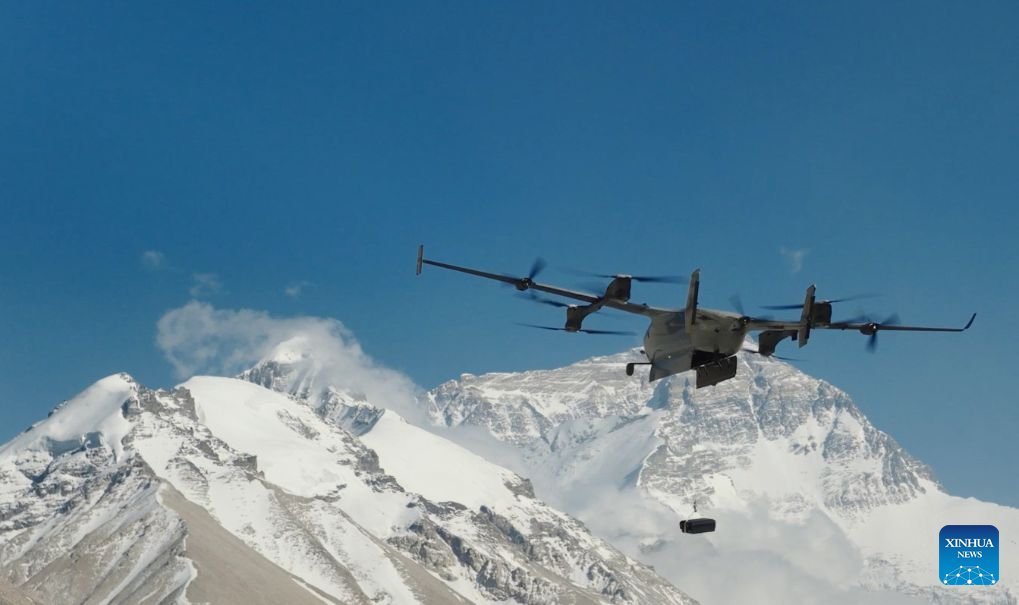
The achievement marks one of the most comprehensive high-altitude ozone observation efforts conducted in one of the world’s most challenging environments.The expedition employed a state-of-the-art vertical take off and landing (VTOL) fixed wing hybrid drone, enabling researchers to collect atmospheric data at unprecedented heights while operating under extreme weather and terrain conditions.
Beyond measuring ozone concentration at different altitudes, the research team also documented the complete process of downward ozone transport caused by glacier winds, providing scientists with valuable insight into atmospheric dynamics over the Qinghai-Xizang Plateau.
Mount Qomolangma, internationally known as Mount Everest, serves as one of the most important natural laboratories for climate and atmospheric research. Due to its high elevation and unique geographical location, the region allows scientists to study interactions between the upper atmosphere and Earth’s surface with greater accuracy than many other locations.
During the expedition, researchers spent 12 days conducting field operations on the mountain’s northern slope, successfully completing 32 effective drone flights despite difficult environmental conditions.
The hybrid drone exceeded the mountain’s iconic 8,848 meter summit elevation twice, with one mission reaching a stable altitude of 8,861 meters while carrying scientific equipment, demonstrating the remarkable capabilities of China’s latest unmanned aerial technology.
Scientists believe the data collected during the expedition will significantly improve understanding of ozone distribution across the Qinghai-Xizang Plateau, a region that plays a crucial role in Asia’s climate system.
Ozone in the upper atmosphere protects life from harmful ultraviolet radiation, while ozone closer to Earth’s surface can influence air quality, weather patterns, and ecosystem health. Understanding how ozone moves through different atmospheric layers is therefore essential for improving climate models and environmental forecasting.
One of the expedition’s most notable achievements was capturing evidence of how glacier winds transport ozone downward through the atmosphere. This process has long been difficult to observe directly because of the harsh terrain and limited access to extremely high altitudes.
The newly gathered observations provide scientists with valuable real world evidence that can help validate atmospheric models and improve predictions related to climate change.The successful deployment of advanced drone technology also highlights the growing role of unmanned aerial systems in scientific exploration.
Compared to conventional aircraft or weather balloons, hybrid drones can operate more flexibly in mountainous regions while carrying specialized scientific instruments, making them increasingly valuable tools for environmental monitoring and climate research.
Also Read: 48% of Travelers Avoid Sharing Sensitive Data with AI
Researchers say the findings will contribute to long term studies of atmospheric chemistry, ozone variability, and environmental change across western China. The new observations are expected to support future international research efforts focused on climate resilience, glacier preservation, and high altitude ecosystem monitoring.
As climate change continues to affect mountain environments worldwide, innovations in atmospheric observation are becoming increasingly important. The Mount Qomolangma expedition demonstrates how advanced technology and scientific collaboration can expand understanding of Earth’s atmosphere, providing valuable data that supports global climate research and environmental protection initiatives.
The expedition represents another step forward in China’s scientific research capabilities while contributing meaningful knowledge to the international scientific community’s efforts to better understand atmospheric processes and their impact on the global climate system.