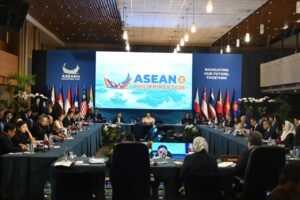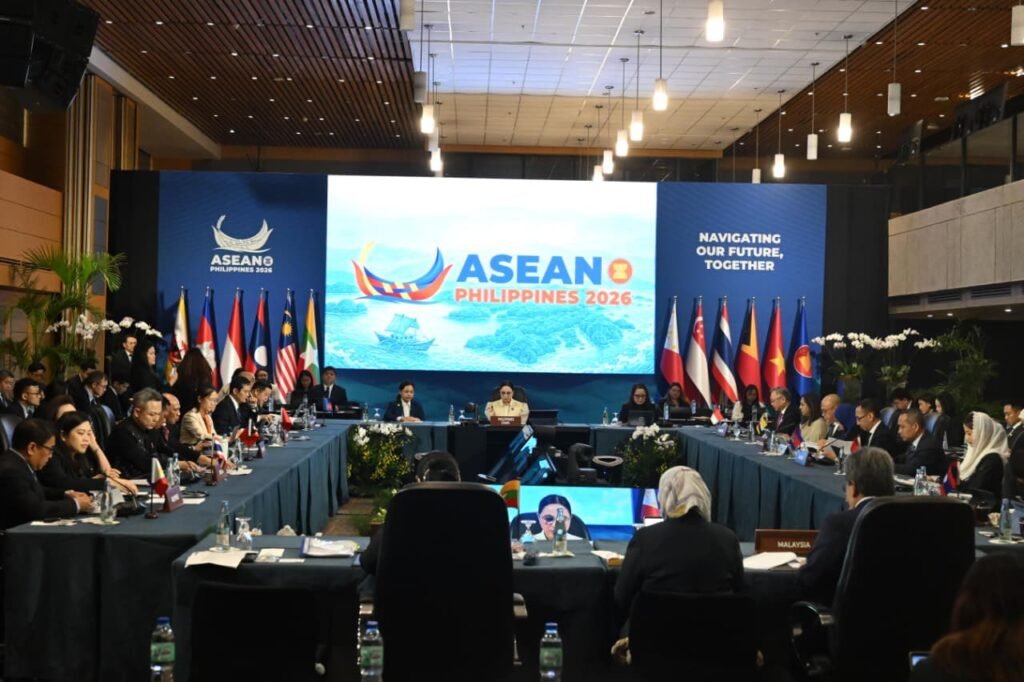
Manila (GNP): ASEAN Economic Ministers and senior officials reviewed key measures aimed at strengthening regional trade integration, improving customs procedures and reinforcing ASEAN’s position as a single market and production base during the joint meeting of the 58th ASEAN Economic Ministers (AEM) and 40th ASEAN Free Trade Area (AFTA) Council Meeting in Manila, the Philippines.
ASEAN Secretary-General Dr. Kao Kim Hourn attended the meeting, which focused on the implementation of the ASEAN Trade in Goods Agreement (ATIGA) and preparations for the early entry into force of the Second Protocol to Amend the ATIGA, commonly referred to as the Upgraded ATIGA.
The meeting formed part of a wider series of economic meetings taking place in Manila from September 19 to 22 under the Philippines’ 2026 ASEAN Chairship.
The discussions on ATIGA reflect ASEAN’s continuing efforts to facilitate the movement of goods among member states and improve the conditions for regional trade.
The agreement provides an important framework for trade in goods within ASEAN, while the proposed upgrade is intended to update and strengthen the regional trading framework.
Trade facilitation was another major focus of the meeting. Ministers discussed the expansion of the ASEAN Authorised Economic Operator Mutual Recognition Arrangement (AAMRA), which is designed to support greater cooperation and recognition among customs authorities.
They also considered the enhanced ASEAN Customs Transit System (ACTS), an initiative aimed at facilitating the movement of goods across participating ASEAN markets.
Also Read: Pakistan Highlights Gaming Ties at Tokyo Game Show 2026
According to ASEAN, the measures discussed at the meeting are intended to reinforce the region as a single market and production base while maintaining competitiveness and resilience in the global economy.
The meeting comes as ASEAN continues to work on economic integration amid changes in global trade, supply chains and investment patterns.
Improving customs cooperation and reducing procedural barriers are among the mechanisms through which the regional bloc seeks to make cross-border trade more efficient.
The Manila meetings are also covering broader economic priorities. The 58th AEM Meeting and related meetings include the 40th AFTA Council Meeting, the 29th ASEAN Investment Area Council Meeting and consultations with dialogue partners, business councils and international organisations.
ASEAN said these meetings provide opportunities to examine global and regional economic developments, the Philippines’ Priority Economic Deliverables for its 2026 Chairship, annual priorities and external economic relations.
Alongside trade discussions, ASEAN has been placing increased attention on the digital economy. On September 19, Dr. Kao Kim Hourn also delivered opening remarks at the Business Dialogue on ASEAN’s Digital Economy 2026 in Manila.
The dialogue brought together policymakers, business leaders and other stakeholders to discuss digital transformation, regional connectivity and opportunities for public-private collaboration.
The Secretary-General also participated in a high-level luncheon focused on the digital economy, where participants discussed partnerships to expand access to regional markets, strengthen competitiveness and support sustainable economic growth.
The latest economic discussions therefore form part of a broader ASEAN agenda combining trade integration, investment, digital transformation and regional connectivity.
For businesses operating across Southeast Asia, continued progress on customs cooperation and trade facilitation could influence the efficiency of cross-border supply chains and market access.
The meeting in Manila demonstrates the continuing role of ASEAN’s economic institutions in coordinating regional trade policies and preparing the bloc for evolving global economic conditions.
With work continuing on the Upgraded ATIGA, AAMRA and ACTS, member states are pursuing measures designed to strengthen the practical foundations of regional economic integration.