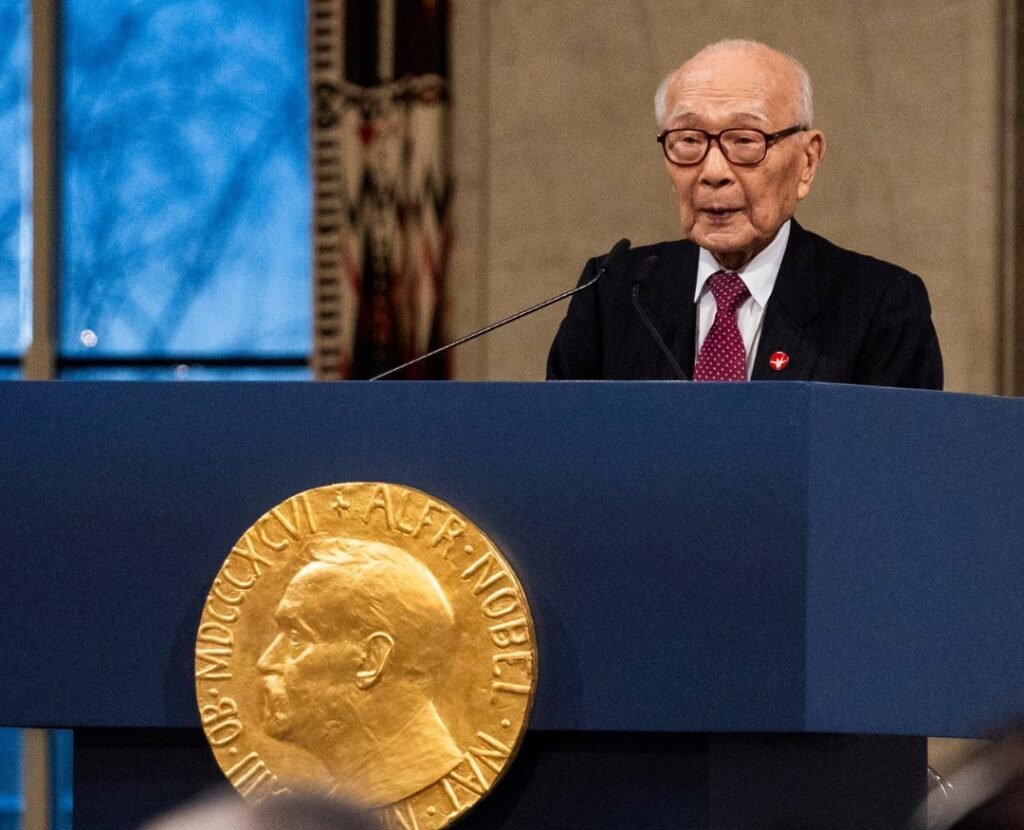
Nagasaki (GNP): Eighty years after the atomic bombing of Nagasaki, survivor Terumi Tanaka has renewed his call for the abolition of nuclear weapons, recalling the devastating human suffering he witnessed as a 13-year-old boy on August 9, 1945.
Tanaka, now 93, was at his home approximately three kilometres east of the Nagasaki bombing’s hypocenter when the atomic bomb was detonated.
He recalled hearing the sound of a bomber before being engulfed by an intense white flash.
He immediately ran downstairs, covered his eyes and ears and took shelter on the floor. Moments later, a powerful shock wave passed through his home.
Although Tanaka survived without serious physical injury, the devastation he witnessed in the days that followed left a lasting impression on him.
Three days after the bombing, Tanaka travelled with his mother to search for relatives who had lived near the hypocenter.
From a mountain pass, he saw extensive destruction stretching toward the port of Nagasaki. Buildings had been destroyed, houses reduced to ashes and victims lay among the ruins.
Among the sites devastated by the bombing was Urakami Cathedral, once one of the largest Christian churches in East Asia.
The surrounding area was left in ruins, while many people who had suffered severe burns and injuries remained without medical assistance.
Tanaka also encountered the remains of members of his own family. One of his aunts and her university-student grandson were found dead near their destroyed home.
Another aunt suffered severe burns and died shortly before Tanaka and his mother arrived. His grandfather was found critically injured with burns covering much of his body.
Another uncle, who initially survived, later died after collapsing at a rescue station and developing a high fever.
The experience profoundly affected Tanaka. He later described witnessing hundreds of people suffering without adequate medical treatment and concluded that such destruction could never be justified by war.“I strongly felt that even in war, such killing and maiming must never be allowed to happen,” Tanaka said in his testimony.
Also Read: Islamabad lights up in tribute to the Makkah Joint Defence Agreement
The atomic bombing of Nagasaki killed an estimated 70,000 people by the end of 1945, adding to the enormous human toll caused by the atomic bombing of Hiroshima three days earlier.
Survivors, known as hibakusha, have spent decades sharing their experiences to preserve historical memory and warn future generations about the consequences of nuclear warfare.
Tanaka has dedicated much of his life to nuclear disarmament and the elimination of nuclear weapons.
His testimony highlights not only the immediate destruction caused by an atomic bomb but also the long-term human consequences carried by survivors and their families.
As the world marks eight decades since Nagasaki, Tanaka’s story serves as a reminder that nuclear weapons are not merely instruments of military power.
Behind every discussion of nuclear deterrence and strategic security are human lives, families and communities that can be destroyed within seconds.
His testimony comes at a time when nuclear weapons continue to pose a major threat to international security.
Tanaka’s appeal for their abolition reflects the continuing efforts of atomic-bomb survivors to ensure that the suffering experienced in Hiroshima and Nagasaki is never repeated.
The 80th anniversary of the Nagasaki bombing therefore represents not only an occasion for remembrance but also a renewed call for peace, disarmament and international cooperation to prevent the use of nuclear weapons against humanity again.