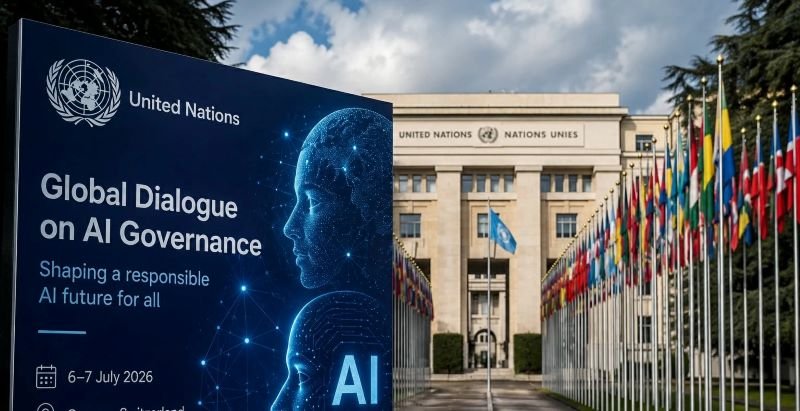
GENEVA (GNP): Following the conclusion of the inaugural United Nations Global Dialogue on Artificial Intelligence (AI) Governance in Geneva, UNESCO has emerged as the leading agency driving the global transition toward safe, ethical, and human-centered artificial intelligence.
Established under the mandate of the UN General Assembly, this landmark Dialogue marked the first inclusive, truly multilateral platform where all Member States converged to shape the future of digital governance. Throughout the two-day summit, discussions focused on bridging the global AI divide, ensuring meaningful human oversight, and guaranteeing that AI systems are developed and governed in accordance with international law and human rights.
Speaking at the high-level opening of the Dialogue, UN Secretary-General António Guterres called for immediate, unified implementation of international standards:
“AI is advancing at runaway speed. The question is whether we will govern it together – or let it govern us. We must turn global participation into global action to make AI safer, fairer, more accessible and more ethical.”
UNESCO Director-General Dr. Khaled El-Enany highlighted the importance of protecting cultural and linguistic diversity in the age of artificial intelligence:
“Humanity’s rich and diverse cultural and linguistic heritage is our greatest source of creativity, identity and resilience, but we must ensure Artificial Intelligence strengthens, rather than erodes this diversity. Global AI governance is essential to protect all voices, empower all cultures, and guarantee that innovation reflects the full breadth of human culture.”
Watch the full speech here: Khaled El-Enany (UNESCO) – Global Dialogue on Artificial Intelligence Governance – Day 1 | UN Web TV
The Global Dialogue builds upon six months of worldwide consultations involving a diverse international coalition of technical experts and policy contributors. More than 1,500 written submissions informed the agenda, with AI safety, capacity-building, transparency, accountability, and human oversight emerging among the highest global priorities.
The Dialogue also follows the release of the preliminary report of the Independent International Scientific Panel on Artificial Intelligence, providing governments with an evidence-based foundation for future policy discussions and international cooperation.
The high-level outcomes of the Dialogue built upon six months of worldwide consultations and more than 1,500 written technical submissions. At the center of these global discussions was UNESCO’s own Recommendation on the Ethics of Artificial Intelligence—the world’s first global normative framework on AI, adopted unanimously by Member States. To operationalize these standards, UNESCO mandates the use of the Readiness Assessment Methodology (RAM) and the Ethical Impact Assessment (EIA). These tools serve as the premier international diagnostics for evaluating a nation’s digital, legal, and social preparedness for AI integration.
These global deliberations, recommendations and tools, directly trickle down to shape local action, particularly at a time when Pakistan is undergoing a rapid, critical digital transformation. Emerging as a leading global participant in translating these ethical frameworks into domestic reality, Pakistan currently leads the world in the UNESCO-Oxford capacity-building initiative on AI and Digital Transformation in Government, with more than 1,000 Pakistani civil servants actively trained to manage ethical public sector digital projects. To anchor this systemic progress in robust governance, UNESCO is providing key technical assistance to the Ministry of Information Technology and Telecommunication (MoITT) to align Pakistan’s draft National AI Policy with international ethical and human rights standards. As part of UNESCO’s AI and Rule of Law Programme, the Office in Pakistan is reviewing the opportunities, challenges, and capacity needs for the ethical use of AI within Pakistan’s judicial sector. The findings will support evidence-based policymaking and capacity development to promote transparent, accountable, and rights-based AI in justice systems. Simultaneously, UNESCO is bridging the competency gap in education, with initiatives such as training teachers from the Federal Directorate of Education (FDE) and the Associated Schools Project Network (ASPnet), in AI, to equip teachers and students’ future needs.
This localized momentum in Pakistan serves as a prime, operational example of the broader UN Digital Week in Geneva, which aimed to transform the Global Digital Compact’s vision of inclusive international cooperation into a lived reality. Ultimately, the success of the Global Dialogue is measured not just by the declarations, but by this very ability to convert global consensus into safe, human-centric technological progress on the ground.

Sohail Majeed is a Special Correspondent at The Diplomatic Insight. He has twelve plus years of experience in journalism & reporting. He covers International Affairs, Diplomacy, UN, Sports, Climate Change, Economy, Technology, and Health.