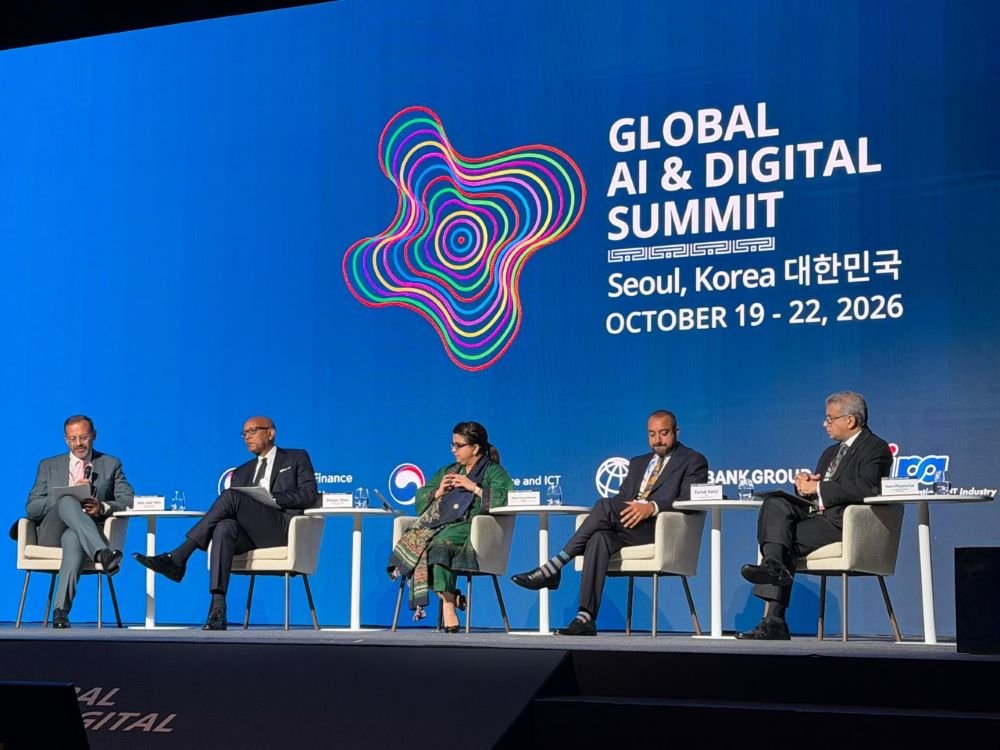
SEOUL (GNP): Information Technology and Telecommunication Minister Shaza Fatima Khawaja spoke at the Global AI & Digital Summit in Seoul, South Korea, in an address titled “Digital and AI Compacts: From Ambition to Action.”
She began by saying that her main lesson from three years in office, as far as AI in government is concerned, is that being willing to start before you are fully ready is a core capability governments must develop. Citing the UN Secretary-General’s warning that institutions are unprepared for machines that make decisions, she said the move from ambition to action is now unavoidable.
1. One owner at the top. More than a hundred government bodies in Pakistan used to work in isolation. To change that, Parliament passed the Digital Nation Pakistan Act 2025, which created a National Digital Commission chaired by the Prime Minister. Its members include the four provincial Chief Ministers, key regulators and the Digital Authority. The Prime Minister has approved a National Digital Master Plan to digitise 12 priority sectors through 2035. Only leadership at the highest level, she said, can break through institutional inertia.
2. Pathways for everyone. Pakistan is building a Data Exchange Layer, Digital Identity and Unified Payment Interface as one interoperable national architecture. Under the governing rule, data is shared but never copied or stored, and always depends on citizen consent and a transparent record. As an example, she cited the registration of more than 1 million women-led farms in agriculture, along with work on their energy needs. Alongside the digitisation of small and medium enterprises, 57 national standards have been set to make it easier for the private sector to deal with government.
3. Govern the state first. To rebuild public trust, proposed protective legislation would require labelling of synthetic or AI-generated content, give every citizen the right to human review of AI-influenced decisions, and oblige government bodies to register their AI systems and assess their impact before deployment.
4. Measure to improve. Pakistan rose 14 places in the UN E-Government Index 2024, from 150th to 136th. Each federal secretary will now answer annually to the Commission for their ministry’s digital scorecard.
The minister announced a USD 1 billion commitment from the Prime Minister for AI through 2030. AI and digital training is being given to 1 million non-IT professionals, and 1,000 fully funded AI PhD scholarships are on offer. She said the Islamabad AI Declaration sets out 9 principles for sovereign and responsible AI, and that under it the digital workforce is being quadrupled within a single year.
She noted that Pakistan holds the presidency of the Digital Cooperation Organization (DCO), which approved the Regional DPI Initiative proposed by Pakistan. Once its national stack is complete, she said, Pakistan will offer it free to other countries that need it.
Citing a scientific panel report that warns dependence on foreign AI models erodes local control, she said Pakistan is focusing on sovereign AI that understands its language and cultural nuances and serves its own interests. She also welcomed the UN Secretary-General’s Global Fund for AI.
Also read: PAK–US TECH CONNECT 2026 TAKES PAKISTAN’S TECH TO THE US
She closed by describing the Digital Compact as a declaration of independence in the digital age, saying that from Islamabad to Seoul the future belongs to those who build it with sovereignty and inclusion.

Sohail Majeed is a Special Correspondent at The Diplomatic Insight. He has twelve plus years of experience in journalism & reporting. He covers International Affairs, Diplomacy, UN, Sports, Climate Change, Economy, Technology, and Health.