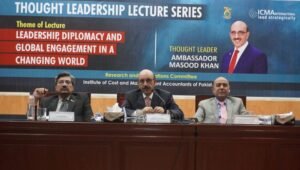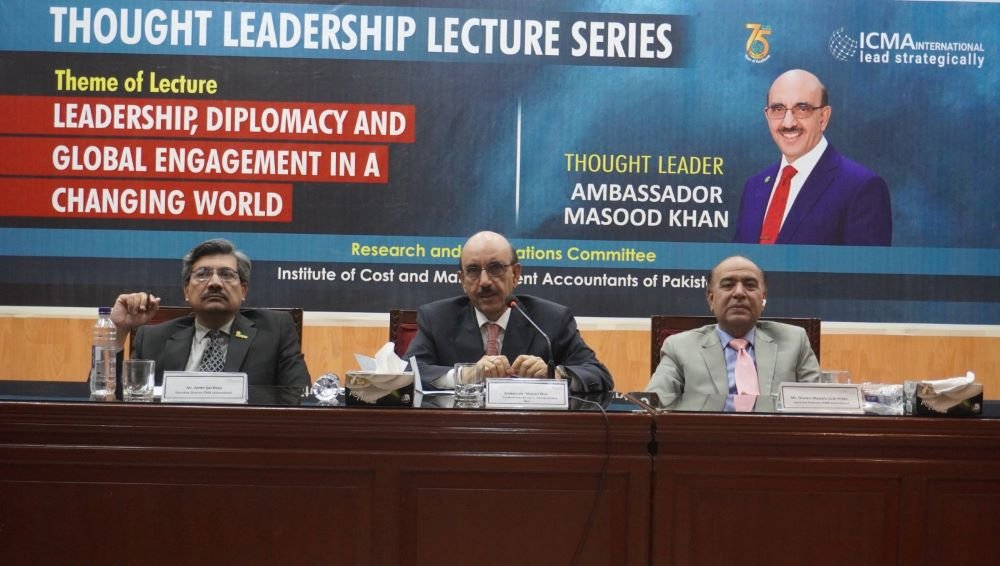
Islamabad (GNP): Pakistan’s youth must take responsibility for shaping the country’s future through visionary leadership, effective diplomacy, domestic reforms and constructive global engagement, said Sardar Masood Khan, Former Ambassador of Pakistan to the United States, China and the United Nations, and former President of Azad Jammu and Kashmir.
Addressing the Thought Leadership Lecture Series at the Institute of Cost and Management Accountants of Pakistan (ICMA Pakistan), Islamabad Campus, on the theme “Leadership, Diplomacy and Global Engagement in a Changing World,” Sardar Masood Khan urged students and young professionals to believe in themselves, recognise Pakistan’s potential and prepare to lead the country towards a more prosperous future.
He said Pakistan was blessed with a strategically important geographical location, a substantial population, functioning institutions and considerable human potential. Referring to a 2019 World Bank report projecting that Pakistan could become the world’s tenth-largest economy by 2047, he emphasised that this ambition would require sustained effort, institutional strengthening and consistent national policies.
Discussing leadership, Sardar Masood Khan highlighted the example of Prophet Muhammad (peace be upon him), describing his life as a model of service, compassion, strategic vision, negotiation and public welfare. He stressed that leadership was not defined by position or authority but by the ability to serve people and inspire lasting change.
On diplomacy, he explained that international relations had evolved beyond traditional state-to-state engagement. Public diplomacy, people-to-people contacts, cultural ties, digital communication and social media now played an increasingly important role in shaping international perceptions and influencing decisions. He noted that global diplomacy also encompassed climate action, sustainable development, inequality and the welfare of disadvantaged communities.
Addressing the changing world order, he observed that China’s economic rise, the growing influence of the Global South and the emergence of regional middle powers were reshaping international relations. He said Pakistan had opportunities to strengthen its global standing through digitalisation, human capital development, technological innovation and deeper engagement with its extended neighbourhood.
He cautioned, however, that Pakistan needed urgent reforms in governance, industrial development and agricultural modernisation. Foreign investment alone could not deliver sustainable growth without policy consistency, political stability, effective implementation and the institutional capacity to absorb and utilise investment productively.
Responding to questions, Sardar Masood Khan highlighted Pakistan’s longstanding contribution to the United Nations and international diplomacy, while calling for stronger multilateral institutions. He also emphasised the importance of sustained engagement with Afghanistan, improved regional connectivity and value addition in Pakistan’s mineral resources, urging the country to develop domestic processing capabilities rather than export raw materials.
Also read: Govt Ensures Adequate Fertilizer Availability and Price Stability: Rana
Concluding his address, he encouraged young Pakistanis, particularly members of the educated middle class, to participate actively in public life and national development. He said Pakistan’s international achievements must be institutionalised through domestic reforms, adding that the country’s future would depend on the confidence, integrity and determination of its next generation.

Sohail Majeed is a Special Correspondent at The Diplomatic Insight. He has twelve plus years of experience in journalism & reporting. He covers International Affairs, Diplomacy, UN, Sports, Climate Change, Economy, Technology, and Health.