Picture two scenes. In the first, a university student in the Global South asks an AI assistant a question in her own language. The answer is vague and full of errors. She asks again in English and gets a far better reply. In the second, a young worker in Nairobi or Manila spends the day reviewing violent and abusive content. His job is to filter it out, so that the same AI systems stay “safe” for users in rich countries. He is paid little, and he carries the images home.
Both scenes are about AI sovereignty. Neither involves a dramatic switch being flipped. Yet both show how control over AI, and the costs of building it, are unevenly shared.
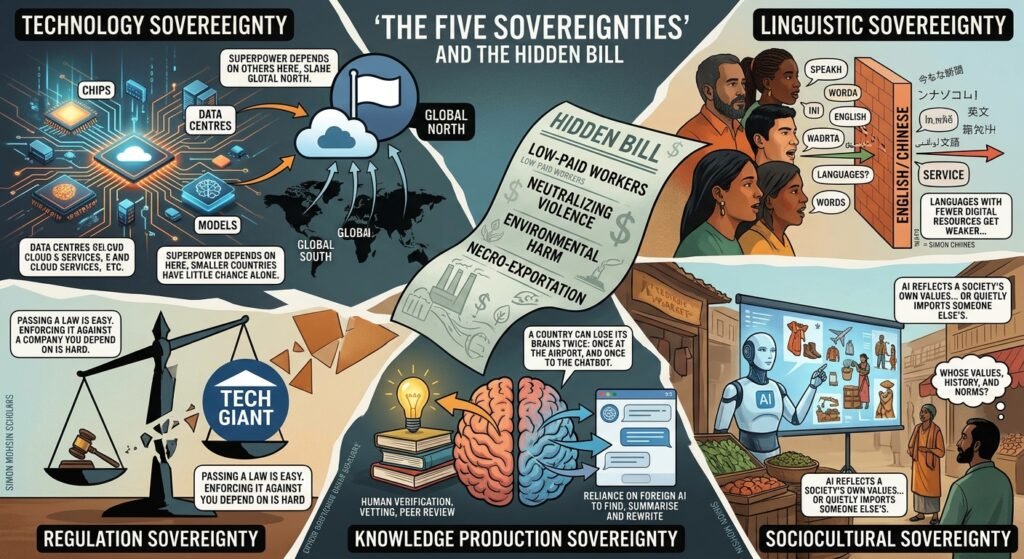
At a recent international conference, a academic expert, broke AI sovereignty into five parts. His framework covers technology, regulation, language, culture and the production of knowledge. It is a useful lens for seeing what is really at stake.
Chips, Laws, Words and Values
The first is technology sovereignty: who owns the chips, data centres, cloud services and models. This is the hardest layer to secure. Stanford University’s AI Index notes that a single Taiwanese company makes most of the chips inside America’s data centres. If even a superpower depends on others here, smaller countries have little chance alone. Data adds another risk. Citizens’ information may be stored abroad and fall under foreign law. The US CLOUD Act, for example, lets American authorities demand data held by US companies, wherever it sits.
The second is regulation sovereignty: whether a country’s own laws, or a foreign company’s terms of service, decide what AI may do on its soil. Passing a law is easy. Enforcing it against a company you depend on is hard. Small markets have little leverage. A global firm can simply threaten to withdraw.
The third is linguistic sovereignty: whether AI works well in your language. Most leading models learn mainly from English and Chinese text. Languages with fewer digital resources get weaker and less accurate service. Their speakers fall behind in education, public services and jobs. Hundreds of millions of people are affected.
The fourth is sociocultural sovereignty: whether AI reflects a society’s own values, history and norms, or quietly imports someone else’s. Every model carries built-in choices about what it refuses, how it frames history and what it treats as harmful. When a government runs its services on a foreign model, those choices come with it. There is an uncomfortable flip side, though. Governments can also invoke “cultural sovereignty” to justify censorship. The most prominent example that is shared online is how the same AI answers the same question differently when it is asked about Palestine as compared to Israel.
Knowledge: A Gift and a Trap
The fifth part, knowledge production sovereignty, is the least discussed. It may also be the most important. It asks whether a country’s scholars, schools and media still produce their own knowledge, or rely more and more on foreign AI to find, summarise and rewrite it for them.
There is real value here. AI makes research faster and cheaper. A scholar at an under-funded university can now search the literature, analyse data, translate sources and draft papers in a fraction of the time. Used well, AI can narrow the gap with richer institutions.
But one condition is essential. Human verification, vetting and peer review must remain. AI systems can produce confident errors and even invent references. The human expert must stay responsible for what is published, taught and decided.
There is also a deeper risk. Heavy reliance on AI may weaken the thinking skills of a whole generation. Early research points in this direction. A 2025 study by Michael Gerlich, published in the journal Societies, linked frequent use of AI tools to lower critical-thinking scores. A survey of knowledge workers by Microsoft Research and Carnegie Mellon University found that people who trusted AI more tended to think less critically about its output. A small study at the MIT Media Lab found weaker brain engagement among students who wrote essays with an AI assistant. These findings are early and need confirmation. But the warning is clear. A tool that thinks for us can also stop us from thinking.
For the Global South, this adds a new layer to an old problem. Poorer countries already lose many of their best minds to emigration. Now they risk eroding the abilities of those who stay. A country can lose its brains twice: once at the airport, and once to the chatbot.
The Hidden Bill
Then there is the question of who pays. The Cameroonian philosopher Achille Mbembe coined the term “necropolitics” to describe power that decides whose lives matter and whose are treated as expendable. Salvador Santino Regilme, a scholar of international relations at Leiden University, has applied this idea to AI. In a 2024 article in the SAIS Review of International Affairs, he describes a pattern he calls “necro-exportation.”
Regilme argues that AI works as a form of digital colonialism. Wealth concentrates among a global elite, mainly in the North. The Global South bears the damage. Its workers fill insecure, low-paid jobs that make AI possible, yet stay invisible in the industry’s story of progress. The worst of these jobs involves removing hate speech, violence and child-abuse material from platforms and training data. Much of it goes to English-speaking countries such as Kenya, the Philippines and India.
Also Read: Who Holds the Switch?
The environment pays too. Data centres consume huge amounts of energy and water. More of them are being built in the Global South to serve users elsewhere. Journalists have documented similar patterns. An MIT Technology Review series on “AI colonialism” showed how Venezuela’s economic collapse turned it into a hub of cheap data-labelling labour.
Keeping it Honest
This critique is powerful, but it should be handled with care. Some scholars argue that “AI colonialism” is a metaphor, not literal colonialism. No army occupies anyone, and AI systems cannot colonise on their own.
The critique also applies beyond American firms. Chinese companies build data centres southeast Asia, telecom networks systems across Africa, Asia and Latin America, including under the Digital Silk Road. A fair analysis applies the same test to every supplier, wherever it is based.
Finally, these jobs and data centres also bring income, skills and investment to countries that need them. The real question is not whether to accept them. It is on what terms.
Also Read: Three Powers, Three Philosophies, and a World of Dependents
Sovereignty lost quietly
Sovereignty is not only lost when someone flips a switch. It can slip away quietly. It goes when a language is poorly served. It goes when foreign values arrive by default inside imported software. It goes when workers absorb trauma for little pay, and when a generation stops thinking for itself.
None of this is inevitable. Each of these losses is the result of choices, and choices can still be shaped. But a single developing country has little power to shape them alone. The final article in this series argues that the Global South can only change the terms if it acts together.
This is the Third of a four-part series on AI sovereignty.

Political and International Affairs Analyst; Research Fellow, Bangladesh Neeti Gobeshona Kendra (Policy Research Center, NGK)