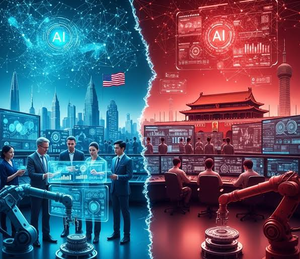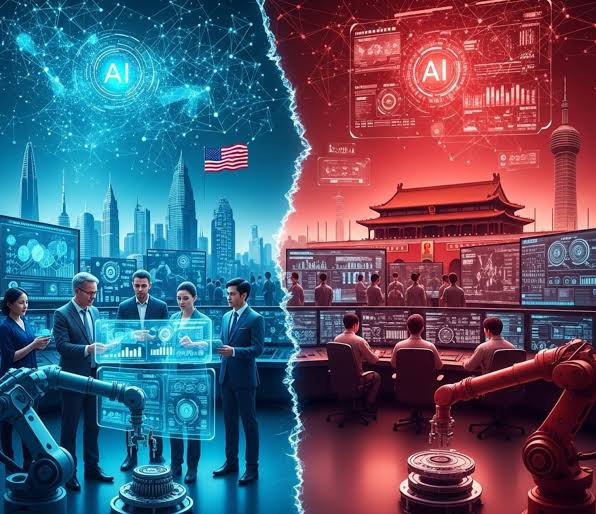
In 2025, around 90 notable AI models were released worldwide. That is the count in Stanford University’s AI Index 2026, which draws on data from the research group Epoch AI. By the report‘s original count, the United States produced 50 of them and China 30. Revised figures on Stanford’s website put the totals at 59 and 35.
Either way, the message is the same. Two countries dominate. Europe as a whole produced only two notable models. The rest of the world, home to most of humanity, produced only a handful.
Behind these numbers lie very different ideas about what AI is for, who should pay for it, and who should benefit.
Three philosophies
At a recent international joint academic conference in Kunming organized jointly by China’s Yunnan and Bangladesh’s North South Universities, an academic summarised the three main approaches. Drawing on his research, he described them the following way. The United States puts America first and the market and profit first, and shares advanced AI only with its allies. The European Union puts human rights first and regulation first, and insists on European values. China puts domestic social stability first and inclusive global benefit first, and says it favours sharing AI between nations.
This is a useful summary. It closely matches the work of Columbia University law professor Anu Bradford. Her 2023 book Digital Empires describes three rival models of digital power – American market-driven, Chinese state-driven and European rights-driven.
But each label is partly a self-description and partly a caricature. “Global benefit first” is how China describes its own approach. Critics would point to its strict domestic data controls and its content censorship rules. The United States would say its priorities are innovation and national security, not simply market protection. Europe would describe its goal as trustworthy AI that protects fundamental rights.
The framework is best read as one informed perspective, not a neutral scorecard. Still, it captures a basic truth. Each power is building AI to serve its own priorities first.
Who pays
The differences show up clearly in who pays. In the United States, AI is overwhelmingly a private venture. Stanford counts about $20.5 billion in US public AI investment over the twelve years from 2013 to 2024. Private investment reached $285.9 billion in 2025 alone. The government’s share is in the low single digits.
China works differently. The state plays a much larger role, although estimates vary with how it is measured. The research firm Rhodium Group finds that direct government funding made up about a quarter of equity investment in Chinese AI in 2026, down from 30% in 2024 and 2025. In AI chips and servers, more than 60% comes from state-linked sources. Bank of America estimated that the government would provide about $56 billion of China’s projected $98 billion AI investment in 2025. Stanford cautions that headline figures understate China’s total, because much of its funding flows through government guidance funds.
For citizens elsewhere, the lesson is simple. In the United States, the direction of AI is set mainly by companies answering to shareholders, and controlled by private investors. In China, it is set heavily by a state answering to its national priorities. In neither case does a citizen of another country have a vote.
Where everyone else stands
Where does that leave the rest of the world? The same scholar offered a helpful way to think about it. He sorted national AI sovereignty into four types – independent, cooperative, dependent and trusteeship.
Independent countries control most of the AI chain themselves. Realistically, only the United States, and partly China, come close. Even they depend on each other’s supply chains.
Cooperative countries pool resources with partners. The European Union is the main example. Researchers have proposed that mid-sized “bridge powers” could do the same.
Dependent countries use foreign AI with little control over its price, terms or access. This describes most of the world today.
Trusteeship is the weakest position. Here, another country or company effectively runs critical AI on a nation’s behalf. Many “sovereign AI” partnerships between developing countries and big technology firms look closer to this than their branding suggests.
The smaller and poorer a country is, the more exposed it becomes. It faces a hard choice – depend on foreign AI, or fall behind.
Why going it alone is so hard
Why not simply build your own? Because the price is enormous. Researchers at the University of Maryland and Sandia National Laboratories describe the costs of AI sovereignty in exactly those terms. Even the United States relies on Taiwan for advanced chips and on the Netherlands for the machines that make them. China still struggles to obtain the most advanced chips.
National AI models can also become vanity projects. They usually lag behind the best systems. The consultancy McKinsey identifies one failure above all – spending heavily before demand, governance and skilled people are ready.
Refusing foreign AI is no answer either. The Tony Blair Institute for Global Change warns that isolation and protectionism weaken sovereignty rather than protect it. A country that refuses to adopt AI may lose more control than one that adopts it on smart terms.
Finally, the word itself can be abused. Governments may use “AI sovereignty” to justify censorship, surveillance or protectionism. Companies use it as a sales pitch. McKinsey projects that sovereignty requirements will shape a market worth roughly $500 billion to $600 billion globally by 2030. There is money in the label.
Also Read: Who Holds the Switch?
A customer or a bloc
The three powers will keep competing. Each will offer the rest of the world a deal on its own terms. For most countries, the real choice is not between independence and dependence. It is between negotiating alone, as a small customer, or bargaining together, as a bloc.
That choice, and what it means for the Global South, is where this series will end. First, the next article asks what exactly is at stake, and who pays the hidden bill.
This is the second of a four-part series on AI sovereignty.

Political and International Affairs Analyst; Research Fellow, Bangladesh Neeti Gobeshona Kendra (Policy Research Center, NGK)