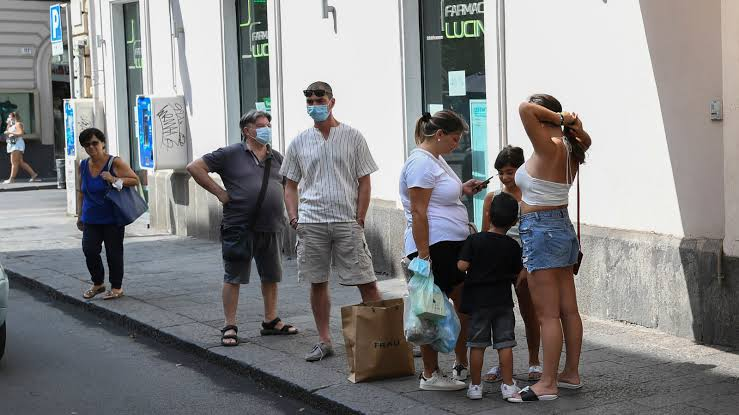
Floridia (GNP): Five years after registering the highest temperature ever recorded in continental Europe, residents of this Sicilian town say extreme heat is now measured less by records and more by its steady erosion of everyday life, driving people indoors, thinning social interaction and putting local livelihoods at risk.
The town became a symbol of Europe’s warming climate in August 2021, when a reading of 48.8 degrees Celsius was recorded nearby as the continent was emerging from COVID-19 restrictions.
Today, increasingly frequent and prolonged heatwaves are keeping streets and piazzas across the town of 20,000 largely empty for much of the day, with Piazza del Popolo, long the town’s social hub, standing nearly deserted despite its cafes and palm-lined walkways.
Floridia’s culture councillor, Serena Spada, described the shift as a kind of renewed lockdown, noting that even families with young children are affected, since children cannot use parks or play outdoors until temperatures ease later in the afternoon.
The heat has also disrupted a longstanding local custom known as “pigghiari u frescu,” in which families traditionally carry kitchen chairs outside in the evening to catch the breeze and socialise with neighbours, a practice now increasingly difficult as high temperatures linger well past sunset.
Resident Ugo Tomasello recalled struggling to breathe while walking outdoors, describing a moment of genuine fear at being alone on an empty street in extreme heat. Spada said what many initially assumed was an isolated extreme in 2021 has since become a recurring pattern, turning that year’s record into a warning sign that proved difficult to ignore.
Climate scientists tracking the region say the record-setting single-day extreme matters less than the sustained rise in average temperatures. Data cited from a climate monitoring service showed the town reaching 33.3 degrees Celsius in mid-August this year, more than four degrees above the historical average for the 1961-1990 period.
Luigi Pasotti, director of Sicily’s Agrometeorological Information Service, said the region is no longer contending with short-lived peaks lasting a day or two, as it did in 2021, but with stretches of consistently high temperatures lasting entire weeks or months, compounded by a rise in tropical and super-tropical nights that leave little relief from daytime heat.
Also Read: Islamic Relief Pakistan: 2026 Monsoon Situation Report
The broader pattern of extreme weather linked to climate change has touched much of Europe through drought, wildfires and heavy rainfall, with Sicily emerging as one of the continent’s most exposed regions. The island recorded a wave measuring nearly seventeen metres between Sicily and Malta in January, and accounted for roughly seventy percent of southern Italy’s burned area between January and July, according to an analysis of satellite fire-monitoring data.
Agriculture, a key pillar of the island’s economy, has proven especially vulnerable. More than 3,000 beehives were lost in the Floridia area in 2021, with honey production falling by eighty percent that year. Agronomist Francesco Bellomi linked the decline in bee populations and pollinators to a combination of climate pressures and pesticide use, warning that the resulting loss of biodiversity is reducing both the quality and yield of agricultural production.
Beekeeper Francesco Pappalardo, who has worked in the trade since childhood, said the anxiety around simply surviving each summer has grown sharply in recent years, with entire apiaries at risk of collapse under sustained heat, a loss he said he has already experienced firsthand.