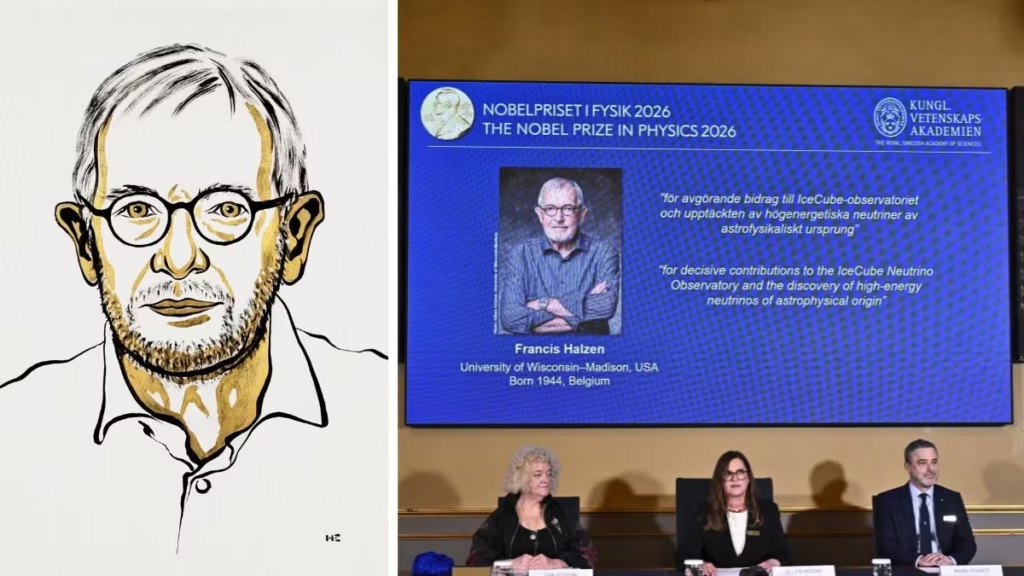
Sweden (GNP): Belgian-born physicist Francis Halzen has won the 2026 Nobel Prize in Physics, with the announcement made on Tuesday.
The Royal Swedish Academy of Sciences honoured him for decisive contributions to the IceCube Neutrino Observatory and the discovery of high-energy neutrinos of astrophysical origin. He is the sole laureate this year, and the prize is worth 12 million Swedish kronor, about $1.2 million.
Halzen, 82, was born in Tienen, Belgium, in 1944. He is a professor at the University of Wisconsin–Madison, the lead institution for IceCube. Earlier this year he received the American Physical Society Medal for Exceptional Achievement in Research, and he won the Balzan Prize in 2015.
Speaking by phone from Italy at the Nobel news conference, Halzen called the news a “great surprise” and a “pleasure”. He added that although people had long predicted he would win, the announcement still felt strange.
His work centres on neutrinos, tiny and nearly massless particles that rarely interact with matter, which is why they are often called ghostly. That same quality makes them valuable to scientists. Neutrinos cross the cosmos unimpeded and carry information from places light cannot escape, such as the surroundings of black holes or sources hidden behind dust clouds.
Catching them, however, demands enormous scale. Halzen studied a rare class of neutrinos that scientists regard as messengers from the cosmos, and he first presented plans for IceCube in 1988. His vision was a vast network of sensors buried in Antarctic ice.
Also Read: Nobel Prize 2026 Announcements Roll Out Through 12 October
The path was not immediate. According to the Nobel Committee, the predecessor project, AMANDA, was completed in 2000 but did not detect the high-energy neutrinos Halzen was after. IceCube did. It is the first gigaton neutrino detector ever built and remains the largest neutrino telescope in the world.
Its findings helped launch multimessenger astronomy, in which neutrinos, conventional telescopes and gravitational-wave detectors are combined to study distant, violent phenomena. The field is still growing, and a project to expand IceCube so that it can monitor eight cubic kilometres of ice is planned.
The Nobel Committee for Physics pointed to the leadership behind that progress while stressing that the achievement was collective. Committee chair Mark Pearce said Halzen led an international team that provided “a fantastic instrument”. He added that Halzen’s tenacity and vision paved the way for a new kind of astronomy.