New Delhi (GNP): Activists linked to India’s Cockroach Janta Party are taking Prime Minister Narendra Modi’s government to court over its use of AI-driven surveillance during the country’s largest youth protest in decades, with the case now poised to test the limits of federal authority even though the underlying protest has already ended.
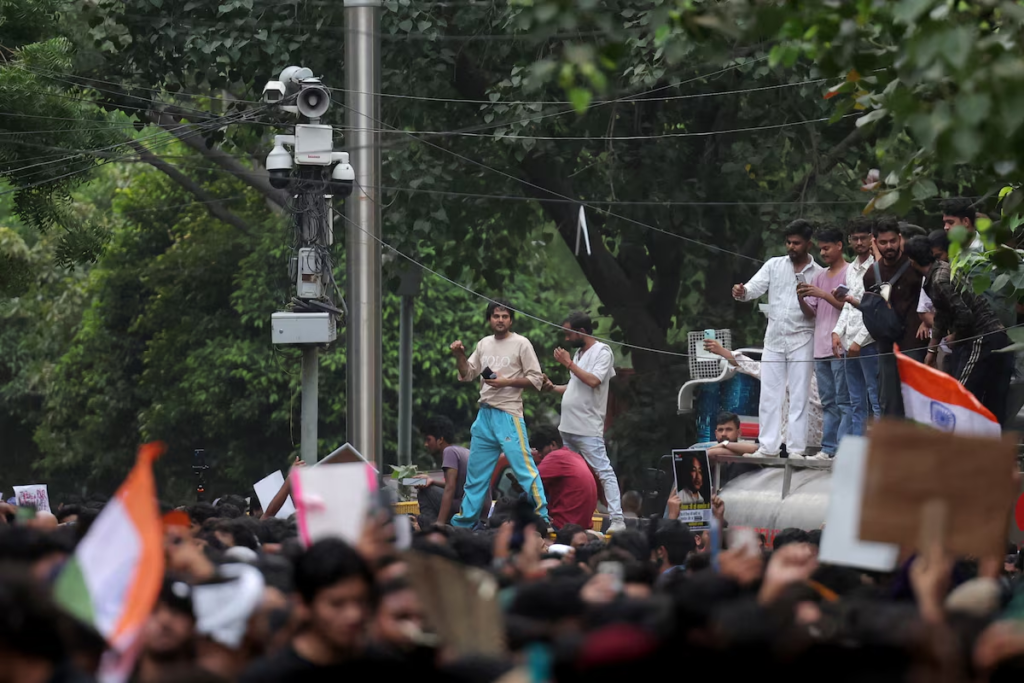
The controversy first surfaced during student demonstrations last week over leaked exam papers, when protesters shared photos online of a mobile police surveillance van fitted with cameras mounted on a telescopic mast capable of scanning the entire gathering.
Student activist Aishe Ghosh has since petitioned the Delhi High Court, asking it to rule that mass surveillance of protesters is unconstitutional, to order the deletion of all personal data gathered during the demonstration, and to establish clear guidelines governing how such surveillance technology may be used going forward.
Ghosh is continuing to press the case even though the protests themselves wound down after Education Minister Dharmendra Pradhan resigned, a rare political setback for Modi, who has since set up a panel tasked with overhauling India’s exam system following repeated cheating scandals.
Activists argue that the surveillance deployed at the main protest site in New Delhi violated the law, pointing out that India currently has no legislation governing police use of facial recognition technology, while the government maintains that the measures were lawful and necessary to preserve public order.
Modi’s administration has long faced criticism from opposition parties and digital rights groups over what they describe as an expanding surveillance apparatus and tightening control over digital communication, allegations the government has consistently denied, insisting its actions serve the public interest.
During a Friday hearing, Solicitor General Tushar Mehta defended the police response, arguing it was contradictory for demonstrators to raise privacy concerns while gathered in a public space and describing the surveillance measures as essential and firmly grounded in legitimate state interest.
At a shorter hearing on Monday, judges heard Ghosh argue that the scale of surveillance imposed on protesters was disproportionate, as she pushed for fuller disclosure of the government’s surveillance practices during public demonstrations, with the court set to continue hearing the matter on Tuesday.
The Internet Freedom Foundation, a New Delhi-based digital rights organization, formally wrote to the city’s police commissioner on July 24 demanding that biometric data collected at the protest site be deleted. Delhi police did not respond to a request for comment from Reuters, though the force stated in a social media post on Sunday that it had not restricted anyone’s freedom through its use of facial recognition technology.
Technology law partner Akash Karmakar of the Indian law firm Panag & Babu argued that any national security justification for surveillance must be matched by proportionate oversight, saying “accountability must flow both ways.”
He added that if facial recognition is being used to track protesters, the same technology should also be applied to identify officers who took part in the response without wearing visible name badges. Separately, police were observed recording the Instagram usernames of protesters as they arrived, a practice Inspector Sunil Kumar told Reuters was meant to screen out individuals with criminal backgrounds.
Also Read: Pakistan Needs Water Security Policy to Curb Flood Risks
The surveillance van stationed at the protest site carried the Delhi Police emblem alongside a branding label reading “Ikshana,” the Hindi word for vision, though little public information exists about the system beyond a since-removed post from its development partner, Indian CCTV manufacturer CP Plus, which had previously described the setup as featuring advanced AI-powered cameras, mobile units and adjustable varifocal bullet cameras.
That 2023 post was taken down from the company’s website over the weekend, and CP Plus did not respond to a request for comment. When a Reuters reporter walked past the van last week, an internal display reportedly showed his face outlined in a green box alongside a face-matching accuracy score, after which an officer inside quickly closed the vehicle’s window. Police officer Raj Kumar Dahiya told Reuters that the onboard computer systems help identify individuals with criminal records and also assist in estimating crowd size at demonstrations.

Managing Editor at Global News Pakistan (GNP), with a Bachelor's degree in International Relations from Riphah International University, graduated with a Gold Medal. Reach out at sabahtareengnp@gmail.com