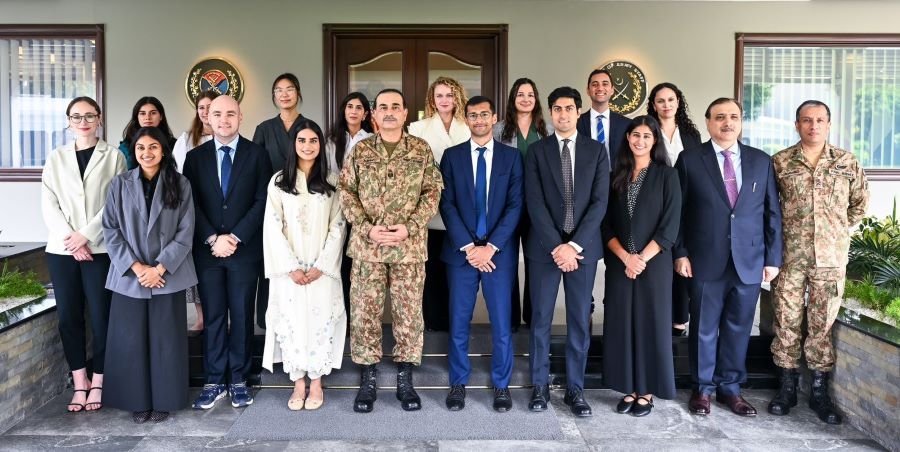
Rawalpindi (GNP): Field Marshal Syed Asim Munir, Chief of Army Staff and Chief of Defence Forces, spoke about the importance of education, skill development, entrepreneurship met with a delegation of Harvard Business School students representing several countries during their visit to Pakistan.
The conversation touched on regional and global developments, Pakistan’s security outlook, and ongoing efforts to promote peace, stability and prosperity both within the region and beyond. The COAS & CDF spoke about the importance of education, skill development, entrepreneurship and fact-based analytical thinking for young people navigating an increasingly volatile world shaped by social media and propaganda.
The visiting students shared positive reflections on their trip, particularly praising the openness and warmth they encountered among Pakistanis, as well as the significant potential and opportunities they observed in the country.
Rethinking Pakistan’s Global Narrative: The 2026 Pakistan Symposium
The 2026 Pakistan Symposium set out to reshape both how Pakistan is perceived internationally and how it views itself. Rather than dwelling on crisis-driven narratives, organizers aimed to build stronger connections between Pakistan’s leadership, its future trajectory, and partners in the United States — creating a space where global expertise could inform Pakistan’s specific context, while Pakistan’s own experience could contribute to broader international discussions.
Over the past year, Pakistan has increasingly featured in regional and global conversations, whether through renewed diplomatic engagement, rising interest from international investors, or its ambitions in digital finance and artificial intelligence. Yet much of the international discourse still tends to emphasize Pakistan’s difficulties rather than its potential — even as this shift coincides with what may be the most significant technological transformation since the internet’s early days.
AI, digital finance, blockchain and automation are redefining economic growth, governance and where value gets created, and nations that adapt now stand to shape the next era of economic leadership.
For Pakistan, the stakes are especially high. Economic growth has consistently underperformed relative to the country’s potential, and conventional development approaches alone are unlikely to deliver the transformation needed.
Boosting productivity, expanding financial inclusion, generating quality employment and competing on a global scale will increasingly depend on the country’s ability to harness emerging technologies.
A common misconception holds that Pakistan trails behind technologically — but in reality, certain segments of the country are advancing rapidly. Pakistan ranks among the world’s leaders in cryptocurrency adoption, a reflection of its young, digitally engaged population and strong grassroots interest in emerging financial tools.
The country is also seeing meaningful progress in AI, including domestically developed language models such as PVARA, alongside regulatory milestones like the establishment of PVARA itself and increasing investment in digital infrastructure and fintech. The real question, then, isn’t whether Pakistan will adopt these technologies — it already has — but whether its institutions, regulatory frameworks, education systems and investment climate can keep pace.
Another misconception is that technology is purely a technical or engineering matter. In practice, it is now deeply tied to public policy — decisions around AI governance, financial regulation, digital identity, education, labor markets, cybersecurity and responsible innovation will ultimately determine whether these technologies foster broad-based prosperity or widen existing inequalities. This is why the symposium deliberately convened voices from central banking, global finance, public policy, academia, venture capital and major technology firms, framing the discussion not just around innovation but around preparing institutions for rapid change.
Pakistan finds itself at a particularly critical juncture. With a median age of around 22, millions of young Pakistanis will be entering the workforce just as AI and automation reshape every major industry — presenting both a major opportunity and a substantial policy challenge. Investment in skills, entrepreneurship, research and digital infrastructure could turn the country’s demographic advantage into a technological one; failure to do so could carry significant costs.
Also read: Pakistan, Kuwait Sign Protocol Agreement-2026
Ultimately, the symposium centered on a single guiding question: how can Pakistan prepare for the future rather than simply react to it? Each panel explored a different facet of this challenge, spanning capital markets, venture investment, education technology, AI, financial inclusion and governance.

Sohail Majeed is a Special Correspondent at The Diplomatic Insight. He has twelve plus years of experience in journalism & reporting. He covers International Affairs, Diplomacy, UN, Sports, Climate Change, Economy, Technology, and Health.