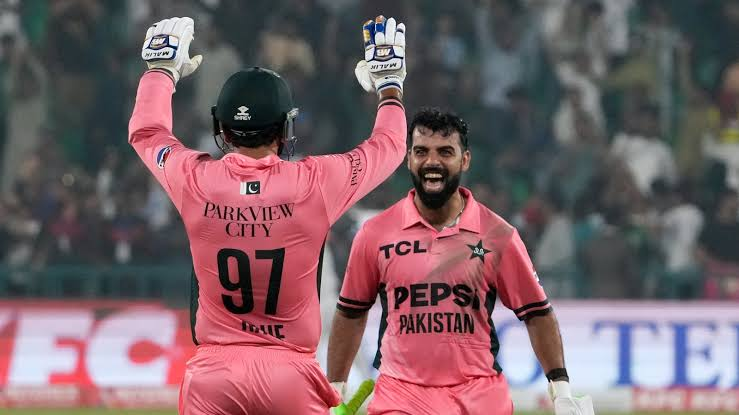
Lahore (GNP): Cricket fans witnessed an unforgettable moment when Pakistan all-rounder Shadab Khan survived a dramatic LBW decision against England, even after players had started shaking hands. What looked like the end of Pakistan’s hopes suddenly turned into one of the most exciting moments of the match.
The thrilling One Day International (ODI) took place at Gaddafi Stadium in Lahore on October 25, 2026. Pakistan were chasing England’s target of 242 runs when the game appeared to slip away. However, a successful Decision Review System (DRS) review changed the result, and Shadab went on to guide Pakistan to a remarkable one-wicket victory.
Shadab Khan’s LBW Decision Leaves Everyone Stunned
The most dramatic moment came when Shadab Khan was batting on 97 runs. England fast bowler Gus Atkinson delivered the ball, and the umpire gave Shadab out LBW, meaning leg before wicket.
England’s players believed they had finally won the match. Handshakes began, and Shadab appeared ready to accept the decision. Pakistan were still 21 runs away from victory, and only one wicket remained.
For a few moments, the atmosphere suggested that England had completed a remarkable bowling performance. Pakistan had already lost nine wickets, and their chances of winning looked extremely low.
However, Shadab decided to review the umpire’s decision. That single choice created a dramatic twist that changed the entire match.
DRS Review Reveals the Crucial Inside Edge
The Decision Review System is used in cricket to help check important umpiring decisions. It allows teams to challenge certain decisions and use available technology to determine whether the original call should stand.
In Shadab’s case, the replay showed that the ball had touched the inside edge of his bat before hitting his pad. The UltraEdge technology detected contact between the bat and ball, proving that the original LBW decision was incorrect.
The third umpire overturned the decision, and Shadab was allowed to continue batting.
The change brought fresh hope to Pakistan’s dressing room and the crowd in Lahore. England’s players, who had thought the match was over, suddenly had to return to the field and continue defending their total.
This unexpected DRS twist became the defining moment of the contest.
Pakistan Were Nine Wickets Down in a Difficult Chase
Pakistan’s chase had been far from easy. England’s bowlers put the home side under serious pressure and removed several important batters.
Pakistan eventually fell to 154 runs for nine wickets, leaving Shadab Khan with only number 11 batter Haris Rauf for support.
At that stage, England appeared to have complete control of the match. Their bowlers had taken wickets at important moments, and Pakistan needed an extraordinary effort from their final pair to stay alive.
Shadab refused to give up. Instead of allowing the pressure to affect his batting, he continued attacking the bowlers, finding boundaries and keeping the required run rate under control.
His confidence and determination gave Pakistan a chance that few people expected.
Shadab Khan Scores a Brilliant Unbeaten Century
Shadab Khan produced a remarkable innings under pressure, finishing unbeaten on 113 runs from 96 balls. His innings included 13 fours and five sixes, making it one of the most memorable performances of his international career.
He showed excellent control while batting with Haris Rauf, carefully managing the strike and taking responsibility for most of the scoring.
The century was Shadab’s first international hundred. His performance also set a new record for the highest individual score by a batter coming in at number eight or lower in men’s ODI cricket.
Also Read: Pakistan begin training camp for SAFF Championship
Rather than allowing the pressure to end Pakistan’s hopes, Shadab turned the situation around with aggressive shots, smart running, and strong determination.
His innings proved that a cricket match is not over until the final wicket falls.
Haris Rauf Supports Shadab in a Record-Breaking Partnership
Although Shadab played the leading role, Haris Rauf’s contribution was equally important to Pakistan’s victory.
Rauf remained unbeaten on seven runs from 19 balls, providing valuable support at the other end. Shadab managed the strike effectively, allowing Pakistan to keep scoring while reducing the risk of losing their final wicket.
Together, the pair added an unbeaten 89 runs for the tenth wicket. This became the highest last-wicket partnership in a successful men’s ODI run chase, breaking the previous record of 64 runs.
Their partnership demonstrated the importance of patience, teamwork, and belief in difficult situations. England needed only one more wicket, but Shadab and Rauf refused to let the opportunity slip away.
Pakistan Beat England by One Wicket
After surviving the LBW scare, Shadab continued his outstanding batting performance. He reached his century and kept Pakistan close to the target.
Haris Rauf eventually struck the winning boundary, completing a stunning comeback. Pakistan finished on 243 for nine in 47.1 overs, successfully chasing England’s total of 241.
The one-wicket victory was especially impressive because Pakistan had been reduced to 154 for nine earlier in the innings.
What looked like a certain England victory had become a famous Pakistan comeback. Shadab’s century, Rauf’s support, and the successful DRS review all played important roles in the result.
The win also secured Pakistan’s place in the final of the ODI tri-series.
England Miss a Golden Opportunity to Win
England had put themselves in a strong position during Pakistan’s chase. Their bowlers took regular wickets and reduced the home side to just one wicket remaining.
However, the overturned LBW decision gave Pakistan another opportunity. England could not take the final wicket, allowing Shadab and Rauf to complete their extraordinary partnership.
The defeat was England’s third consecutive loss in the tri-series, increasing the pressure on the team as it tried to keep its hopes of reaching the final alive.
For England, the match was a painful reminder of how quickly cricket can change. A team can dominate most of a game but still lose if it cannot finish the job.
Why the Shadab Khan DRS Moment Became So Special
The incident stood out because of the unusual sequence of events. Shadab appeared to be out, players began shaking hands, and England seemed ready to celebrate a victory.
Then the review revealed an inside edge, allowing the Pakistan batter to return to the crease.
The moment showed why DRS has become such an important part of modern cricket. Technology can help correct an incorrect decision and ensure that a match is decided according to the rules.
It also highlighted the importance of reviewing a decision when a batter believes the original call may be wrong. Shadab’s decision to use the review gave Pakistan another chance to fight for victory.
What This Victory Means for Pakistan Cricket
Pakistan’s victory was more than just another win in the tournament. It demonstrated the team’s ability to fight back from a difficult position and perform under extreme pressure.
Shadab’s century gave the team a major boost, while the partnership with Haris Rauf showed how valuable contributions from lower-order batters can be.
The result also secured Pakistan’s place in the tri-series final, giving the team further momentum ahead of the next stage of the competition.
For fans, the match provided a reminder of why cricket remains so exciting. Unexpected twists, individual brilliance, and dramatic finishes can turn even a seemingly lost game into an unforgettable victory.
One DRS Review Changes the Entire Match
The Pakistan vs England match in Lahore will be remembered for Shadab Khan’s remarkable century and the dramatic LBW decision that nearly ended his innings.
With Pakistan down to their last wicket, England looked close to victory. But the successful DRS review revealed an inside edge, allowing Shadab to continue and complete an unbeaten 113-run innings.
Together with Haris Rauf, he produced a record-breaking 89-run partnership that carried Pakistan to a one-wicket victory.
The match delivered a powerful lesson: never count a team out until the final ball has been bowled. In Lahore, one review changed everything, and Shadab Khan turned a moment of apparent defeat into a historic cricketing triumph.

I am Areesha, a 3rd-year International Relations student with a strong academic focus on Foreign Policy, International Law, History of International Relations, Non-State Actors, and Diplomacy & Statecraft. With a diverse internship background including HESCO, ISPR, and a current Research and Media Newsletter internship focused on Climate and Economy, I bring a unique blend of analytical thinking, research skills, and media understanding. I am passionate about translating complex global affairs into engaging, reader-friendly, and SEO-optimized content. My academic training in IR has equipped me with excellent research, critical analysis, and structured writing skills, which I now aim to apply in the field of SEO writing and digital content creation. Seeking an opportunity as an SEO Writer Intern where I can contribute with well-researched, impactful, and search-optimized content.