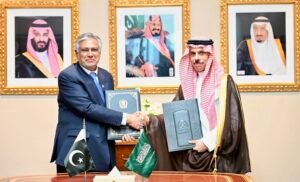
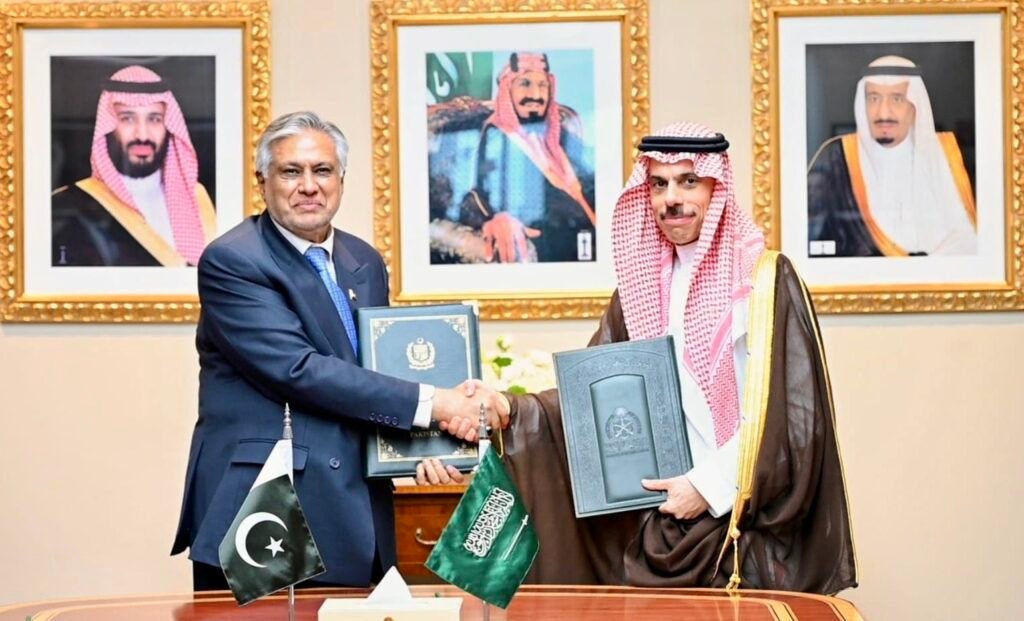
Islamabad (GNP): Pakistan and Saudi Arabia have signed an agreement abolishing visa requirements for holders of diplomatic and official/special passports, in a move aimed at facilitating high-level engagement and institutional exchanges between the two countries.
Deputy Prime Minister and Foreign Minister Senator Mohammad Ishaq Dar announced the signing during his engagements on the sidelines of the 81st session of the United Nations General Assembly in New York.
He signed the agreement with Saudi Foreign Minister Prince Faisal bin Farhan Al Saud.
The agreement covers holders of diplomatic and official/special passports and is intended to simplify official travel between Pakistan and Saudi Arabia.
It does not constitute a general visa-free arrangement for ordinary passport holders.
In his announcement, Ishaq Dar said the agreement would facilitate high-level engagement and institutional exchanges and contribute to advancing the longstanding strategic partnership between Pakistan and Saudi Arabia across areas of mutual interest.
The signing comes against the backdrop of continued high-level diplomatic engagement between Islamabad and Riyadh.
Pakistani and Saudi officials have maintained regular consultations on bilateral relations as well as regional and international developments.
In March 2026, Ishaq Dar and Prince Faisal bin Farhan held discussions on evolving regional and international developments and reaffirmed their commitment to closer bilateral and multilateral cooperation.
Visa exemption arrangements for diplomatic and official passport holders generally serve to facilitate government-to-government contacts by reducing administrative requirements associated with official travel.
For Pakistan and Saudi Arabia, the new agreement can provide greater ease of movement for diplomats, senior officials and other eligible representatives travelling for official duties, consultations, meetings and institutional exchanges.
The arrangement is particularly relevant as both countries continue to engage on a broad range of issues. Their bilateral relationship encompasses political and diplomatic cooperation, economic ties, investment, security, defence, technology and other areas of mutual interest.
Recent bilateral contacts have also focused on regional peace and stability. Pakistan’s Foreign Ministry has repeatedly emphasized dialogue, diplomacy and continued coordination with Saudi Arabia in addressing regional developments.
The visa agreement provides a practical mechanism for supporting official-level interaction.
Easier travel for eligible passport holders can assist ministries, diplomatic missions and government institutions in maintaining regular contacts and participating in bilateral and multilateral meetings.
The development also comes after a period of increased Pakistan-Saudi engagement on regional security and diplomatic matters.
Pakistan has publicly maintained close consultations with Riyadh over developments affecting the Gulf and wider Middle East, while advocating diplomatic engagement and de-escalation.
At the same time, cooperation between Pakistan and Saudi Arabia has expanded into emerging economic and technological fields.
Earlier in September, officials from the two countries discussed cooperation in artificial intelligence, data governance and emerging technologies, reflecting the breadth of areas now included in bilateral engagement.
Also Read: U.S-Pakistan Cotton and Textile Cooperation
The signing in New York demonstrates how the UN General Assembly provides an opportunity for countries to conduct bilateral meetings and conclude agreements alongside the main multilateral proceedings.
For Pakistan, the 81st UNGA has involved a series of diplomatic engagements covering bilateral relations, regional developments, international security and economic cooperation.
Ishaq Dar has held meetings with counterparts from several countries during the session, including discussions focused on strengthening political and economic relations.
The Pakistan-Saudi agreement adds another institutional component to the two countries’ diplomatic relationship.
The two governments have maintained frequent high-level communication in recent months. In July, Pakistan’s Foreign Ministry said Ishaq Dar and Prince Faisal bin Farhan discussed regional developments, bilateral cooperation and the importance of continued diplomacy and constructive engagement.
The agreement is also being signed at a time when Pakistan and Saudi Arabia continue to strengthen their wider strategic relationship. Both countries have longstanding political, economic and people-to-people links.
Saudi Arabia remains an important destination for Pakistani workers and pilgrims, while Pakistan and the Kingdom maintain extensive institutional contacts.
The new arrangement, however, is specifically focused on diplomatic and official/special passport holders. Its immediate practical effect is therefore on official travel and government-level engagement rather than on ordinary tourist or business travel.
By removing visa requirements for eligible passport holders, Pakistan and Saudi Arabia have established an additional mechanism to support official exchanges and diplomatic interaction.
The signing of the agreement reflects the continuation of high-level Pakistan-Saudi engagement and provides a framework for more streamlined official travel between the two countries.
As Islamabad and Riyadh continue consultations across political, economic, technological and regional issues, the agreement is expected to support institutional contacts and facilitate the movement of officials involved in bilateral cooperation.