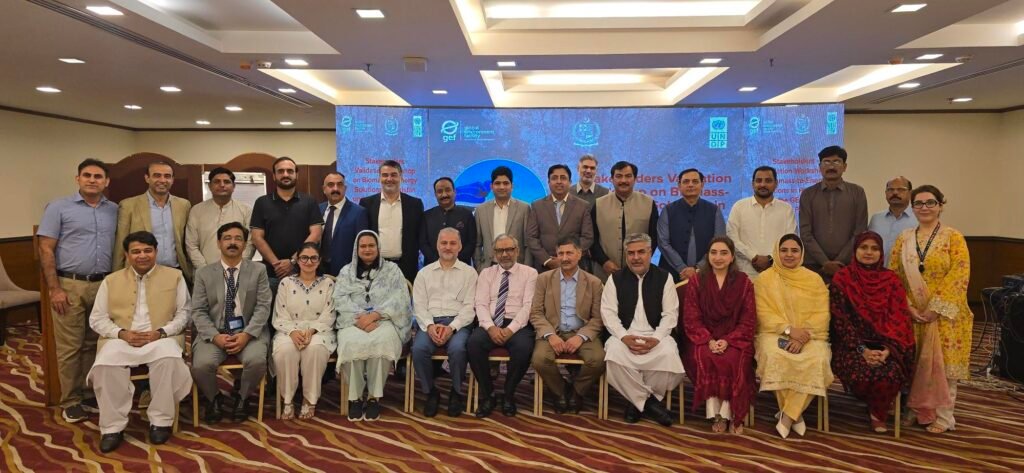
Karachi (GNP): The United Nations Development Programme (UNDP) Pakistan, with support from the Global Environment Facility (GEF) and the Ministry of Climate Change and Environmental Coordination, has convened a Stakeholder Validation Workshop in Karachi under the Promotion and Application of Sustainable Biomass Energy Technologies in Pakistan (PASBET) project.
The workshop brought together stakeholders from Sindh and Balochistan to review and validate project outputs to discuss implementation challenges and identify practical pathways for developing sustainable biomass-to-energy solutions in Pakistan.
The PASBET project is designed to address energy insecurity in rural Pakistan by promoting the sustainable production and efficient use of woody biomass as a renewable energy resource.
The project aims to support rural households and industries, improve livelihoods, reduce greenhouse gas emissions and strengthen community resilience.
During the Karachi workshop, participants reviewed project outputs and incorporated provincial perspectives into the ongoing work.
Discussions also focused on identifying implementation bottlenecks that could affect the development and adoption of biomass energy solutions.
A key outcome of the consultation was agreement on a way forward for pilot demonstrations and sustainable biomass-to-energy solutions.
The stakeholder engagement is intended to help ensure that the project’s planned interventions reflect local conditions and the priorities of provincial stakeholders.
The PASBET project is being implemented by UNDP in partnership with the Ministry of Climate Change and Environmental Coordination, with financial support from the GEF.
The project has a total budget of approximately US$3.5 million in GEF funding and is scheduled to run from November 2023 to November 2028.
Its geographical scope covers Sindh, Balochistan, Punjab and Khyber Pakhtunkhwa. UNDP’s project framework includes strengthening policies and institutional support, expanding sustainable biomass production, mobilizing financing and developing local technical capacity.
It also incorporates gender-responsive approaches to ensure that women and marginalized groups can participate in biomass energy planning and implementation.
The project is also moving toward practical demonstrations. A recent UNDP procurement notice states that biomass demonstration plants are being established in Sujawal and Badin in Sindh, Layyah in Punjab, Sohbatpur in Balochistan and Mansehra in Khyber Pakhtunkhwa.
The initiative includes community demonstrations, training and activities related to sustainable biomass and environmental conservation.
Also Read: Planning Minister Proposes SCO Digital Governance, AI Network
These pilot activities are intended to demonstrate how locally available biomass resources can be used more efficiently while supporting cleaner energy access and rural development.
The Karachi workshop therefore represents an important stakeholder-engagement stage in the PASBET initiative.
By bringing provincial stakeholders into the validation process, the project can incorporate local perspectives while identifying practical barriers before wider implementation.
The broader objective is to develop biomass energy approaches that can contribute to cleaner energy access, rural livelihoods, climate action and long-term energy resilience in Pakistan.
UNDP identifies the project as contributing particularly to Sustainable Development Goal 7 on affordable and clean energy and SDG 13 on climate action.
The stakeholder discussions in Karachi provide a platform for continued collaboration among government institutions, development partners and provincial stakeholders as Pakistan explores sustainable and locally appropriate solutions to its energy and climate challenges.