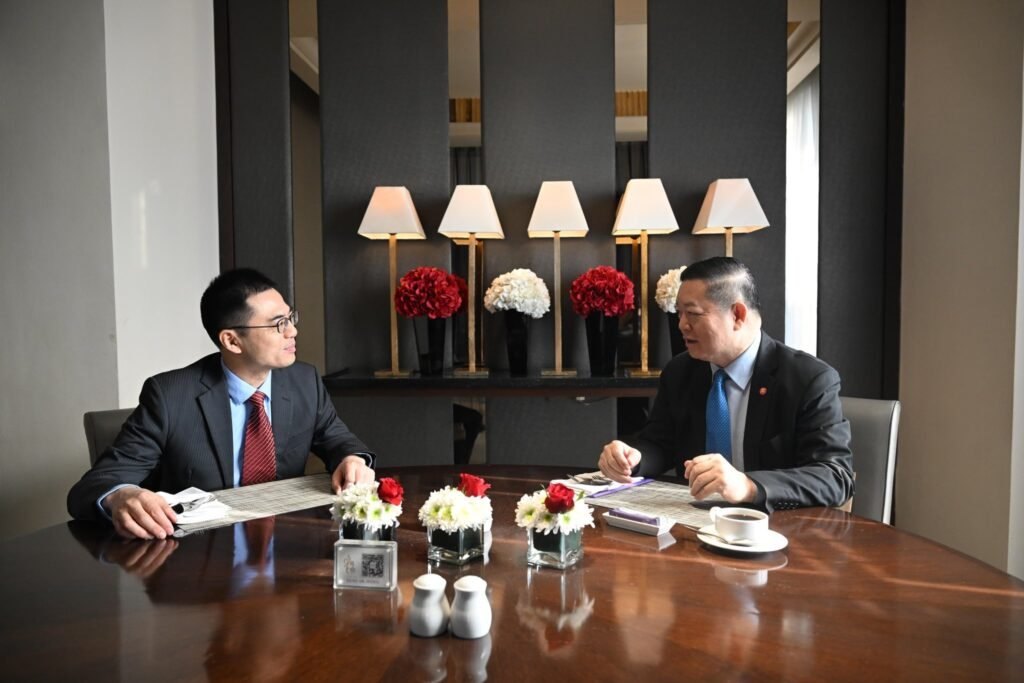
Jakarta (GNP): ASEAN and China have reaffirmed their commitment to strengthening cooperation as ASEAN Secretary-General Dr. Kao Kim Hourn met with China’s Ambassador to ASEAN, H.E. Wang Qing, on August 10, 2026.
The meeting, held during a breakfast engagement, provided an opportunity for both sides to exchange views on ASEAN and China relations and discuss priorities for future cooperation.
According to the ASEAN Secretariat, the discussions followed up on the outcomes of the 59th ASEAN Foreign Ministers’ Meeting and related meetings held in Manila, the Philippines.
The meeting comes during an important year for ASEAN–China relations. 2026 marks the fifth anniversary of the ASEAN–China Comprehensive Strategic Partnership, providing an opportunity for both sides to review progress and identify areas for deeper engagement.
During the meeting, Dr. Kao Kim Hourn and Ambassador Wang Qing discussed priorities and initiatives for ASEAN–China cooperation.
They also exchanged views on regional and international developments that could affect Southeast Asia and the wider Asia-Pacific region.
The ASEAN–China relationship has developed across multiple areas, including political and security dialogue, trade, investment, connectivity, education, culture and people-to-people exchanges.
The Comprehensive Strategic Partnership provides a framework for expanding this cooperation while supporting regional peace, stability and development.
The latest engagement also demonstrates the importance of diplomatic dialogue between ASEAN and its external partners.
ASEAN maintains relations with major regional and global powers through dialogue partnerships, allowing member states to address shared challenges and pursue mutually beneficial cooperation.
Also Read: Colombia Recognizes Morocco’s Sovereignty Over the Sahara
China is one of ASEAN’s major external partners, making regular communication between ASEAN officials and Chinese representatives particularly significant.
Meetings such as the one between Dr. Kao and Ambassador Wang provide opportunities to assess ongoing initiatives and discuss emerging regional developments.
The relationship has also gained importance amid changes in the regional strategic environment. Southeast Asia faces a range of challenges, including economic uncertainty, geopolitical competition, maritime security concerns, climate change and the need for sustainable development.
Maintaining open diplomatic channels can help ASEAN and China address areas of common interest while managing differences through dialogue.
The meeting also builds on earlier diplomatic engagement between the two sides. Ambassador Wang Qing presented his Letter of Credence as China’s Ambassador to ASEAN in January 2026, beginning his diplomatic assignment with the regional organization.
The fifth anniversary of the Comprehensive Strategic Partnership provides both sides with an opportunity to evaluate achievements and consider the next phase of cooperation.
Earlier ASEAN remarks highlighted the anniversary as an important moment to reflect on progress and reaffirm commitments to peace, stability and sustainable development.
For ASEAN, maintaining balanced and constructive relations with major partners remains an important element of its regional diplomacy.
Engagement with China allows ASEAN member states to pursue cooperation in areas where interests overlap while continuing to support ASEAN centrality in regional affairs.
For China, stronger engagement with ASEAN supports its broader regional diplomatic and economic relationships. Regular high-level meetings can facilitate coordination on shared priorities and contribute to greater understanding between the two sides.
The August 10 meeting therefore represents another step in the continuing development of ASEAN–China relations.
While the discussions focused on cooperation and regional developments, their broader significance lies in maintaining regular communication at a time of rapid geopolitical and economic change.
As ASEAN and China mark five years of their Comprehensive Strategic Partnership, continued dialogue, practical cooperation and mutual understanding are expected to remain central to their relationship.