
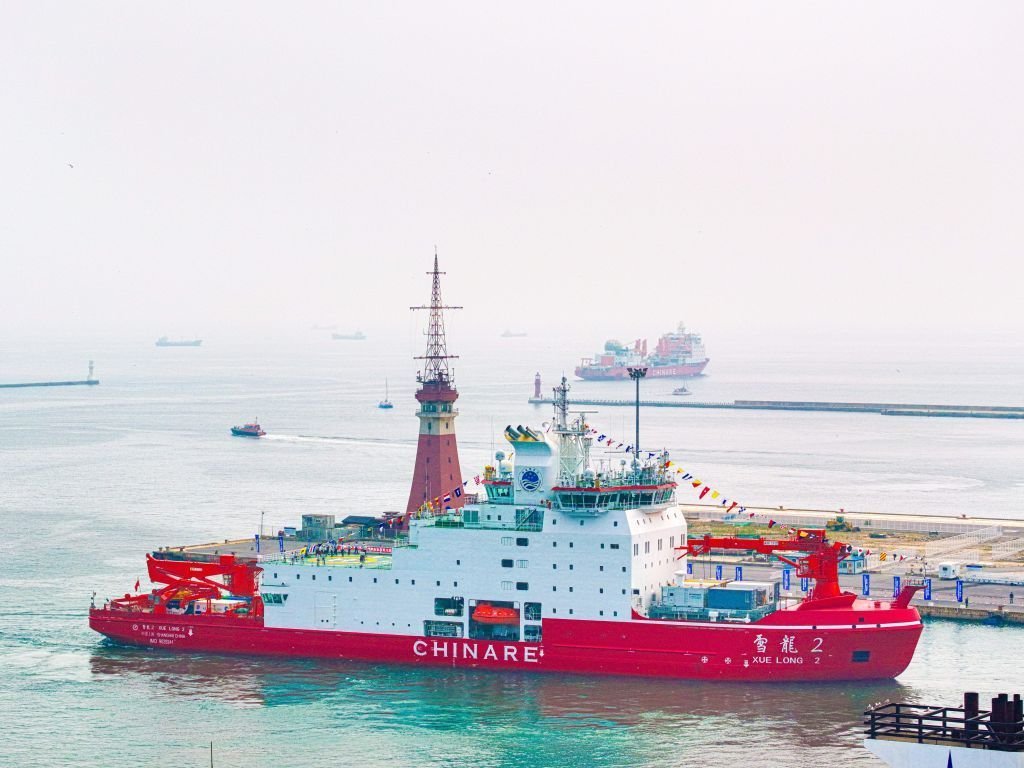
China (GNP): China’s research icebreaker Xuelong 2 has begun an intensive ice station survey in the central Arctic Ocean, marking another significant stage in the country’s 16th Arctic scientific expedition.
According to China Science, the research vessel began its first ice station survey near 84 degrees north latitude on Sunday.
The operation is expected to continue for approximately half a month and will involve a series of scientific investigations designed to improve understanding of the rapidly changing Arctic environment.
The survey is planned to include six short term ice stations and one long-term ice station. More than 20 types of scientific operations are expected to be conducted during the programme, covering different aspects of the Arctic’s physical and environmental conditions.
The current expedition is part of China’s wider 16th Arctic scientific expedition, which began in July. Three research vessels , Xuelong, Xuelong 2 and Jidi , departed from Dalian on July 3, while another research vessel, Tansuo-3, is also involved in the expedition.
The mission is being organized by China’s Ministry of Natural Resources.The expedition comes as the Arctic continues to experience major environmental changes associated with global warming.
Scientists have increasingly focused on declining sea ice, changing ocean conditions, atmospheric changes and their effects on Arctic ecosystems.
During the broader expedition, Chinese scientists are carrying out comprehensive surveys involving sea ice, hydrology, biology, ecology and the atmospheric environment.
Research is also examining geological and oceanographic processes, including the evolution of the Gakkel Ridge and oceanic crust.
The importance of Arctic research extends well beyond the polar region. Changes in Arctic sea ice and ocean conditions can influence global climate systems, weather patterns, ecosystems and sea-level processes.
As a result, scientific observations from the region contribute to the wider international effort to understand climate change.
The ice station surveys allow researchers to collect information directly from the Arctic environment.
Scientists can examine sea ice characteristics, ocean conditions and atmospheric factors while working in locations that are difficult to access through conventional research methods.
Also Read: OpenAI Flags Possible Critical Cybersecurity Risk in Upcoming Model
China’s continued Arctic expeditions also reflect the increasing international interest in polar science.
The current mission includes international scientific cooperation, with researchers expected to conduct collaborative operations with scientists from countries including Russia and Germany.
For China, the expedition represents both a scientific and environmental initiative. Regular Arctic observations provide long term data that can help researchers identify changes over time and better understand the relationship between polar processes and global climate systems.
The survey also demonstrates the growing role of advanced research vessels in modern climate science.
Icebreakers such as Xuelong 2 provide scientists with the ability to operate in difficult polar conditions and establish temporary research stations across remote areas of the Arctic Ocean.
As climate change continues to transform the Arctic, scientific monitoring has become increasingly important.
Researchers need reliable observations to understand how quickly conditions are changing and what those changes could mean for ecosystems and societies around the world.
The latest survey by Xuelong 2 therefore represents more than a single research operation. It contributes to a broader international effort to understand one of the planet’s most rapidly changing environments.
Through continued observation, international scientific cooperation and long term data collection, Arctic expeditions can provide valuable knowledge for climate research and sustainable management of the polar environment.