
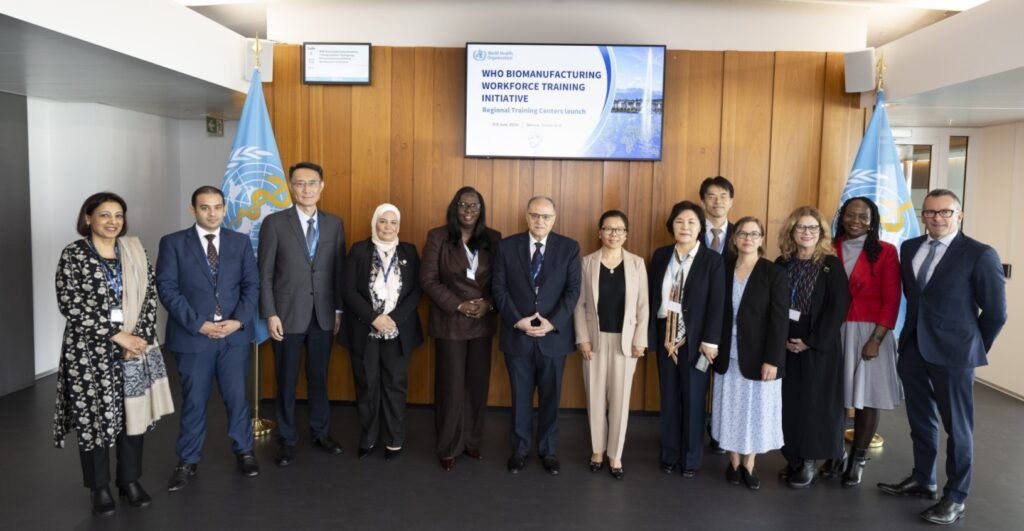
Geneva (GNP): WHO Biomanufacturing Workforce Training 2026 conference brought together key global partners at WHO headquarters in Geneva from June 3 to 5, as representatives from seven newly designated Regional Training Centers, the Global Training Hub for Biomanufacturing, the WHO Academy, and WHO regional offices met to strengthen collaboration and speed up workforce development for local production of vaccines and essential health products.
The three-day event was the first in person gathering of key partners since the Regional Training Centers were officially designated earlier this year.
Opening the conference, Dr Jicui Dong, Head of WHO’s Product Policies, Access and Manufacturing Support Unit, said that building sustainable biomanufacturing capacity requires more than infrastructure and technology. She stressed that it requires a skilled workforce, strong institutions, and lasting partnerships.
She added that by connecting regional training centers, governments, academia, and industry, WHO is laying the foundations needed to turn innovation into sustainable local production and stronger health systems worldwide.
The WHO Biomanufacturing Workforce Training 2026 initiative is built on three pillars: WHO capacity building programs, the Global Training Hub for Biomanufacturing hosted by South Korea, and a growing network of Regional Training Centers covering all six WHO regions.
A key highlight of the conference was the official launch of the seven Regional Training Centers, representing institutions from Brazil, China, Egypt, India, Ireland, Senegal, and South Africa. These centers will work alongside the Global Training Hub to deliver needs-based training programs for their respective regions.
The Global Training Hub for Biomanufacturing has trained nearly 4,000 participants from 79 countries since its WHO designation in 2022. Since 2020, more than 14,000 professionals from over 118 countries have taken part in WHO supported learning programmes covering manufacturing, quality assurance, regulatory systems, and technology transfer.
Also read: Population Control Vital for Sustainable Growth, Health Minister
WHO Biomanufacturing Workforce Training 2026 Focuses on Future Skills
WHO Biomanufacturing Workforce Training 2026 discussions placed strong emphasis on the skills that will be needed as science and technology continue to advance rapidly. Participants highlighted the growing demand for expertise in advanced manufacturing technologies, digitalisation, artificial intelligence, regulatory affairs, quality management, and supply chain systems.
The conference also stressed the important role of partnerships between universities and industry in preparing the next generation of professionals for a more complex and innovation-driven biomanufacturing environment.
The WHO Academy presented its work on lifelong learning and competency based education, highlighting opportunities to strengthen quality standards across the entire network.
Participants agreed that collaboration between training centres, governments, industry, and international partners will be essential to keep workforce development in step with the changing needs of global public health.
The conference concluded with a shared commitment to building a skilled and capable workforce that can support resilient health systems, improve access to essential medicines, and contribute to stronger global health security for years to come.