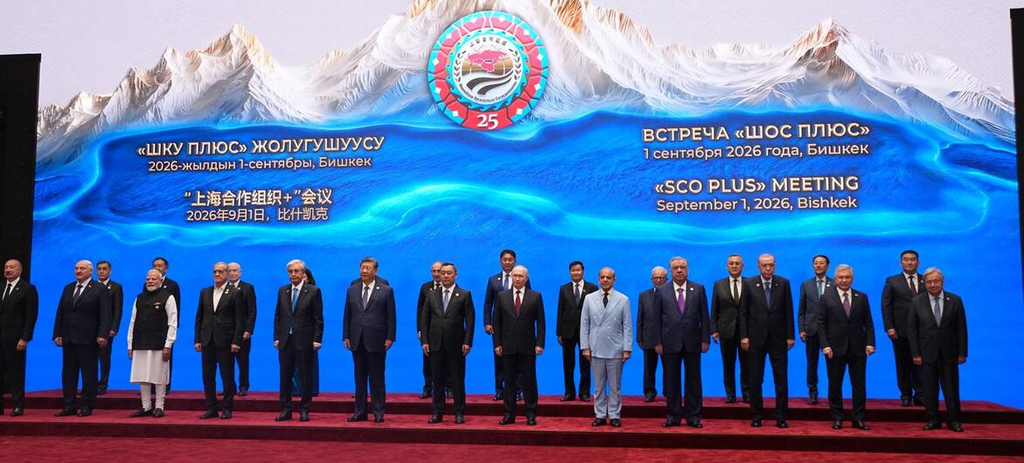
The family photograph from the SCO Summit 2026 was an unusual one even by the standards of summit diplomacy. It placed the leaders of China, India, Iran, Pakistan, Russia and the Central Asian states in the same frame at a time when many of their interests are pulling in different directions.
That picture explains both the value of the Shanghai Cooperation Organisation and the doubts surrounding it.
The group can keep conversations going across political divides that would strain a smaller alliance. Yet its meetings now cover so much ground that the final declarations risk becoming inventories: security, trade, transport, banking, artificial intelligence, water, energy, culture and education all appear, often with another committee or forum attached.
Bishkek followed that pattern. Leaders adopted an anniversary declaration and a package of agreements after meeting on September 1, according to the Uzbek presidential office. The summit also marked 25 years since the SCO was founded.
The occasion invited grand language. The more useful question is what happens after the delegations leave.
A Larger Organisation With Harder Politics
The SCO began in 2001 with China, Kazakhstan, Kyrgyzstan, Russia, Tajikistan and Uzbekistan. Its early work grew out of border confidence-building and a common concern about armed groups and instability in Central Asia.
It is a different organisation today. India and Pakistan became full members in 2017, Iran followed in 2023 and Belarus joined in 2024. The SCO now has 10 member states, alongside observers and dialogue partners extending from Mongolia to the Gulf and Southeast Asia.
Expansion gave the organisation greater diplomatic weight. It also made agreement more laborious.
China and Russia give the SCO a prominent place in their Eurasian diplomacy. Central Asian republics use it to maintain several major partnerships at once. India values access to the region but has serious disputes with Pakistan and China. Iran participates while facing sanctions and conflict around the Gulf.
They do not arrive with a single view of the world. The SCO works by consensus and is formally non-aligned. Its contribution is quieter: regular official contact, joint security mechanisms and a forum where rivals stay in the same meeting.
Still, dialogue alone is a modest return for an organisation with such a wide agenda. After a quarter-century, members want roads, rail links, finance and faster trade—not another restatement that cooperation is desirable.
Uzbekistan Brought a Working List
President Shavkat Mirziyoyev’s address showed what Central Asian states now expect from the organisation.
Uzbekistan proposed a long-term development concept looking toward 2040, an industrial map linking economic zones with logistics and markets, and a council to coordinate the integration of national railway systems. Mirziyoyev also called for work on the long-discussed SCO Development Bank to move beyond general agreement.
The Uzbek proposal also included multilingual data for artificial intelligence, a Tashkent technology forum and a water and energy efficiency programme running to 2035.
There was a security component too. Uzbekistan offered to support the Universal Centre for Countering Security Challenges and Threats in Tashkent. Mirziyoyev also urged the SCO to resume regular contact with Afghanistan, connecting economic engagement with the region’s security concerns.
This was not accidental agenda-setting. Uzbekistan is double-landlocked; reaching a seaport requires crossing at least two national borders. Slow customs procedures, missing rail links and political friction have direct economic costs. For Tashkent, connectivity is not a diplomatic slogan. It determines which markets exporters can reach and how much they pay to get there.
The same is true across Central Asia. A railway council would matter if it helped settle timetables, standards and border procedures. The names of new mechanisms matter less than the delays they remove.
The declaration covered transport, the economy, environmental issues, technology and security. Its success cannot be measured by the number of subjects included. It will be measured at freight terminals, border posts, banks and project sites.
Security Remains the Easier Common Ground
The SCO has always found it simpler to organise around threats than around commerce.
Its Regional Anti-Terrorist Structure is based in Tashkent. At the 2025 Tianjin summit, members approved an Anti-Drug Centre and a broader security centre. The SCO’s account recorded 24 approved documents and the launch of both bodies.
Bishkek carried that institutional work forward through regulations for the new centres and changes to the SCO Charter. These are less eye-catching than a leaders’ declaration, but potentially more important because they shape what officials can do between summits.
Even here, cooperation has limits.
Member governments do not always define terrorism, extremism or political violence in the same way. India again pressed the organisation to avoid selective responses to terrorism. Prime Minister Narendra Modi’s summit address placed security beside connectivity and economic opportunity, while arguing that the organisation should be judged by results that citizens can see.
That message carried a regional subtext. India and Pakistan remain in the same organisation despite deep mistrust. Their membership preserves a table for discussion while limiting joint action.
Afghanistan presents a more immediate area for limited cooperation. Every Central Asian member has an interest in containing cross-border crime, militancy and narcotics trafficking. Pakistan, China, Russia, Iran and India also watch developments there closely, although their policies differ.
Regular technical contact may therefore be more realistic than a unified political strategy.
The Missing Bank Tells a Larger Story
Economic cooperation is where the organisation’s promises have been hardest to cash.
SCO governments have discussed a development bank and fund for years. Members differ over capital, influence, currencies and sanctions exposure. The region already has several multilateral lenders, while China finances infrastructure through its own banks. Any SCO institution must offer something distinct or become another emblem on a conference wall.
Uzbekistan’s request to begin with mature regional projects is sensible. Choose a short list, publish the financing rules and show who benefits. A rail junction or cross-border energy project completed on schedule would do more for the SCO’s reputation than another declaration supporting connectivity in principle.
The same test applies to AI. Shared multilingual data could help languages poorly represented in commercial models. It still requires technical standards, licensing, funding and researchers.
Otherwise, “AI cooperation” will simply join the summit vocabulary.
Pakistan Takes Over
The chairmanship passed from Kyrgyzstan to Pakistan at the end of the summit. Islamabad is due to host the next meeting of the Council of Heads of State in 2027, according to Pakistan’s Foreign Ministry.
Islamabad has a strong interest in routes connecting South and Central Asia, energy cooperation and a calmer Afghanistan. The SCO lets Pakistan work on those issues while Central Asian governments, China, Russia, Iran and India are present.
Pakistan’s chairmanship will be judged partly by whether it narrows the agenda. Carrying every Bishkek proposal into another year of conferences would produce activity without much movement.
A more convincing programme would concentrate on a few deliverables: workable transit procedures, a defined project pipeline for regional finance, operational rules for the new security centres and a realistic form of engagement on Afghanistan. Progress could then be reported publicly before the Islamabad summit.
Also Read: SCO Summit Concludes in Bishkek, Hands Chairmanship to Pakistan
Relations with India will remain the most visible difficulty. Neither side is likely to set aside its disputes for the sake of the SCO calendar. Pakistan does not need a diplomatic breakthrough to run a useful chairmanship, though it does need meetings that do not become hostage to the dispute.
What Bishkek Actually Achieved
The SCO did not emerge from its anniversary summit as a single geopolitical bloc. It was never likely to.
Its members disagree too much for a common foreign policy. The summit’s broad language sometimes conceals those divisions, but their existence does not prove failure.
Bishkek kept a crowded Eurasian forum functioning. It advanced the rules for security bodies, adopted a new declaration and handed Pakistan a full programme for the next year. Uzbekistan added proposals tied to the everyday problems of a landlocked region. India offered a blunt reminder that citizens will look for outcomes, not meeting schedules.
Officials must choose projects, settle financing, write regulations and remove delays at borders. They will have to decide which of the many proposals deserve money and which should quietly be dropped.
The SCO’s first 25 years proved that countries with competing interests can remain inside the same institution. Its next phase will be harder. It has to show that staying in the room leads somewhere.