The search for critical minerals, which are essential for the renewable energy and defence industries, has gone beyond the land and into the depths of the ocean. This raises an important question: who owns the deep sea?
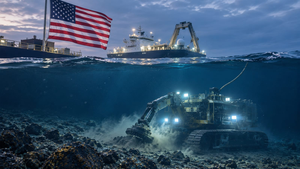
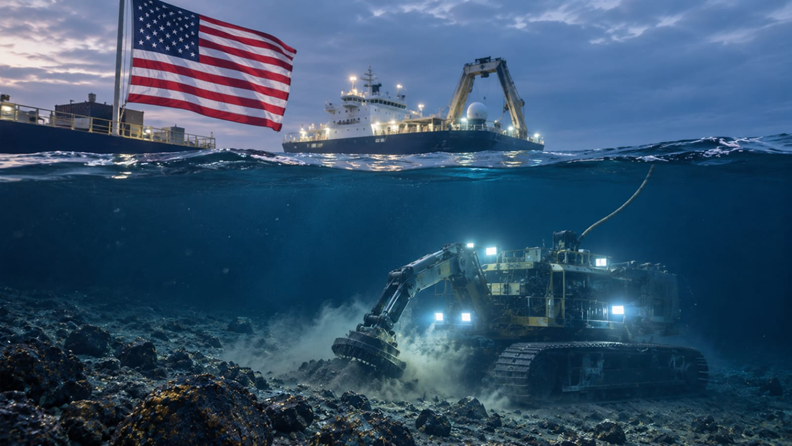
Recent deep-sea mining developments in the United States show how it perceives the ocean floor: as a strategic and economic resource. On 11 November, two American companies applied for exploration licences near the Cook Islands, Kiribati and French Polynesia. Later, on 19 November, America conducted its first mineral lease auction near American Samoa. Examined critically, these developments raise a question: who owns the critical resources of the sea, and who has the right to extract them?
This development cannot be limited to a mining or business perspective. In fact, it is a new phase of geopolitical competition. Traditionally, powerful states have tried to acquire oil, gas, mineral-rich land and key chokepoints. This is an example of an imperialism-inspired search, in which states try to access and influence new routes for resource hunting, hence the interest in the ocean floor.
Power in this case is not defined by military strength, but by the control states have over resources, technology and international rules. Whoever is able to secure critical mineral supply will become the future powerhouse of industrial and defence production. Competition for these minerals will decide future global economic power.
The Geopolitics of the World’s Untapped Resources
The deep sea holds polymetallic nodules. These are small mineral deposits that include cobalt, manganese, copper and nickel. These minerals are essential for electric vehicle batteries, renewable energy and electronic devices used for defence purposes.
When states try to reduce dependence on foreign suppliers, they search for new sources of minerals, which is why the deep ocean has become a new area of international competition.
America’s efforts to access these resources are not restricted to economic benefit but have also become a matter of national security and competition with China over critical mineral supply chains.
International law regulates ocean ownership. According to the United Nations Convention on the Law of the Sea (UNCLOS), coastal states can explore and secure natural resources within 200 nautical miles of their coastline. These areas are called Exclusive Economic Zones (EEZs). The area beyond 200 nautical miles, where the international seabed begins, is called “the Area”. This international seabed is considered the common heritage of humankind, meaning it is free from the control of any country. It is regulated by the International Seabed Authority (ISA).
However, this exposes global inequality. Developing countries often lack the technology or investment for deep-sea exploration within their EEZs. Meanwhile, powerful states and corporations are able to access and exploit these resources.
Also Read: Afghanistan’s Qosh Tepa Canal and Rising Amu Darya Crisis in Central Asia
American Unilateralism and the Limits of Seabed Governance
The United States is not a member of UNCLOS. Despite this, America established its licence framework under the Deep Seabed Hard Mineral Resource Act in 1980. This created an institutional conflict. In a system where international institutions such as the ISA ensure the governance of seabed resources, America is able to explore under its domestic legal framework. This raises a major concern: if powerful states are able to apply their own rules within the international system, who will be held accountable for resource exploitation?
The American government made the American Samoa auction part of its strategy to secure critical mineral supply. Two seabed areas covering approximately 31.5 million acres received bids from Wetstone U.S. Ventures. It offered a starting price of 3 million for each area. This does not mean that the company has received immediate permission to conduct mining, as it needs further regulatory approvals and environmental checks.
Deep-sea mining exposes a contradiction within the current international governance order. Liberal institutions and powerful states promote clean energy, yet they change the same policies when acquiring natural resources becomes the priority of a world power.
International institutions may be seen as prioritising environmental causes, but the interests of powerful states complicate collective governance. This also highlights the vulnerability of such institutions, which exert power on peripheral states for the interests of core states.
The main debate concerns the distribution of power rather than resource extraction itself. Obtaining natural resources is not a foreign concept, but the role of powerful countries in the international political economy creates an unbalanced geopolitical competition.