Afghanistan’s Qosh Tepa Canal has influence over Central Asian water politics, leading to regional instability and agricultural concerns.
Qosh Tepa canal of Afghanistan has become an important political issue for Central Asia. The region has been affected by water scarcity, external agriculture reliance and severe climate change pressure. The irrigation project is based to help with water related issues and effective governance. The plan is based on diverting water from Amu Darya to Northern Afghanistan, holding the capacity to transform Afghanistan’s agricultural sector. However, this concerns downstream countries in Central Asia.
This project is a classic example of how structural development, which is traditionally viewed as an economic instrument of economic progress, becomes a cause of interstate competition when natural resources are involved.
Afghanistan Interests and Regional Concerns in Central Asia
The construction of Qosh Tepa Canal began in March 2022, with an approximately 285 km long canal laid around Northern Afghanistan, covering 550,000 hectares of irrigated agricultural land. It includes Balkh, Jawzjan aur Faryab Provinces. The Afghanistan leadership considers this as an opportunity to reduce dependence on imports, increase agricultural production and strengthen the domestic food security. However, the initial plan of the water diversion of Amu Darya has concerned Uzbekistan and Turkmenistan as both countries are dependent on Amu Darya for their agriculture.
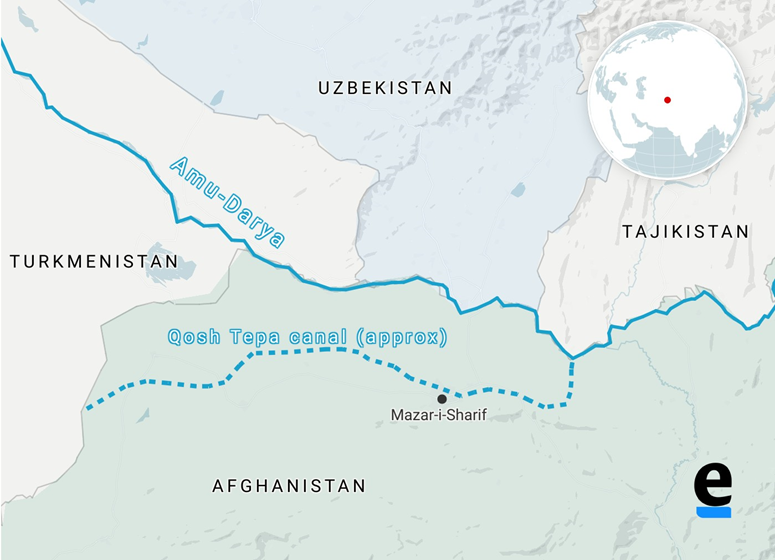
An estimate suggests that the canal diverts approximately 15 to 25% of the river’s natural flow, annually. Although there are different estimates, none is confirmed.
Central Asia has been long influenced by climate change, inefficient irrigation structure and the increasing demand of agriculture due to which its stress on water has considerably increased. The economies of these nations are dependent on Amu Darya, not only for their agriculture but also cotton cultivation and other water intensive activities. The existing regional arrangements were initially developed without Afghanistan’s participation which complicated the situation further, as negotiation efforts with downstream states could not be backed through strong institutional mechanisms.
The canal could intensify competition during drought periods. In such periods water accessibility is significantly reduced and it could have a direct influence over agricultural production. The economic pressure could deepen the vulnerabilities of these communities. The situation could lead to yet another water-based conflict.
This project does not necessarily mean conflict. On 19 November 2026, Uzbekistan showed interest through engagement with Afghanistan, as cooperation over water management is mutually beneficial than confrontation.
There exists a challenge for Afghanistan, its current leadership is not recognised by several established institutional frameworks. Hence, its efforts to maintain a cooperative environment is questionable.
Also Read: Europe’s Security Dilemma and the Challenges of Hybrid Warfare
The Geo-politics of Water in Central Asia
Qosh Tepa Canal shows the power dynamics and resource security in contemporary times. The new project challenges the existing water sharing arrangement, as Afghanistan being the new actor influences the distribution of shared resources.
Hydro hegemony is a useful concept to understand this case. It shows how a state could influence other sovereign states through water infrastructure and accessibility. The Afghanistan scenario reveals how the diplomatic arrangements could not be determined by upstream geographical position alone. A State could have a rigid stance on its national interest to secure a water governance position, unilaterally planned, which could later weaken the regional cooperation.
Qosh Tepa Canal is not just an agricultural initiative but a reflection of the increasing importance of resource security in regional geopolitics. The question exists, If Central Asia would leverage this natural commodity as competition or a diplomatic instrument?