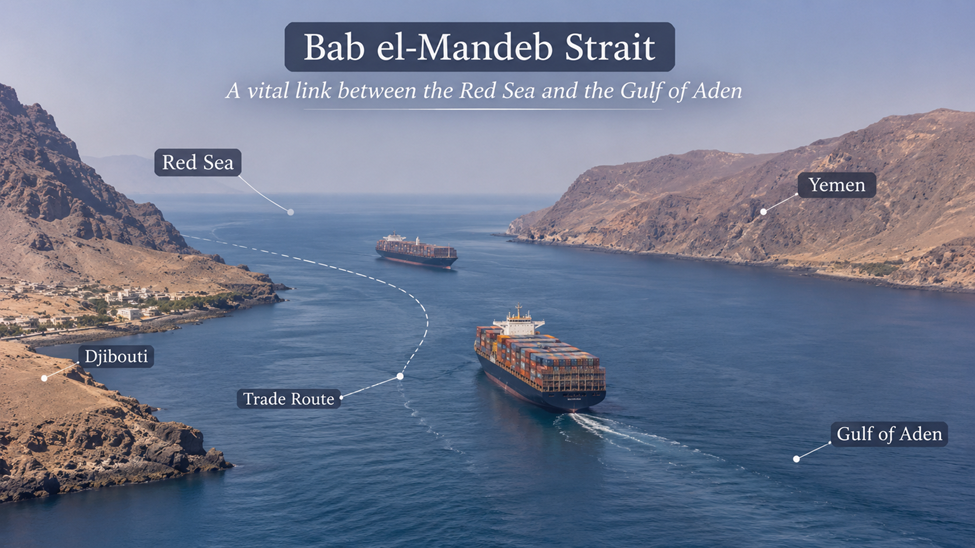
The crucial maritime chokepoint along the Red sea, with geopolitical rivalries and regional tensions have turned this route into the most significant strategic head for global trade and energy security today.
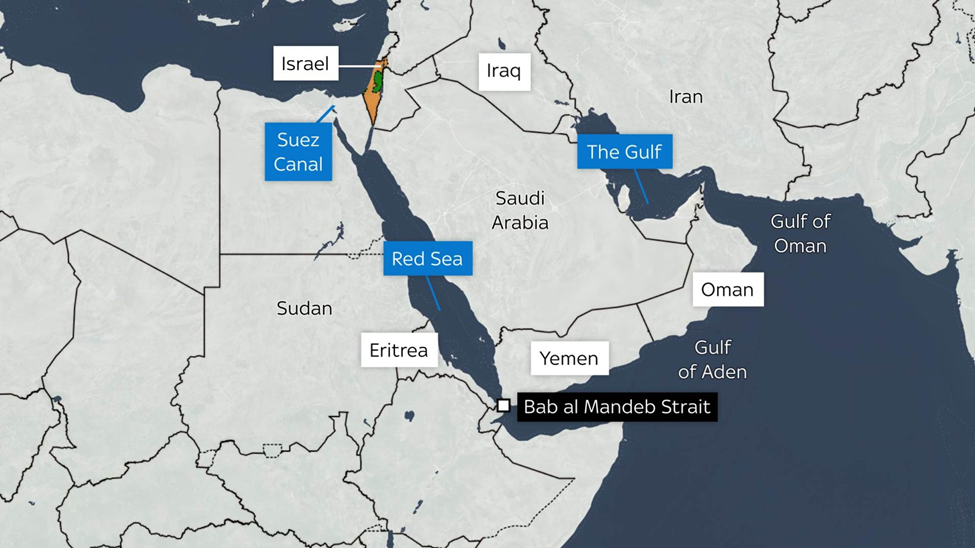
Bab el-Mandeb is one of the most important maritime routes that connects the Red Sea with the Gulf of Aden and the Indian Ocean. Its significance lies in the strategic location. Several commercial ships travel from Asia to Europe and then through the Suez Canal. It could be understood better through the actual figures. The UNCTAD 2023 data stated Bab el-Mandeb carries approximately 8.7% of global seaborne trade volume. Moreover, 15% of oil products and 13% of crude oil is also transported through this route.
The ongoing conflict in Yemen has made this crucial route into a dangerous course. Since November 2023, Houthi rebels of Yemen have been targeting commercial ships through missiles and drones. This shows how regional conflict is not limited to Yemen, but influences the entire international trade. This could be viewed as efforts to deter the external actors and secure their own interest.
The Cost of Maritime Insecurity
Since Bab el-Mandeb has been perceived as an unsafe passage for global trade, The shipping companies have been gradually opting out for alternative routes. Often, ships travel through the southern tip of Africa, the Cape Of Good Hope.
It comes with its challenges, hence the reason it was not the primary route in the first place. The major concern is the economic cost of this alternative maritime route. The US Energy Information Administration (EIA) stated, 9.3 million barrels of oil per day were transported through Bab el-Mandeb in 2023. In 2024 it was recorded, 4.1 million bearers per day, resulting in an approximate 56% reduction.
Shipping diversion is another issue. The replacement by Cape of Good Hope adds additional distance fuel and delivery time. Since the Suez Canal has been affected with steep decline in shippings, it has affected Egypt’s economy as well.
According to Lloyd’s List Intelligence, 1338 transits were recorded on the Suez Canal in October 2026 which are 34% less than the pre-dispute average. Another important example is the LNG, liquified natural gas transportation through Bab el Mandeb, recorded 4.2 billion cubic feet per day. The following years 2024 and 2025 recorded zero flows.
Also Read: The Weaponization of Water and Geopolitical Competition
Regional Conflict Shifts to Global Security Challenge
The crisis is intense when seen through the global security perspective. According to the US maritime administration, Houthis launched over 100 attacks on commercial vessels, from November 2023 to October 2025. This affected more than 60 states. In July 2025 there were two key incidents, first the magic seas, referring to the abundant ship after the Houthi attack on 7 July 2025. Secondly, the Eternity C, where a bulk carrier was attacked on the same day and three fatalities were confirmed.
The United States and European Nations have naval operations to protect ships but military protection alone cannot result in stable political settlement in Yemen. The reason that Bab el Mandeb is more than a maritime issue, is due to its significance in international trade and global energy security.
Stating complete closure of Bab el Mandeb is technically incorrect. In 2026 October, ships were able to transit through the route but the volume of those was considerably low, and most important none of them were ensured security. Even today, in 2026 the situation is not normal. This shows how non-state actors and armed groups can exert political influence by controlling and exploiting significant choke points.