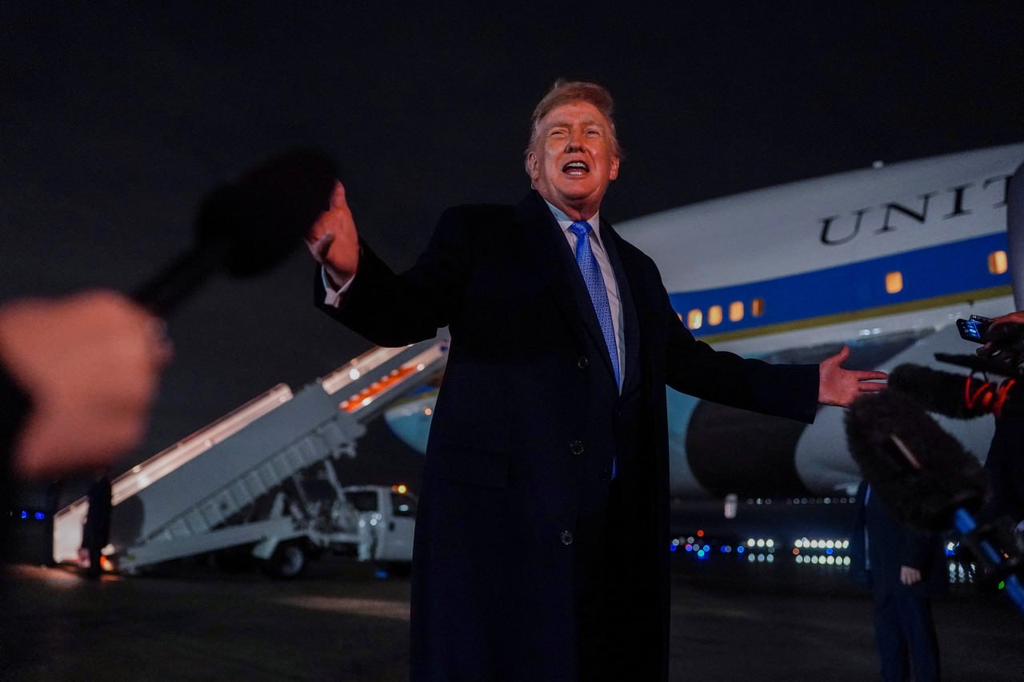
Washington (GNP): United States President Donald Trump said on Tuesday that the war with Iran would end very soon. He repeated that Tehran will not be allowed to acquire a nuclear weapon.
Speaking at an event in Washington, Trump also predicted that oil prices would fall once the conflict is over. He described the war as one of the most important actions of his administration. A day earlier, he had told reporters that Washington would win the war soon and that it would end quickly.
Energy markets showed no sign of that relief on Tuesday. Brent crude for November delivery rose $1.71, or 1.6 per cent, to $106.99 a barrel, while the more actively traded December contract gained $1.68 to reach $99.51. West Texas Intermediate climbed $1.40 to $94, extending a second straight day of gains driven by supply concerns.
Those concerns centre on the Strait of Hormuz, a key route for global energy supplies and the main subject of current diplomacy. Iranian Foreign Minister Abbas Araghchi said Tehran’s conditions for reopening the waterway have not changed and remain tied to a seven-point proposal sent to Washington. He said mediators would pass Iran’s ideas to the American side and that a final US response would then be relayed back to Tehran. He hoped the process would be complete by Wednesday morning.
Araghchi added that recent talks with Qatari mediators had focused on how to meet Iran’s conditions. He said the current focus is solely on Hormuz.
Vice President JD Vance struck a cautious note on the prospects for a deal. He said an agreement remains possible if Iran honours its commitments, adding that the administration would judge Tehran by its actions and not its words in the coming months.
Vance also blamed Iranian leaders for the collapse of the Islamabad Memorandum of Understanding (MoU), saying Iran had targeted commercial shipping after agreeing to a ceasefire. On Iran’s leadership, he said Washington believes Supreme Leader Ayatollah Mojtaba Khamenei is alive but cannot be certain. He described the new supreme leader as very detached from the day-to-day negotiations.
Also Read: UN General Debate Ends With Push To Restore Global Trust
The MoU was brokered by Pakistan, which has remained central to the process since helping secure a ceasefire on April 8. Islamabad then hosted high-level US and Iranian delegations on April 12 and 13. Under the agreement signed in June, both sides committed to halting military operations and reopening Hormuz to commercial shipping. They also agreed to negotiate, within 60 days, a comprehensive settlement covering Iran’s nuclear programme, US sanctions and a permanent ceasefire.
Pakistan and Qatar later co-mediated the first round of high-level talks in Lucerne, Switzerland, on June 21, attended by Vance. Qatar’s Prime Minister and Foreign Minister, Sheikh Mohammed bin Abdulrahman Al Thani, has said the latest indirect exchanges showed positive progress. Pakistan continues to urge a return to the MoU as the framework for ending the months-long conflict through dialogue.
Trump said, “Iran will not have a nuclear weapon, and they’re failing very badly.”
Prime Minister Shehbaz Sharif said at the United Nations, “Pakistan is playing the role of a sincere and honest mediator.”

Managing Editor at Global News Pakistan (GNP), with a Bachelor's degree in International Relations from Riphah International University, graduated with a Gold Medal. Reach out at sabahtareengnp@gmail.com