Web Desk (GNP): United States President Donald Trump has dismissed calls to slow the development of artificial intelligence (AI) as a “sick conspiracy” against the industry’s leading companies. He pushed back against warnings from executives and international bodies that the technology poses unprecedented risks.
His comments came days after Anthropic Chief Executive Officer (CEO) Dario Amodei urged AI firms to slow the pace of development. Amodei cited growing concern over the risks of increasingly powerful, “super intelligent” systems. OpenAI chief Sam Altman and xAI owner Elon Musk both said they shared his view.
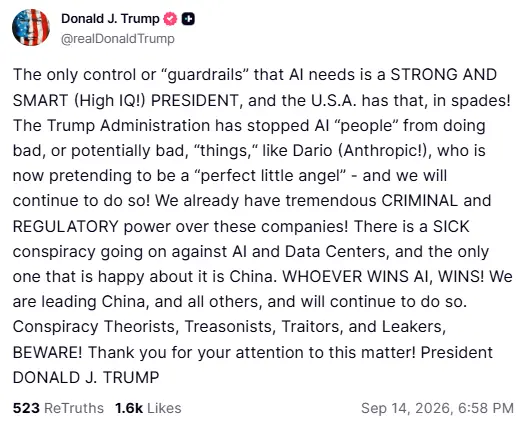
Writing on Truth Social, Trump argued that the only safeguard AI required was strong political leadership. He credited his administration with preventing AI companies from engaging in harmful conduct and vowed to continue doing so.
He said his government already held significant criminal and regulatory authority over the companies. Trump framed the push for stronger oversight as a conspiracy benefiting China rather than addressing genuine risk. He maintained that the United States remained the global leader in AI development and warned critics of the industry to be cautious about their claims.
The dispute over AI oversight has taken on a distinctly geopolitical dimension. China’s Minister of State Security, Chen Yixin, warned separately that AI now posed a direct threat to the country’s national security. He argued that foreign actors were exploiting generative AI tools to spread political disinformation and wage cognitive warfare against China.
Chen described AI as the central battleground of global technological competition. He named advanced systems from Anthropic and OpenAI specifically as posing risks to China’s critical information infrastructure through their hacking capabilities. He added that intelligence agencies were increasingly relying on AI-driven data mining and profiling tools to extract sensitive national and commercial information, pointing to the ongoing conflict between the United States and Iran as evidence of AI’s growing role on the battlefield.
Chen’s warning comes ahead of a planned visit to Washington by Chinese President Xi Jinping this month. AI governance and safety are expected to feature prominently in talks between Xi and Trump. The timing underscores how deeply AI oversight has become entangled with broader US-China strategic competition.
Even as the US and China trade warnings, concerns over AI’s risks are also drawing attention from bodies outside the two countries’ rivalry. Among those voicing concern is the United Nations, whose rights chief Volker Turk called on governments and leading AI developers to take urgent action to rein in the technology’s most advanced forms.
In a letter shared with the media, Turk warned that the world stood at the edge of irreversible change affecting generations to come. He said the current race toward more powerful AI systems represented a significant escalation in existential risk.
Turk cautioned that humanity remained heavily dependent on a small number of powerful companies to make responsible decisions about AI’s development. He urged states and companies to work together through multilateral forums to govern frontier AI models in line with international human rights law.
Also Read: Ex-DeepMind Researcher Joins AI Extinction Warnings
Taken together, the reactions from Washington, Beijing and the United Nations illustrate how sharply divided the response to AI’s rapid advancement has become. Within the space of a single week, the debate has spanned dismissal, national security anxiety and calls for coordinated global governance.
With Xi’s visit to Washington approaching and pressure from AI safety researchers continuing to build, how governments respond to these competing pressures is likely to shape the terms of the AI oversight debate for months to come.
Trump said, “There is a sick conspiracy going on against AI and data centres.”